
Teal W. Benevides, PhD, professor in the Department of Community and Behavioral Health Sciences in Augusta University’s School of Public Health, is a leading national voice for individuals with intellectual and/or developmental disabilities, or IDD. Recently, she published two papers on improving health outcomes and elevating the voices of people with IDD in research and decision-making, and both are open access, which was important to Benevides.
She co-leads the Individuals with IDD Engaged, Aligned, and Leading initiative, also known as IIDDEAL, with Mai Pham, MD, president and CEO of the Institute for Exceptional Care. IIDDEAL is a national project that aims to advance health policy and improve outcomes for people living with IDD. Those working on the project believe those with lived experience should guide decisions that affect their health and well-being. To support this, the IIDDEAL team works to build capacity for shared leadership and reach consensus on what matters most to the IDD community.
Although conversations around IDD have become more common in health care settings, Benevides emphasizes that meaningful change requires continued effort. People with IDD often have diverse support needs related to communication, self-care and community participation. However, they experience high rates of poor health due to consistent barriers to high-quality, accessible care. Benevides’ work highlights the urgency of addressing these disparities through research, policy and practice with input that reflect the priorities of individuals with IDD.
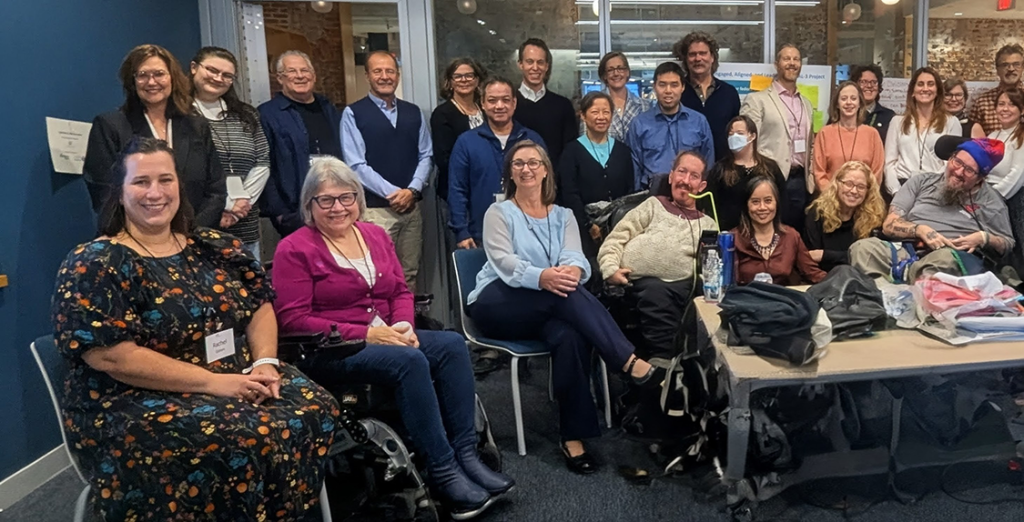 Teal W. Benevides, PhD, (front row, third from left) with members of IIDDEAL during an in-person IIDDEAL Consensus Working Group Summit in Washington, D.C., in November 2025. [Photo courtesy of the Institute for Exceptional Care]
Benevides’ most recent paper, “Antipsychotic Drug Prescriptions for Transition-Age Youth on the Autism Spectrum,” was published by Journal of Autism and Developmental Disorders and examines prescribing patterns for youth and young adults with autism ages 14 to 29. She was joined by AU colleagues Jen Jaremski and Jennifer Poon, MD, as well as Jessica Rast, PhD, with the University of Colorado Anschutz; Brian Lee, PhD, Jonas Ventigmiglia and Lindsay Shea, DrPH, from Drexel University’s A.J. Drexel Autism Institute; Kristy Anderson, PhD, with the Florida State University College of Social Work; and Edward S. Brodkin, MD with the University of Pennsylvania Medicine.
The team analyzed 2019 Medicaid records to understand how frequently antipsychotic medications are prescribed to autistic individuals during the transition to adulthood. The study found that nearly half of autistic youth with intellectual disability received an antipsychotic prescription, a rate higher than other groups. The analysis also revealed that young adults were more likely to receive antipsychotic medications than adolescents, suggesting that prescribing practices may intensify as autistic youth transition into adulthood.
“Autistic people want community support and resources to help support their goals and manage their mental health,” Benevides said. “Sometimes, medications are important in managing mental health, but antipsychotics have not been evaluated in autistic people for long-term use and can unfortunately be used as chemical restraints. Our paper points to a need to better understand how antipsychotics are being prescribed and by whom. We also need clinical trials to understand long- and short-term side effects of these medications.”
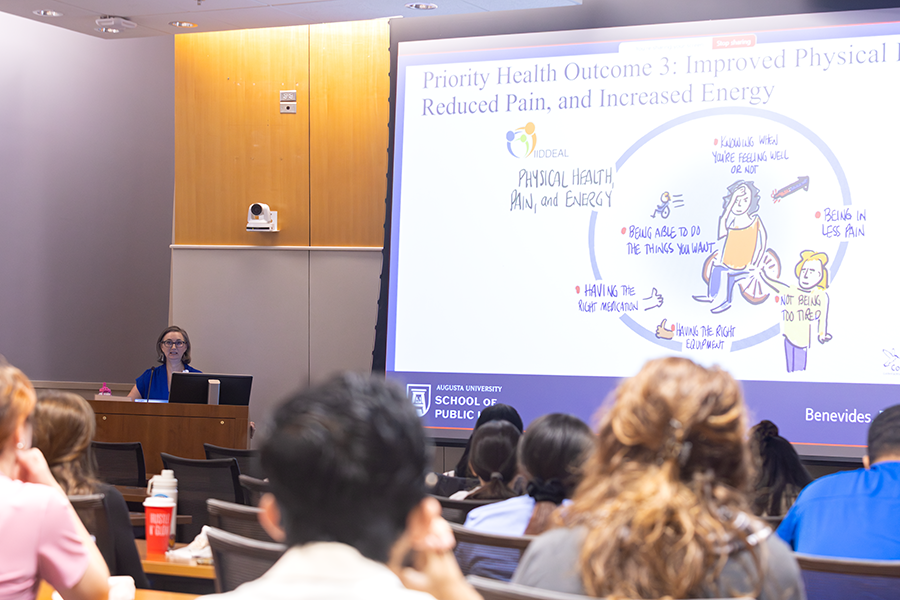 Benevides presenting her research to students at the Medical College of Georgia at Augusta University and clinicians with Wellstar MCG Health. [Milledge Austin/Augusta University]
Benevides also had her paper, “Engagement to Identify Health Priorities of People With Intellectual and/or Developmental Disability,” published in the Occupational Therapy Journal of Research. She worked on the paper with Jaremski, as well as Pham, May-Lynn Andresen, DNP, and Madelyn R. Bahr with the Institute for Exceptional Care; Tim Corey from the Colibri Facilitation; Joanne Nicholson, PhD, and Kristen Faughnan with Brandeis University; Carolyn Langer, MD, from the University of Massachusetts Chan Medical School; Vincent Siasoco, MD, with Montefiore Medical Center; Alexis Hernandez-Hons, PsyD, with Allen-Cochran Enterprises Inc.; and Stephen M. Shore, EdD, from Adelphi University.
The study explores how to meaningfully include individuals with IDD in identifying health outcomes that researchers, clinicians and policymakers should address. The team collaborated with adults with IDD, caregivers, clinicians and researchers over two years using videos, graphic illustrations, accessible language and visual tools to help project partners contribute confidently.
The project resulted in nine illustrated health priorities that partners found personally and professionally compelling. These priorities will serve as a foundation for future research, policy change and clinical approaches. While more perspectives are needed to refine the priorities, the project shows how meaningful engagement can strengthen health initiatives and bridge communication gaps among diverse partners.
“IIDDEAL partners ultimately identified priorities that we all want – regardless of intellectual or developmental disabilities,” Benevides said. “We all want healthcare providers to listen to our goals, understand our personal priorities and support our decision-making about our bodies. We all want to have opportunities for good health. When environments of care, stigmatizing attitudes or lack of resources create barriers, we have an obligation to find strategies to address those barriers.”
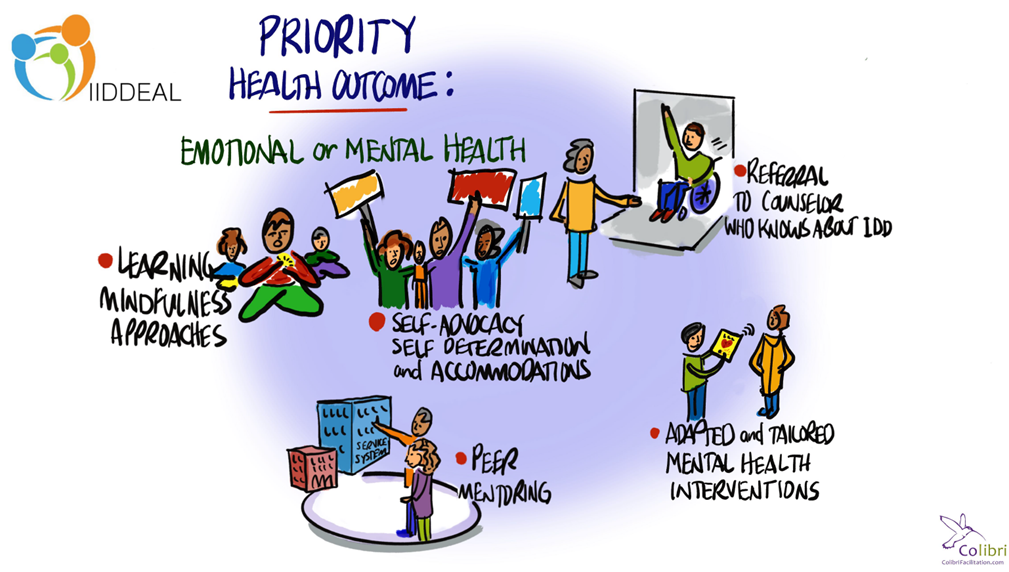 An example of the artwork that features the priority health outcomes developed through IIDDEAL. [Artwork provided by Tim Corey, graphic illustrator at Colibri Facilitation]
These two studies reflect Benevides’ mission to improve health outcomes for people with autism and IDD through rigorous, inclusive and experiential research and collaborative engagement. Her work influences healthcare practices, shapes policy conversations and guides researchers toward more authentic and equitable engagement methods. Through her leadership, Benevides is helping build a future where individuals with IDD are active participants and leaders in shaping the systems that support them.
“I’m very encouraged through the conversations we have had. We have had health insurance payers, policy experts and other decision-makers listening to these priorities,” Benevides said. “I think that there is momentum to make health care better, and I’m excited to continue these partnerships to advance the priorities.”
Like
Like
Love
Haha
Wow
Sad
Angry