


Men’s mental health has been shadowed and undermined for generations. With phrases like, “there’s no crying in baseball” and “men don’t cry”, we as men are conditioned and taught not to handle our emotions properly leading to depression, anger issues and, in some cases, suicide. Men all over the world suffer from mental health issues. These feelings about mental health can start from a young age and progressively get worse as you grow up, which can lead to a disconnect between us and family members and other relationships we need to be human. Having mental health issues doesn’t make you weak, like most are led to believe, it’s what makes you human in the sense that we have these emotions for a reason.
As of 2025, 1 in 8 men suffer from mental health issues, where depression alone impacts 6 million men directly. Some of the disorders men suffer with are depression, anxiety, PTSD, substance abuse and bipolar disorder. In the United States, men make up 80% of suicides and are 3.5 times more likely to commit suicide compared to women.
Men are told to not seek help or assistance when they’re struggling because “it isn’t manly,” an anonymous sophomore at Angelo State University said.
So that begs the question, what causes men’s mental health issues? Some of the most common reasons are societal expectations, hormonal imbalances, chronic illnesses, substance abuse and trauma. An anonymous freshman at ASU commented, “most of my mental health issues and anxiety came from my coaches when I was a kid.” This is an example of societal pressure, where you think you have to perform well or look a certain way when that isn’t the case at all. We as men are conditioned to listen and obey societal norms.
When men are suffering from mental health issues, some symptoms of depression and anxiety-related issues are irritability, risky behavior, social withdrawal, physical complaints and even lack of concentration in school or work. “When I’m at practice and my coach is yelling at us to be better, I get a lot of angry feelings I guess,” an anonymous senior from ASU said, “and I use that anger in practice instead of yelling back.”
Treatment for your symptoms or trying to prevent mental health issues seems hard, but you have options. Some of the ones that work most effectively are psychotherapy, cognitive behavioral therapy and some lifestyle changes. An anonymous junior at ASU said, “The easiest way I started coming out of my depression was going to the gym, just for 30 minutes a day to get my body moving.”
Being told your whole life as a man that your mental health isn’t a priority is hard and now, in 2026, it’s become harder with social media playing a major part in increasing the rates of anxiety, depression and even different forms of body dysmorphia.
I decided to hold my own study with men in college “worldwide” (whoever decided to be a part of the study), this lasted from February 23rd to February 27th. I posted a google forum that was free response and anonymous for men to respond to and here’s what I found out in college students:
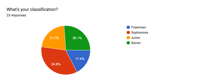
The majority of the responses were Sophomores in college. Following there were seniors, juniors and freshmen (34.8%, 26.1% 21.7% and 17.4%) in that order. This is important to know because sometimes depending on where you are in college can impact your mental health with building up and piling assignments and responsibilities.
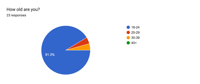
Next I wanted to know the age range, with social media growing and influencers wanting to make more money. This can play an important role in one’s mental health, my study concluded that the majority of participants were 18-24 for the age range with some responses from people 25-29 and 30-39.
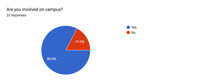
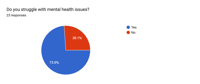
Next I wanted to know if these men were/are involved on their respective campus’, this included: clubs, sports, jobs, interacting during events, etc. This was important because it showed me that being involved on campus can still mean that distracting yourself doesn’t mean your problems go away. 82.6% of participants were involved on campus, with similar results for them struggling with mental health (73.9%).
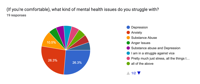
Now moving forward I wanted to see a direct correlation between all of these previous responses and what kind of mental health issues resulted from either, past trauma, social media, verbiage from friends, online, etc. The majority answered with depression and anxiety. I expected this because social media (which is a big part of culture now) causes people to feel bad and anxious about the life they could have or show them what they don’t.
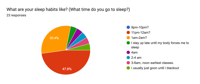
Now, sleep is important, especially for developing brains such as the majority of participants being 18-24. That being said, I wanted to show you how sleep deprivation and patterns play a major role in mental health. The majority, 52.2%, go to sleep around anywhere from 1am-6am. This kind of sleep deprivation can cause a lot of stress on one person, to get up in time and get all of the things they need done during the day such as: classwork and regular work.
Now that I’ve finished my study, I want to reiterate that men’s mental health is just as important even when people tell you it isn’t. There are many organizations and things you can do to help preserve your mental health, some things such as: going to therapy on campus, picking up a small hobby, meditation, etc. This ties back into seeing something, and saying something.
This is the link to the article I used for information, if you’d like to read it yourself! https://www.reviveresearch.org/blog/mens-health-month-2025/
If youre struggling and need help, please contact:
Counseling Services: (325) 942-2371
Title IX: (325) 942-2022
The Suicide Hotline: (800) 273-8255
Even in severe need, 911