
Lottie Elliott comes across as intelligent and energetic. She’s self-assured, speaking at law enforcement conferences, assisting families dealing with mental health issues and taking college classes to advance her career.
Four years ago, though, Elliott was in a tailspin.
Decades of undiagnosed mental illness beginning when she was 15, when her father gave her methamphetamine — along with brain injuries, domestic abuse and addiction — had led Elliott to homelessness, the loss of her children and repeated arrests.
She racked up more than two dozen arrest mugshots as she bounced in and out of jail and cycled through mental hospitals, prison cells and, at times, a homeless encampment.
In one violent, drug-fueled encounter with an abusive ex-partner, she took the man’s stash of black gunpowder and tried to ignite it.
“I could have blown up a block,” she says. “I really just felt lost in my psychosis. My mental health had just overcome me, and I didn’t know how to separate any of it anymore.”
Then, in 2022, Elliott was offered a way to stop that damaging cycle through a program called Bridges of Colorado. Created in 2018 and elevated to an independent state office under Colorado’s judicial branch in 2023, the program places mental health liaisons in courtrooms across the state to help criminal defendants whose persistent mental illness has contributed to repeated arrests — and to try to stop that cycle.
An Illinois task force of legislators, law enforcement and judiciary officials and mental health professionals is looking at Bridges of Colorado as a potential model for Illinois. Last month, the Illinois panel attended a briefing on how the Colorado program works.
Elliott, who lives in Colorado Springs, Colo., says two people from the Bridges program worked with her in jail until she was found to be competent to face her criminal charges.
“Even if our unit had gotten locked down, they would stand at the door and tell the deputies, ‘Please let Ms. Elliott know we came,’” she says. “I’ve never had someone so consistently in my life.”
The liaisons eventually helped get her into a residential sober-living program with intensive therapy under the monitoring of a judge, who granted her probation.
She’s now off probation and in her own apartment, has reunited with her son, is taking regular mental health medication and is helping others as a peer counselor.
She understands that managing her illness will be a lifelong endeavor.
“My life is incredibly humbling,” Elliott says. “I want to share with people who were like me, who believed there was no hope and it was not possible. It is. We can recover.”
The Illinois task force has been working since October to figure out how to improve the handling of criminal defendants with severe and persistent mental illness — many of whom are also homeless — and to stop the cycle of deterioration and repeat arrests.
It’s a problem in many American cities and states.
Last year, the Chicago Sun-Times Watchdogs investigation “Failure to treat, failure to protect” spotlighted a series of shocking attacks committed in or near downtown Chicago in which those charged had severe, untreated mental illness and delusional behavior that hadn’t been sufficiently addressed, in some cases for decades. The stories reported that, while most homeless people with mental illness are far more likely to be victimized than to hurt someone else, there is no system to identify and intervene to help those who also are violent.
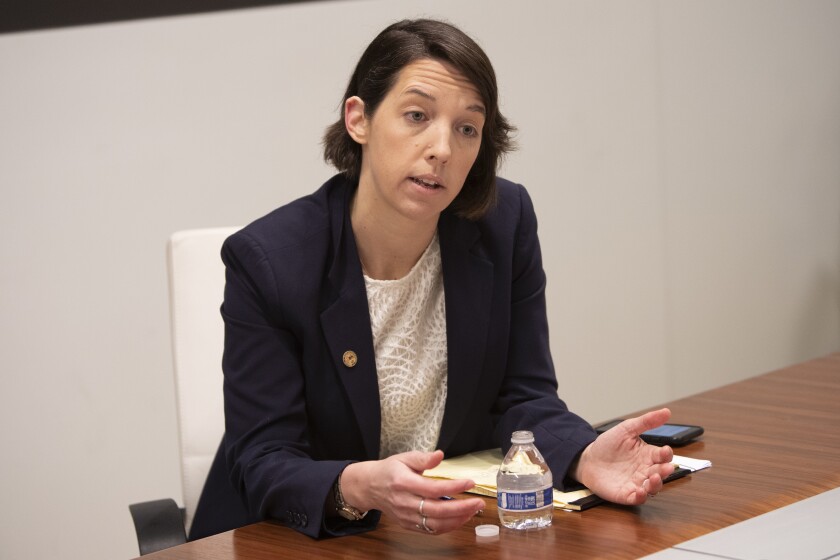
Illinois state Rep. Lindsey LaPointe, D-Chicago.
In addition to examining the Bridges program, state Rep. Lindsey LaPointe, D-Chicago, and state Sen. Karina Villa, D-West Chicago, who co-chair the Illinois state task force, are backing legislation that would require health insurance companies to pay into a “988 Trust Fund” for mobile response teams and stabilization locations for Illinoisans who call the 988 mental health crisis hotline.
“We do not have nearly enough crisis stabilization units or ‘living rooms,’ which are the places to go that are not jail and not a hospital,” LaPointe told a gathering of mental health advocates last month.
‘Scrappy’ solutions
Jennifer Turner, the executive director of Bridges of Colorado, says the program allows for creative solutions in a judicial environment that’s typically viewed as black-and-white. With Bridges liaisons in court, judges in Colorado can look out from the bench and see a prosecutor on one side, a defense lawyer on the other and also someone whose job is to present options to address a defendant’s mental illness as part of a sentence.

Jennifer Turner, executive director, Bridges of Colorado.
Jennifer Turner, executive director, Bridges of Colorado: “If mental health needs aren’t addressed, they can get worse year after year, especially when we’re talking about chronic mental illness.”
The Bridges staff members don’t get involved with the legal facts of the cases. Because they get to know the defendants so well, they can point out obstacles others might miss.
Turner gives an example of a homeless defendant who couldn’t get to his mandatory treatment appointments because the wheel on his cart was broken and he didn’t want to leave his belongings behind.
Bridges staff found and bought a wheel for him, and the man made it to treatment and to court.
Other times, staffers have located family members who are willing to support the person in their recovery.
“That’s another scrappy sleuth thing that I love,” Turner says. “Sometimes, folks just get lost, and then we create these family reunions, and then people are plugged back into their communities and their support system.”
Bridges liaisons also help people in the program apply for and get Medicaid benefits and sometimes help fund treatment until Medicaid is approved.
Turner likens mental illness to unaddressed physical illnesses.
“If somebody has diabetes and that goes unchecked, then it’s going to get worse year after year after year,” she says. “The same thing happens with mental health. If mental health needs aren’t addressed, they can get worse year after year, especially when we’re talking about chronic mental illness.”
She points to studies showing that defendants with untreated mental illness are much more likely to get arrested again compared to those without mental health needs.
Turner says some of the program’s biggest fans are county sheriffs who see mentally ill people in their jails yet aren’t equipped to get them needed treatment.
Even in the best-run jails she’s toured in Colorado, Turner says all that law enforcement can do is manage symptoms.
“They’re not getting treatment to get better,” she says.
For years, mental health advocates have pointed out that it’s less expensive to fund comprehensive mental health programs on the front end than to pay for incarceration, which averaged $49,271 per Illinois prison inmate per year in 2024, compared with $15,000 to $35,000 to provide intensive social services in the community, experts say.
Turner, who’s planning a wide-ranging analysis looking at cost savings in Colorado, estimates the Bridges liaisons cost about $6 for each participant per day over the course of a year, compared with $66 a day to jail someone or up to $1,476 a day to keep an incompetent defendant in a psychiatric hospital bed.
Last year, Bridges’s $10.5 million budget helped 4,600 defendant-participants, with staffers filing more than 32,000 reports to the court system and attending more than 20,000 hearings, according to its annual report.
Getting judges on board
Turner says she logged 30,000 miles driving around during the program’s first year and managed to get more than 90% of judges with a criminal docket to use the program.
“There were times when judges were tearing up,” she says. “They knew who we were talking about, and they were just feeling like, ‘I can’t do anything from where I sit, and I know this person just keeps showing up, over and over.’
“Before Bridges, a judge is sitting there with a very, very narrow lens of decision-making, which is guilty or innocent, competent or not competent. We give them a very, very good picture [of] what’s going to make a meaningful difference, not just throw a cookie-cutter program at them.”
Judge Lisa C. Arnolds, a district judge in Denver who formerly worked in the public defender’s office there, sees Bridges liaisons in her courtroom every Tuesday when she holds a specialty docket for defendants who have competency issues.
“To me, what was missing was support for somebody when they were released from jail,” Arnolds says. “They just get released to the streets and don’t know how to access resources. Don’t know how to get an ID if they don’t have one. Don’t have a phone so can’t get calls from their pretrial officer.”
Beyond that, Bridges staffers help with Medicaid or disability benefits, housing and making sure there’s a “warm handoff” for a greater chance of success, Arnolds says.
“I think that is just a tremendous change, rather than releasing people out of the jail doors at 9 o’clock at night and saying, ‘Good luck. Don’t forget your next court date,’ ” the judge says.

Lottie Elliott on a bridge in Monument Valley Park in Colorado Springs, Colo.