
Gov. Gavin Newsom made a major CARE Court announcement last week, dubbing 10 California counties “underperforming” for their slow implementation of his administration’s effort to get more residents with severe mental illness into treatment. The governor also named 10 counties CARE Court “champions” for having among the highest petition rates in the state.
San Diego County did not make either list despite the fact that it was among seven counties statewide that implemented the law first, launching the program in October 2023.
During a news conference last week, Newsom said that the “benchmark” for the program is 6.2 cases per 100,000 residents for petitions filed in calendar 2025. San Diego County appeared to exceed that threshold, recording 216 CARE Court petitions in 2025 for a rate of 6.5. But that was not enough to be declared a champion, despite the fact that the local effort has received statewide coverage for being “among the most robust” in the state.
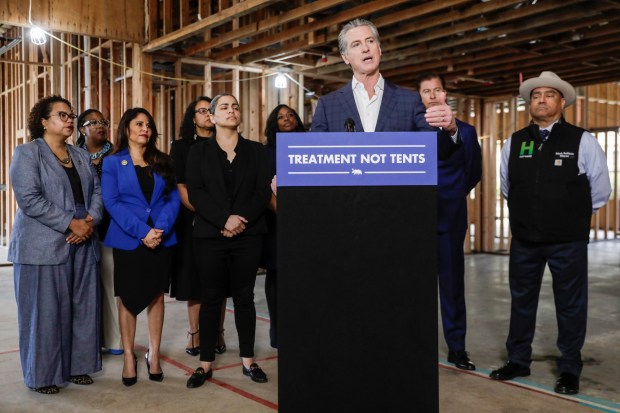 Governor Gavin Newsom speaks alongside local and state leaders during a press conference announcing new funding for communities across the state to address homelessness and mental health and stronger accountability measures for counties administering CARE Court during a press conference at BACS St. Regis Center, in Hayward, Calif., Monday, March 2, 2026. (Jessica Christian/San Francisco Chronicle via AP)
Asked why San Diego did not make the cut, Rodger Butler, assistant secretary for media relations and external affairs at the California Health and Human Services Agency, said through an external media relations representative that the champions list is reserved for the 10 counties with the highest per-capita scores.
“San Diego is above the state average, but not one of the 10 highest performing counties,” Butler said. “San Diego County has shown strong engagement and has been a committed partner throughout the rollout of the CARE Act.
“We appreciated the significant work that San Diego and other counties have undertaken to stand up CARE Court in a short period of time.”
CARE Court allows mental health care and law enforcement professionals, as well as family members, to file petitions on behalf of California residents diagnosed with schizophrenia and other psychotic disorders.
Because the state has not published the number of care petitions recorded in each of the state’s 58 counties in calendar 2025, it is difficult to know exactly how San Diego stacked up against the 10 counties that were dubbed champions.
They are: Humboldt, Tuolumne, Marin, Napa, Merced, Sutter, Alameda, Santa Barbara, San Mateo and Imperial counties.
However, the Judicial Branch of California does provide statistics for the entirety of CARE Court from late 2023 through 2025.
Here, San Diego County compares favorably to many of the counties that did make the list, with 490 total petitions since 2023. Counties that did make the list range from Imperial and Napa counties with 21 to Alameda with 214. All three counties launched their implementations of CARE Court in late November or early December 2024, meaning that judicial branch numbers would be nearly identical to those for calendar 2025.
It was not clear why the state decided to use the number of petitions filed to rate counties’ performance.
The number of petitions made in a given year does not necessarily mean that CARE Court is having a large impact in a given region, because many petitions are dismissed. And some CARE Court referrals, a San Diego County spokesperson noted in an email last week, come from local courts, hospitals and jails and are not officially counted as petitions.
In San Diego County, for example, 297 of the 516 petitions received to date (counting those made in 2026) have been dismissed, with 33% of those set aside because the request targeted someone who was not eligible under the Care Act. And, about 27% of that number was said to have refused to participate.
San Diego County reports that its local implementation of CARE Court has brokered 182 CARE agreements, which specify treatment and other resources, even housing, that participants will receive. San Diego County reports that those who have participated have seen a 66% reduction in use of crisis services. San Diego says its 32 graduates of the CARE program are the most in the state.
Nadia Prevaria Brahms, the county’s director of behavioral health, said in an email Monday that she believes results matter most.
“Since launching the CARE program in 2023, San Diego County continues to be a statewide leader in implementation, and most importantly, in stewarding successful outcomes for our clients,” Prevaria Brahms said. “Our approach focuses on engaging people in a way that honors their preferences, their choices, and their independence.
“Locally, we consider it a success when people choose to access treatment services on their own, without involvement from the Court. We have championed CARE as a valuable tool and another critical pathway to get people access to the behavioral health care and support they need.”