
This is an exclusive BHB+ article
Value-based care used to be one of those terms everyone nods along to, but was defined differently by everyone who used it.
Last week, the Behavioral Health Business team hosted our annual VALUE conference in Orlando, and the conversations were dominated by payers and providers who are deep in the trenches of value-based contracting.
Stakeholders brought to the table key insights about the field’s reality, including payers’ demands shifting from access to outcomes, the need for an operational data-sharing system, and why providers that take on risk for a patient’s overall health may have an upper hand in contracting. While value-based contracting may feel aspirational to some providers, payers were honest about which providers can pull it off and which should stick to fee-for-service.
In this BHB+ Update, I will explore:
–Why access isn’t enough for value-based contracting
–What small providers can do as a stepping stone to value-based care
–Why caring for patients’ physical and behavioral health could pay off for providers
The Evolution from Access to Outcome
Ghost networks and network adequacy requirements have plagued payers for years, with some plans spending millions on settlements. This has made access a key issue for payers.
However, the recent rise in therapist enablement services has made access more readily available to plan members. As a result, payers are now demanding outcomes.
“Historically, [value] was really based on operational things like whether the directory is accurate? Can you get an appointment? Can you get an appointment in 48 hours?” Christian-Herman, head of clinical strategy at Headway, said at VALUE. “These very basic things, and those things are important, but not really meaningful when you think about the big picture. So I think moving from measuring activities to measuring impact is the direction that we’re going in.”
Headway is a patient-matching platform. It has raised more than $320 million and is valued at $2.3 billion.
There is also a growing collaborative approach to deciding the outcome measures.
“Historically, people who decide what value looks like are the ones with the checkbook,” Berto Torres, vice president of business development at Octave, said at VALUE. “Our payer partners are asking us for what they should be measuring. For example, we’re constantly iterating on metrics that should be impacting as your construct, moving beyond just a collection of PHQ-9s and GAD-7s.”
Octave is a hybrid behavioral health provider that treats depression, ADHD, bipolar disorder, chronic insomnia, eating disorders and substance use disorders.
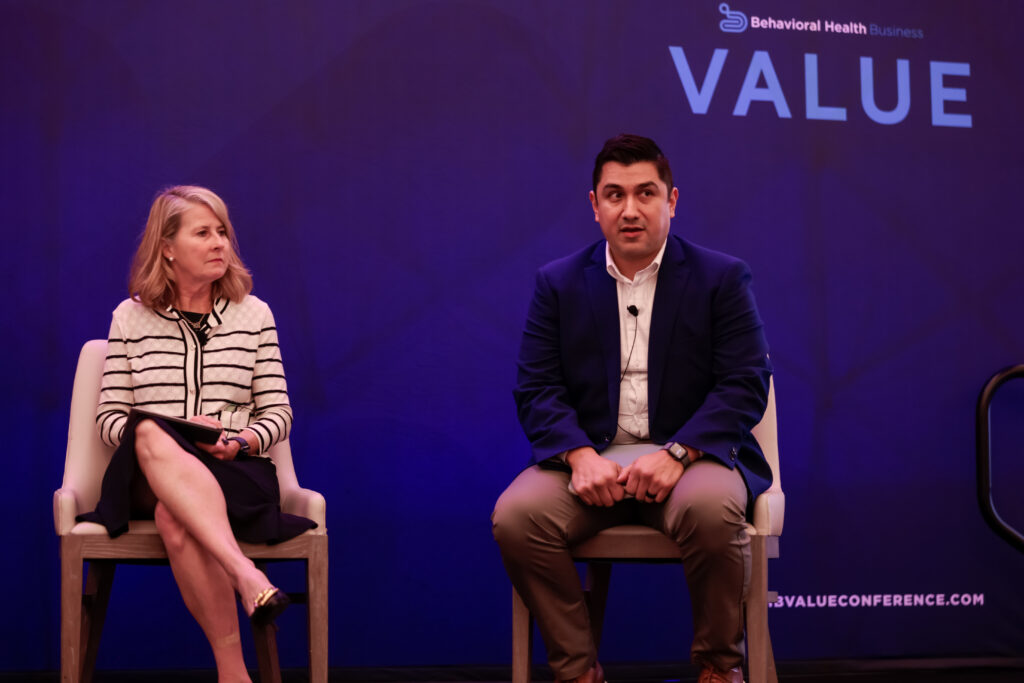 Christian-Herman, head of clinical strategy at Headway and Berto Torres, vice president of business development at Octave, speak at VALUE.
The industry has tools to standardize measuring many lower acuity conditions, such as anxiety and depression. But deciding on what value and quality look like for more specialized conditions can be challenging for payers.
Miriam Ferreira, vice president and head of mental well-being at Aetna, gave the example of a collaboration Aetna has with an eating disorder provider. In this relationship, the provider is key in determining which outcomes are important and should be included in the value-based care model.
Physical health integration is key to full-risk
A longstanding debate in behavioral health centers on how providers can receive credit and reimbursement for the downstream reductions in physical health care spending that effective behavioral treatment produces.
But some value-based care arrangements are now taking full risk for both physical and behavioral health care spending. For example, firsthand, a serious mental illness provider, has engaged in a full-risk partnership with Carelon.
“We select people because they have a serious mental illness, but that’s just the gate to get in. That isn’t necessarily what we need to intervene on to improve their lives,” Dr. Joe Parks, chief medical officer at firsthand, said at VALUE. “We see people who have serious mental illness and most of their drivers are substance abuse. We see some people who have serious mental illnesses, and most of their drivers are chronic medical conditions. I remember a man with methamphetamine and schizoaffective disorder who was repeatedly going to the ER for psoriasis. Well, the good thing is that it’s a lot easier to treat psoriasis than it is methamphetamine, and so we don’t treat them by the category assumed of their diagnosis.”
In the firsthand-Carelone model, the full risk includes physical, behavioral, pharmacy, hospitals, ER, inpatient, outpatient, “soup to nuts.”
Assuming the full risk of a patient also makes the partnerships more appealing to payers as it is simpler and more straightforward.
“The total cost of care model is really what makes this work when we’re looking at all the different kinds of vendors and providers in the ecosystem, all these slices of risk don’t really work on the back end,” John Machalek, general manager at Carelon Behavioral Health’s SMI Business, said at VALUE. “For me as a managed care organization, it is impossible to basically perfectly divvy up all the membership, divvy up all the risks, make sure I’m not double, triple, quadruple, paying for all these services. And so instead of saying everyone just gets like, this pH outpatient risk for this inpatient physical health risk, this all in behavioral medical pharmacy risk actually makes us have a fully aligned incentive model, especially for this population.”
 John Machalek, general manager at Carelon Behavioral Health’s SMI Business and Dr. Joe Parks, CMO of firsthand, speak at VALUE.
Data’s role in VBC
Data is essential in order to prove outcomes and make value-based care relationships work. Still, many operators in the space lack the infrastructure to capture outcomes that meet payers’ demand.
“There’s an interesting thing that’s happening in our space, where some of the technology is evolving really pretty rapidly in terms of the rest of the infrastructure,” Jeremy Klemanski, CEO of Gateway Foundation, said at VALUE. “But one of the things I’ve noticed in a lot of rural organizations is that the spend is not substantial as it should be in [technology’].”
Gateway provides mental health and substance use disorder services to patients across Florida, Georgia, Illinois, Michigan, Missouri, New Jersey, Texas and Wyoming. The provider serves more than 30,000 people annually.
But the good news is, providers don’t need complex systems in order to work with payers on value-based arrangements.
“The most important thing about the data is the shared definitions of the data. And I don’t think you need to have an extraordinarily sophisticated infrastructure,” Lisa Kay, clinical quality leader at Evernorth Behavioral Health, said at VALUE. “You just need open lines of communication and clearly documented definitions. And I would also suggest that you don’t need a super sophisticated infrastructure, because it might actually make more sense to start small than to start large. It’s more about having consistency in terms of the data collection within the provider’s space.”
Evernorth Behavioral Health is the health service division of The Cigna Group. It offers pharmacy, care, and benefits solutions to employers, health plans and government organizations.
Payers are also working on the backend to share more data with their partners and, together, build a clearer picture of a patient’s overall health.
“What we built is a multi-tenancy platform where I can work with partners such as firsthand, basically create this clinical data exchange where they’re not only feeding information in, but I’m feeding information in as well — trying to create that golden member record,” Machalek said.
Payers often want to see that a provider cares for a substantial population of its members before entering a value-based contract. One of the main reasons for this is that each of these arrangements takes time and money from the payer organization to configure.
“To prove a value-based care model, you have to have a sufficient population to be actuarially sound — and show that you’re making a difference in quality metrics and total cost of care metrics,” Dr. Nzinga Harrison, chief medical officer at Eleanor Health, said at VALUE. “And so the time that it takes to get to building that size of population before you can get to your value-based care contracts in a meaningful way, with payers understanding it is not fair to ask the payer for a value-based arrangement on a population of ten members.”
Eleanor Health is a hybrid addiction treatment provider. It has raised more than $104 million in funding.
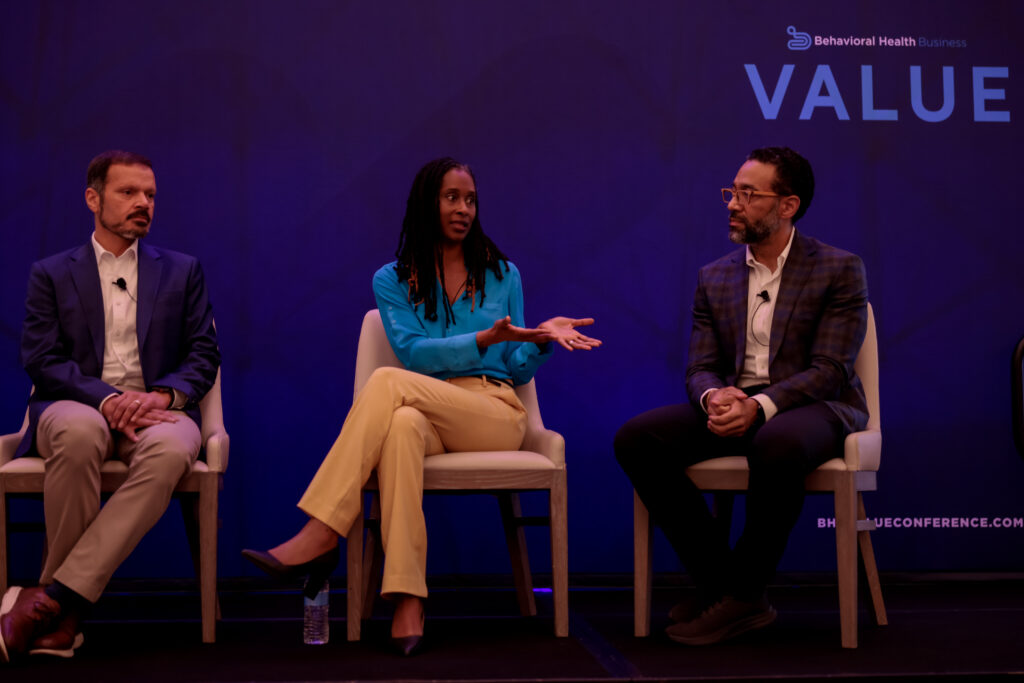 Dr. Nzinga Harrison, chief medical officer at Eleanor Health, speaks at VALUE.
It’s often a wise strategy for small providers to contract with payers using traditional payment models and then prove out their value.
“When you are at a small startup, the best way to get your foot in the door with payers is through that fee-for-service methodology,”Dr. Taft Parsons III, chief psychiatric officer at CVS Health and Aetna, said at VALUE. “That’s what we’re used to, that is what is easy until you have enough of one payer’s membership to prove out that you can actually save them money reliably.”
CVS Health is a health care conglomerate that offers clinical services, pharmacy services and health plans.