
The usual mid-week bustle of CSUN’s Plaza del Sol in the University Student Union (USU) was replaced by the calming presence of therapy dogs as the Blues Project kicked off its 2026 Wellness Week on Tuesday. The event, titled “Your Journey Matters,” centered its focus around suicide awareness and suicide prevention.
 Honey, a four-year-old puppy with Paws-to-Share, trades glasses as she poses with Walter Gonzalez, a communications student at the Blues Project Your Journey Matters event on March 10 in the USU. (Julia Torres)
To promote mental health awareness, the Blues Project invited several other campus resources to highlight their services, including Project D.A.T.E., the Pride Center, University Counseling Services (UCS), the Oasis Center and Joint Advocates on Disordered Eating (JADE).
Talalelei Ae, president and peer educator for the Blues Project, noted that their main goal is to ensure students understand the toll college can take on their mental health. During their workshops, which will include QPR Suicide Prevention Training and Recognizing Suicide Risk Among Latinx People, they always emphasize that they’re not professionals, but serve as a vital connection to professional help.
“It’s midterms, it’s coming up, we just want to create a good space and environment for students,” Ae said. “We’re truly here to just kind of bridge that connection.”
The Blues Project organized activities centered around butterflies, including a coloring the butterfly activity, a vision board with butterfly post-it notes and butterfly origami. According to Halle Perez, a junior majoring in psychology and secretary to Blues Project, butterflies are used to represent growth and self-expression. They symbolize an individual’s personal connection with their mental health.
Abram Milton, staff counselor with UCS who serves as outreach coordinator, said this is a good way for students to discover resources to manage their mood and mental health as they navigate school, especially as midterms begin.
“A lot of times, people get reflective,” Milton said. “Sometimes that transition can be emotionally trying for some people. So, I think this is perfect timing just to remind people to reset and focus in on mental health.”
The importance, according to Milton, is on awareness and normalizing having a serious conversation about support and suicide, which is why they have outreach and teach the QPR training, standing for Question, Persuade, Refer. Milton teaches the course monthly, as well as one scheduled for Wellness Week on March 11. The UCS also works alongside peer educators to get students involved with professional help.
“Obviously, you know, we as mental health professionals – hey, we don’t bite,” he said. “But honestly, why do we have influencers and stuff like that, right? Because people that we feel like we can relate to. That’s why we love the peer programming, because we have students that look like them who are also saying mental health is okay.”
 Jaden Reed smiles down at Honey, a four-year-old maltipoo, as she models a pair of sunglasses. According to Honey’s owner, Ellen Shiao, she has been in the program for years and enjoys the attention. (Julia Torres)
According to Blues Project Vice President Erika Mancera, the therapy dogs and one cat brought in from Paws-to-Share were the main strategy to bring students in. Devi Bhatt, a CTVA major, and her friend Michaela Allen, a deaf studies major, agreed they were mainly interested in the therapy dogs.
“I feel like a lot, at least for us, we have pets at home that we miss,” Bhatt said. “It’s nice to see animals on campus.”
Allen had previous encounters with the Blues Project during her classes last semester, when they gave a presentation on mental health resources. After attending the event, however, she realized how diverse the programs are. While the Blues Project focuses on mental health, groups like JADE, another branch of UCS, focus on eating disorder support.
“It’s also just kind of exciting,” Allen said. “Like you’re walking on campus, and oh my gosh, there’s a dog there. There’s therapy dogs. It’s like nice [to] just, like, sit with dogs for a little bit and take a break.”
Earl Arp, LA territory manager for Paws-to-Share, handled a 10-month-old orange tabby named in the therapy animal tent. Paws-to-Share is a pet-assisted therapy company that visits schools from pre-kindergarten to four-year universities, senior facilities, convalescent hospitals and senior retirement homes.
“It’s a very stressful time in life when you’re going through college,” Arp said. “This gives them a chance not only to relax, but also to kind of connect. There’s some students, maybe from another location, maybe far away, and they’re missing their pets.”
Finn, still in training for the last six months, is one of the younger animals. Honey, a five-year-old Maltipoo, has been in the program for longer. All of the dogs and cats in the organization are tested and vetted for personality. Handlers look for certain markers that have to do with reactivity and aggression so that they are more open to being pet and cuddled.
“We love coming out here and just watching the students and the staff, too,” Arp said. “They go through their stress, especially in their current climate, the way things are. It’s really … a godsend to have something like this.”
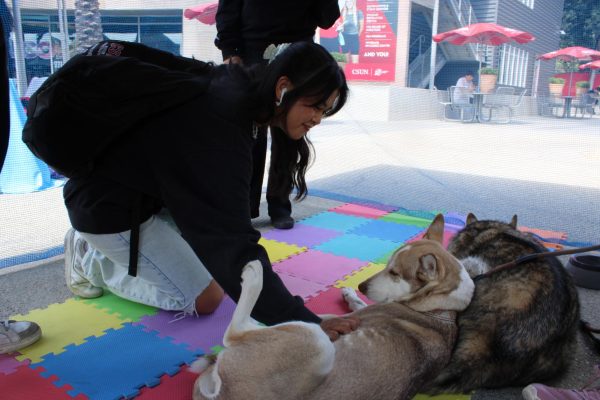 Leilani Boonyanetr smiles down as she pets Dottie, a husky with Paws-to-Share. Dottie and her older brother, Milo, are handled by Amanda Arp, manager for the organization. (Julia Torres)