
Like thousands of others across the country in his shoes, San Bernardino County Sheriff Shannon Dicus has been grappling for years with one of the most persistent problems facing law enforcement: the overwhelming number of mentally ill and drug addicted inmates populating their jails.
In Southern California, county jails have become the largest mental health care providers in the region, with estimates that half or more of the facilities consist of inmates struggling with mental illness or drug addiction — or both.
“The lack of capacity and effective tools to support individuals struggling with addiction and mental health issues represent one of the most significant challenges faced by law enforcement officers,” Dicus said. “Beyond the impact on public safety, this gap in resources is also deeply harmful to the broader human condition.
“As the sheriff, it is important to me to address these challenges directly and focus on their root causes.”
Now, after studying a nationally recognized program in Nashville, Tennessee, Dicus and his department are finalizing plans for a new program at the Glen Helen Rehabilitation Center that will connect inmates afflicted with mental health and substance use disorders to essential services and housing after they are released.
Modeled after the Davidson County Sheriff’s Department’s Behavioral Care Center in Tennessee, the tentatively titled New Beginnings program will serve up to 90 inmates who will be moved into two housing units at the jail that are being retrofitted with cubicle-style bed space and apartment-style rooms.
Glen Helen, the county’s oldest jail, has been closed for remodeling since August 2024.
“Transforming Glen Helen to provide the services, tools, and ongoing support necessary for treatment and recovery was a clear and necessary decision and one that helps ensure individuals receive the assistance and care needed to pursue lasting recovery and stability,” Dicus said.
The Glen Helen Rehabilitation Center opened in 1960 as a men’s work camp, and has expanded over the years to include female detainees and both minimum and maximum security units. It has a maximum capacity of 1,446 and averages a daily population of 800 male and female inmates. Inmates were relocated to the High Desert Detention Center in late summer of 2024 when Glen Helen closed for remodeling.
The Sheriff’s Department isn’t sure when the jail will reopen, but Assistant Sheriff Trevis Newport said he hopes to have the New Beginnings program operational by January 2027 at the soonest.
“We have a lot of renovations and construction to do,” he said.
Program model
The Sheriff’s Department is working with the county Department of Behavioral Health to develop an assessment tool to determine inmate suitability for the program, which will depend on the level of their severity.
Those selected will begin working with a mental health specialist or case worker within 90 days of release. Together, they will develop a treatment plan and connect participants with community organizations offering housing, education, job skills and vocational training.
Participants taking medication will work with behavioral health workers and other providers to ensure they are maintaining their regimens as part of their treatment plan, Newport said.
“We have found that if an individual is going along with their treatment plan, and they’re taking the appropriate medications, or adjusting their medications as they should be, they become more successful, and they’re way less likely to recidivize and come back to us,” Newport said.

The Glen Helen Rehabilitation Center in San Bernardino will offer the New Beginnings program to prepare homeless inmates afflicted with mental health and substance use disorders for life on the outside, connecting them to services and housing.
(Photo courtesy San Bernardino County Sheriff’s Department)

River’s Edge Ranch spirtual director Ernesto Izquierdo, right, 49, leads “ranchers,” including David Howard, left, 30 from Hesperia, in prayer at the Lucerne Valley drug and alcohol recovery facility on Tuesday, Feb. 24, 2026. (Photo by Will Lester, Inland Valley Daily Bulletin/SCNG)
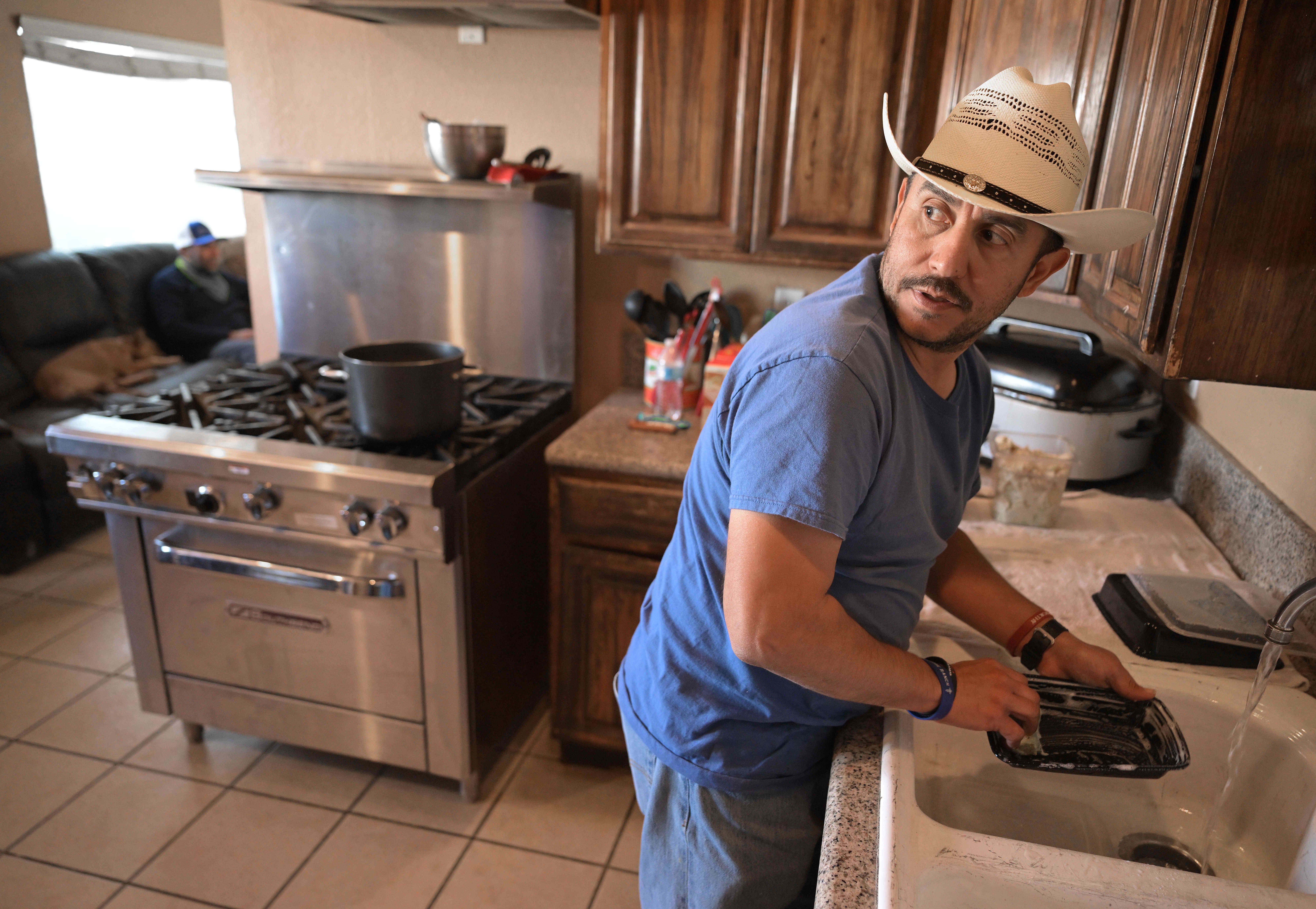
River’s Edge Ranch “rancher” Rodney Mora, from Fontana, washes dishes as he prepares lunch for 30 of the ranchers at the Lucerne Valley drug and alcohol recovery facility on Tuesday, Feb. 24, 2026. (Photo by Will Lester, Inland Valley Daily Bulletin/SCNG)

“Ranchers” at the River’s Edge Ranch line up to get their lunch at the Lucerne Valley drug and alcohol recovery facility on Tuesday, Feb. 24, 2026. (Photo by Will Lester, Inland Valley Daily Bulletin/SCNG)

Two housing units of the Glen Helen Rehabilitation Center in San Bernardino will be converted into independent living quarters for inmates participating in the San Bernardino County Sheriff’s Department’s New Beginnings program, which has a targeted start date of January 2027. (Courtesy San Bernardino County Sheriff’s Department)
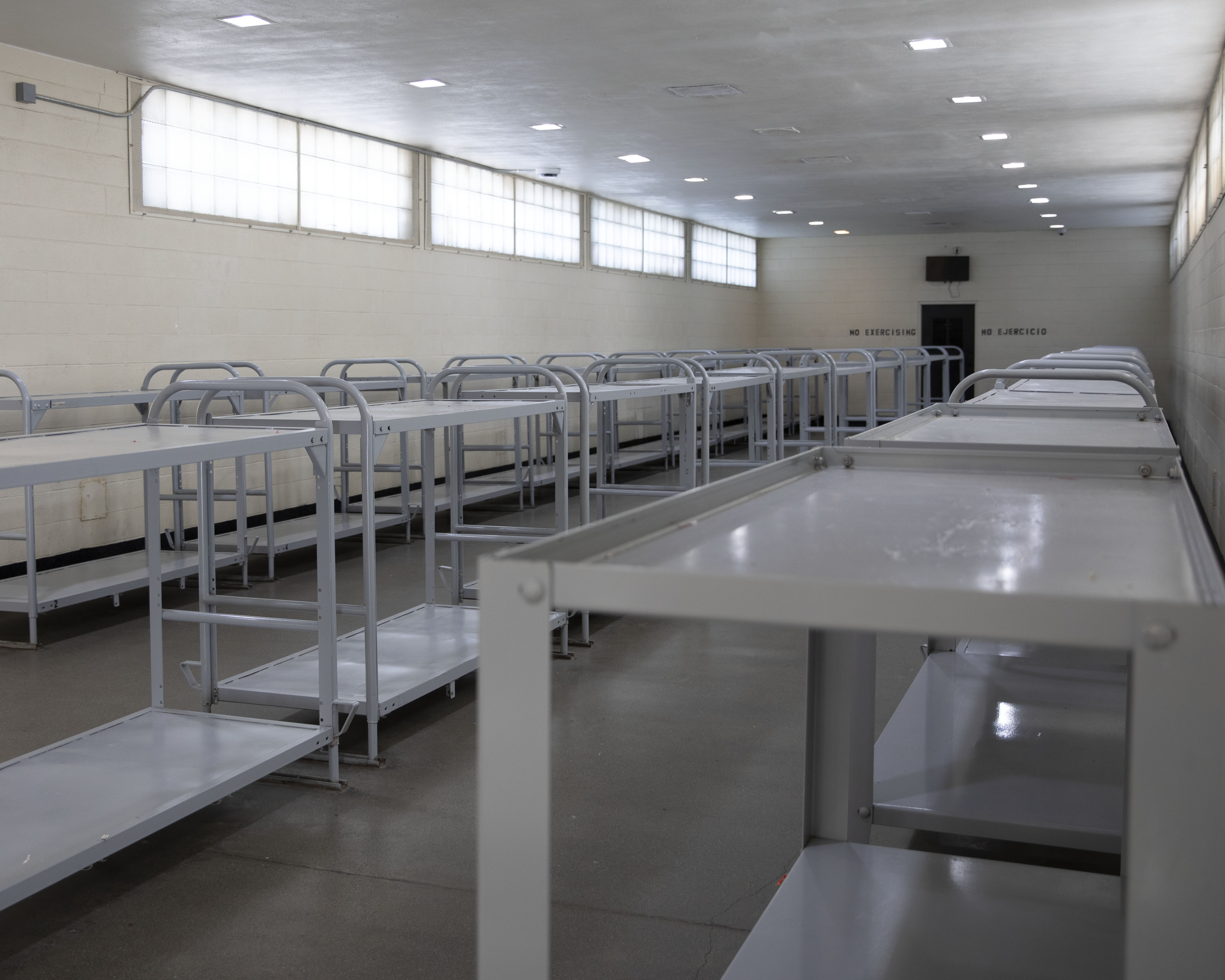
Two housing units of the Glen Helen Rehabilitation Center in San Bernardino will be converted into independent living quarters for inmates participating in the San Bernardino County Sheriff’s Department’s New Beginnings program, which has a targeted start date of January 2027. The program will begin preparing inmates, within 90 days of their release, to transition to life on the outside by linking them with nonprofits to help provide the services they need to live independently. (Courtesy San Bernardino County Sheriff’s Department)

San Bernardino County Sheriff Shannon Dicus said that transforming Glen Helen Rehabilitation Center to provide the services, tools, and ongoing support necessary for the treatment of inmates afflicted with mental health and substance use disorders was a “clear and necessary decision” to help ensure the individuals receive the assistance and care they need.
(Photo by Will Lester, Inland Valley Daily Bulletin/SCNG)
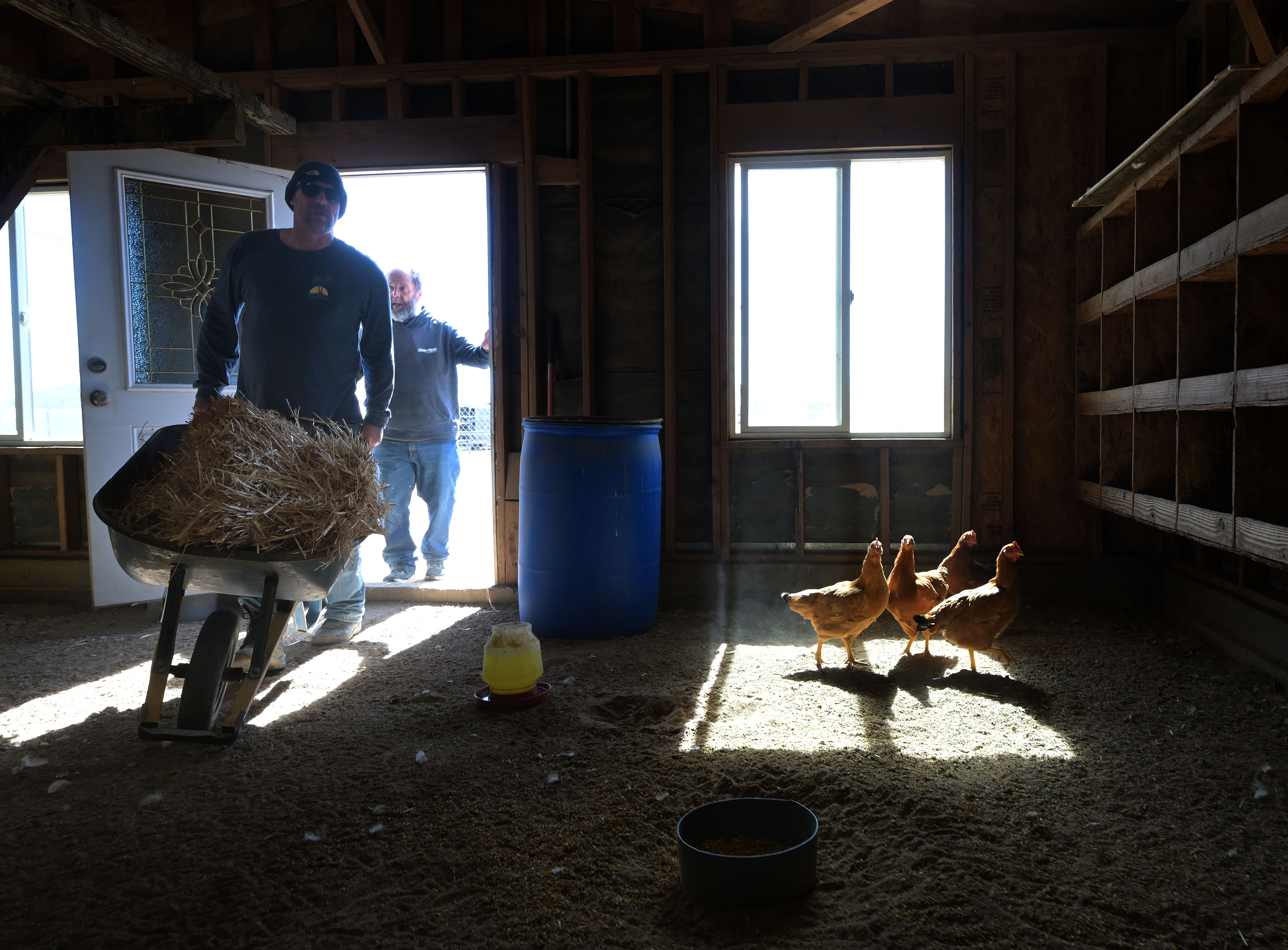
“Rancher” John Fisk, 44 from Ontario, wheels hay into a chicken coop at the River’s Edge Ranch at the Lucerne Valley drug and alcohol recovery facility on Tuesday, Feb. 24, 2026. (Photo by Will Lester, Inland Valley Daily Bulletin/SCNG)
Show Caption
1 of 8
The Glen Helen Rehabilitation Center in San Bernardino will offer the New Beginnings program to prepare homeless inmates afflicted with mental health and substance use disorders for life on the outside, connecting them to services and housing.
(Photo courtesy San Bernardino County Sheriff’s Department)
Expand
River’s Edge Ranch
One option for program participants, depending on bed availability, is the 38-bed River’s Edge Ranch, a faith-based, nonmedical drug and alcohol rehabilitation program on a remote 20-acre working ranch in Lucerne Valley, where residents learn discipline, structure, job and life skills.
Residents rise at 4 a.m. and work the ranch throughout the day, pausing for meals and Bible studies. They tend horses, cows, chickens and pigs, and maintain the property inside and out. Each resident is assigned specific tasks, and those who stick it out for a year receive a car and are transferred to the ranch’s group home in Fontana, where jobs often await them in Ontario and Rancho Cucamonga, said Doug Whiteman, CEO of River’s Edge, which opened in 2007.
Some residents have stayed at the ranch for up to four years, Whiteman said. He said once you’re admitted at the ranch, it’s pretty hard to get kicked out.
“We don’t typically ask people to leave. They’re usually grateful to be here,” he said.
The ranch, however, does not accept sex offenders or people requiring medication to treat any medical or mental health condition, as the ranch is a nonmedical facility.
In January, River’s Edge opened a women’s ranch on a 1-acre property in Apple Valley. It currently houses six women. Program participants must be willing to commit themselves to the life, which by no means is easy.
“You have to absolutely be willing to go to River’s Edge,” Newport said.
Residential treatment
The Sheriff’s Department also works with other residential care facilities in the Inland Empire and Los Angeles area it can refer program participants to, including The Salvation Army, Helping Hearts Hulen in Riverside, Mary’s Mercy Village in San Bernardino, Teen Challenge of Southern California in Riverside, Delancey Street Foundation in Los Angeles, and Coachella Valley Rescue Mission in Indio, said Diana Simmons, an outreach social worker for the Sheriff’s Department.
Helping Hearts Hulen, however, is the only medical respite facility where residents can receive medication management and limited nursing care, she said.
“We try to find out what the inmates need and what they’re comfortable with, and then try and see if they fit in. It is ultimately up to the inmate to decide if they go or not,” Simmons said.
Data tracking
The Sheriff’s Department will track the New Beginnings program data to measure its effectiveness and the recidivism rates of participants, Newport said.
He said about 60% of people in the San Bernardino County jail system, many of them suffering from mental illness and addiction, recidivate within a year of release.
“We have a list of about 100 people who just continue to keep coming back to us. We’re going to review the data and try to reduce those return visits,” Newport said during a recent interview at the jail.
The program also is targeting homeless inmates for participation. “A lot of our top recidivizers are homeless,” he said.
Behavioral Care Center
San Bernardino County drew inspiration from Davidson County, where Sheriff Daron Hall redirected $10 million from a $170 million downtown Nashville jail project to build the 12,000-square-foot, 60-bed Behavioral Care Center. His goal was to “decriminalize mental illness” by allowing offenders with mental health and substance use disorders to opt for voluntary treatment instead of jail.
Hall said the mental health crisis in the U.S. actually began in the 1960s, when psychiatric hospitals were “deinstitutionalized” and closed, leaving many former patients homeless, untreated and in jail. As a result, county jails have become the largest mental health care providers in the country, he said.
“I gave up waiting on a solution and said, ‘Let me go build what I think is a better outcome for the individuals,’ ” said Hall, who was elected to his sixth term as Davidson County sheriff in 2022.
The Behavioral Care Center, often referred to as the BCC, opened in September 2020 and houses 30 men and 30 women who are evaluated by a team of mental health professionals, the District Attorney’s Office and the Sheriff’s Department to determine their suitability for the program. Not all are admitted, as admittance depends on the severity of a detainee’s mental health condition and alleged offense.
Once admitted into the program, the average stay time is about three weeks. If the resident successfully completes the program, his or her criminal charges are expunged.
Hall has been tracking the data over the past five years, and the program has proven successful in dramatically lowering offender recidivism rates.
He said the national recidivism rate in Tennessee for offenders with mental health and substance use disorders is about 90%. But data shows that the recidivism rate for those who successfully completed the BCC program is 20%, Hall said. He said BCC staff determine how long the resident stays and when they are stabilized enough to be released.
Frequently, former BCC residents return, knocking on the door and asking for help — if they could sit in on a group meeting, if there is any food or clothing available, or to see if a certain person still works there. They are never turned away, Hall said.
“I always say, sometimes we just do the right thing. I don’t care what the lawyers say,” Hall said. “To me, this is success. I’ve worked in this jail system for 40 years, and there has never been a person knock on the jail door and ask, ‘Can I come back?’ But we have this happening weekly, if not every other week.”
Newport said the goal of New Beginnings program is to rotate about 250 participants through each year.
“It’s not going to be a 100% fix, we know that,” Newport said. “But if we help one person, and they don’t come back, we’ve won the day. That’s a plus for us.”