
“You’re going to write a bestselling book one day.”
Days after the birth of her daughter, Pasco County writer Ayana Lage recalls hearing that loud voice. In her mind, it was God. But what began as a deeply spiritual experience soon spiraled into something far more alarming.
Lage was diagnosed with postpartum psychosis, a rare psychiatric emergency that affects roughly one to two women out of every 1,000 births, according to the National Institutes of Health.
Her debut memoir, “Missing Me,” draws from notebooks she kept during the episode and medical records to recount the psychotic break and long road back to trusting her own mind.
The book also explores the surprising lessons she learned about faith, relationships and the ways she treated her family while unwell.
The book is available on Tuesday, with a sold-out launch event is slated at a St. Petersburg bookseller.
Lage, 32, who lives in Wesley Chapel with her husband, Vagner, and their two children, recently spoke with WUSF’s Florida Matters Live & Local about her experience and the decision to share it publicly.
The interview was lightly edited for brevity.
Why did you feel moved to share your struggle and your journey in this?
I was recovering from postpartum psychosis. I went to school for journalism, so I love research. I was searching for people who’d been through the same thing – Facebook groups, books, articles. And I was shocked by how little there was out there. I mean, there were resources that existed, but it was nowhere near what you’d find for postpartum depression or postpartum anxiety. So, once I felt ready to look back at it and write about it, I kind of had a mindset of, “If I can help even one person by sharing my story, help them feel less alone, then, you know, it’s worth it for me.”
Have you heard from folks?
Yes, I have, which has been the most rewarding experience.
It’s a lot of work to write a book, and it’s a pretty solitary experience. That sort of connection from your readers must be an amazing experience.
Oh, yeah. It’s very easy, I feel, to get lost in work in a good way, but also in a bad way. So, it’s kind of nice to have something that grounds you outside of that.
Well, let me just read a little bit. This is from the introduction of the sixth chapter, and it’s pretty stunning stuff.
“Because he is Satan, the so-called psychiatrist is also overseeing the hospital’s illegal experience. The doctors at the hospital hold secret meetings to figure out how to bring down people with special powers. At least one patient on the ward also hears from God, although I’m not sure I believe her proclamations. Also, some nurses are patients in disguise trying to trick me. They aren’t doing this independently. Dr. Ramirez has engineered the whole thing to mess with me, right?”
It sounds terrifying. Reading through some of the first parts of the book, it’s also quite funny, like just the way you describe God speaking to you, and then your husband trying to figure out what on Earth is happening. Talk us through that.
I think that I always assumed that if I ever lost touch with reality or my, you know, rational side, that there’d still be a part of me that would push through – like, “OK, something’s off here. You know this. This isn’t true. You know something’s wrong.” And that is not the case when you’re experiencing psychosis. I fully believed all of these delusions that I was experiencing. I was very distressed about the fact that no one else around me seemed to see what I was seeing, and I thought that my life was in danger. I was full of adrenaline all the time. I wasn’t sleeping. I was just overwhelmed by the sense that something terrible was going to happen to me or to my daughter, who was at home at that point. I was in an inpatient unit. She was at home with my husband. So, thank you for saying that it was funny. I think there are parts that were so absurd that I kind of had to look at it and say, “OK, you know this. It’s hard to believe that this happened, but you know it did.” What else can I do with that experience, other than share it?
The other thing that struck me was you kept all this material, that you had notebooks. You had stuff that you’d saved from your experience in hospital, like a half-empty bottle of shampoo. You just put all the stuff aside, and you weren’t sure how to deal with it. At some point, you had to go back through and read through your notes. The experience must have been quite challenging.
I think that I’ve always been a bit of a pack rat and a little bit sentimental when it comes to different things. I did keep all of this material, not sure that I’d ever need it for anything. But once I started thinking about the book, I went back into my hospital records, hundreds of pages of records, and read through them. Honestly, it was excruciating. I don’t know if I’d recommend that to the average person. I don’t know if I would do that again. But I learned a lot about myself, and I learned a lot about how I was perceived while I was in that situation, in that mental state, and I gained a lot from it. So, I’m glad that I kept the notebooks. I’m glad that I kept the records, and I’m glad that it helped me form the book.
You describe how this had been something you dealt with earlier in your life, kind of what later became a full-blown psychosis. Can you talk about that?
I lived through depression and anxiety, starting as a preteen all the way up into college, where I finally started to receive treatment. So, I was familiar with not being in the right mental state and not having yourself together the way that you want it to be together. But I think there was still a part of me that viewed myself as like an acceptable version of mentally ill. You know, at least I’m not someone who has a scary illness or something that is actually bad. I can handle being anxious and depressed. I’m used to it. It was definitely a humbling reality check to experience psychosis
As an African American woman in America, there are a lot of challenges, right? Like inadequate health care. There’s pregnancy and high mortality rates. Did this shape your perception of how you experience what you went through.
I had a very difficult childbirth that ended in an emergency C-section. And I do think that had I been able to advocate for myself more during that process leading up to the emergency, that would have had a different outcome. I definitely felt very aware of my status as a Black woman in the medical system. So that was always on my mind through psychosis, although my mind wasn’t all the way there. I wasn’t always thinking clearly, but it was something that I was thinking about.
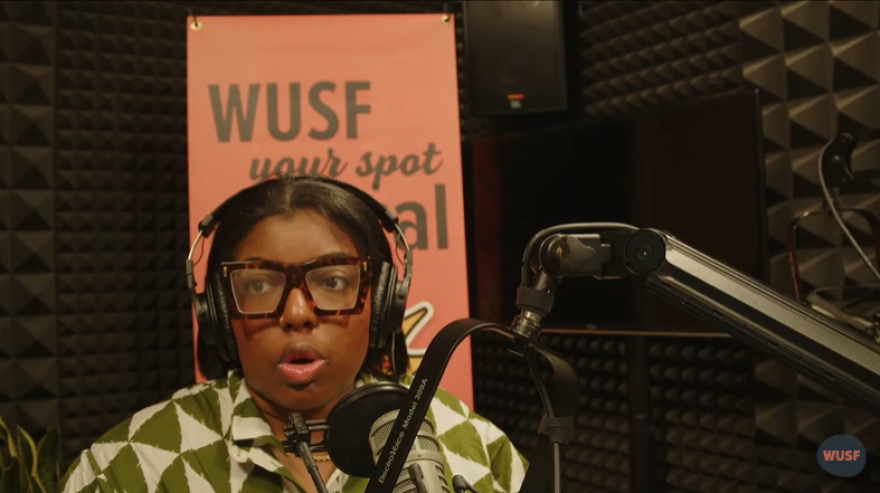
Ayana Lang discusses her book, “Missing Me” during an appearance on WUSF’s “Florida Matters Live & Local” on March 3, 2026.
This was happening around COVID, right? So that’s an extra layer of stress.
Yeah, this was August 2020, so while I was in the hospital, I couldn’t see my husband or my child. There were no visitors allowed due to pandemic restrictions. And that compounded everything that I was feeling because I had a delusion that my daughter wasn’t real. And I think that obviously, like not being able to talk to my husband and be reassured face to face, she exists. Here’s a picture of her, anything like that. Missing out on that made it even harder to live through.
Did you have postpartum depression?
I was extremely prepared for postpartum depression. I knew that I was at higher risk because of my mental health history, and I felt like, “OK, I can do this.” I’d heard of postpartum psychosis, but only in the context of the headlines that you see that are terrifying and scary and awful. It wasn’t something in my mind that would ever happen to a regular person like me. I felt insulated from that, and I felt prepared for the mental health condition that I expected to have, [but] I was prepared for what I went through.
Now you write in the book about God speaking to you, like one of the first things you hear, one of these first visions. Put the listener in your shoes.
At that moment, I was in my room, in bed, trying to fall asleep, and I heard the loudest voice say, ‘You’re going to write a bestselling book one day.” And I was so excited. I turned to my husband, I was like, “You won’t believe this, but I’m hearing this voice telling me this.” And I’d had mood swings and acted erratically in the days leading up to this moment, but there was nothing to clearly suggest that this is a psychotic break until I started to hear voices. I got this word that I’m going to be an author, and then I started to hear from God that he wanted me to rewrite the Bible. The notebooks I kept throughout psychosis are my version of the Bible that I was trying to write with all the voices that I was hearing, keeping track of what I was being told.
You’re obviously a lot more centered. Has your relationship with religion changed?
My relationship with religion was complicated even before the episode, but I had a difficult time reconciling the faraway God that you know is in heaven that some of us believe in. My reality for three weeks, where I had a God who was whispering in my ear constantly and telling me everything and telling me I was special and that there was no one like me, couldn’t be my real God. But when I reckoned with Christianity, that felt boring, like I miss hearing words from God. So, I think that even now my relationship with faith is a little bit tricky, but I did learn a lot through the experience, and I do think that it did shape me in a good way.
And what about your relationship with your family? How is that now?
I dive into it in the book, but I was terrible to my family. I would call them from the hospital and yell at them and tell them that they were going to hurt my daughter, that my husband was cheating on me, that they were murderers. As I came back to myself, I had to reckon with the fact that I’d been so awful and so cruel to the people that loved me most. I think they were very forgiving and just glad to have me back and weren’t holding anything against me. But I honestly still feel some guilt for the way that I treated my loved ones. It was difficult.
You can listen to the full interview in the media player above. This article was compiled from an interview conducted by Matthew Peddie for “Florida Matters Live & Local.” You can listen to the full episode here.