
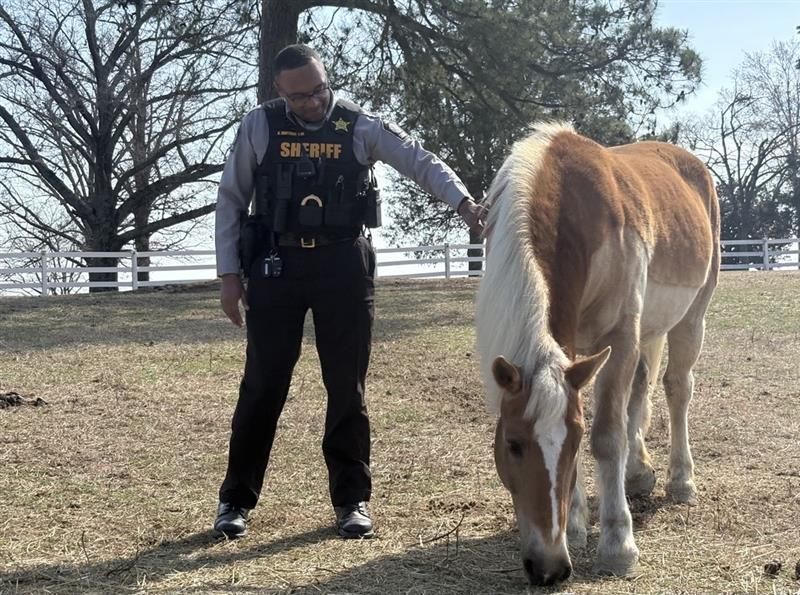
Horses are now helping Wake County Sheriff’s deputies work through tragedies they respond to while on the job.
The Wake County Sheriff’s Office has started a partnership with Helping Horse, a health and wellness program near Wendell.
“Deputies’ jobs are highly stressful,” Jackie Shapaker, the coordinator for Helping Horse’s first responders and veterans program, said. “We offer mindfulness and grounding techniques before they’re with the horses and while they’re with the horses.”
Deputies can go to the facility off-duty and spend time with one of 13 horses individually or with their families. The sessions are free for Wake County deputies.
“In a normal 12-hour shift, you’re going from call to call to call…sometimes you can’t even eat…and, here, you’re just unwinding in the beautiful county with a bunch of horses,” Deputy Sheriff Kevin Matthews told WRAL News.
Most recently, Wake County deputies went to Helping Horse the week after responding to a deadly assault near Fuquay Varina. They found a 12-year-old girl killed and a 9-year-old boy seriously hurt.
This is not the last tragedy deputies will respond to. Wake County Sergeant Mark Szajnberg said an average person will see two-to-three critical incidents in their lifetime. On average, a law enforcement officer will see more than 700 critical incidents in their career.
“We train our officers how to handle a crisis, how to go into a crisis but not that good of a job of teaching them how to process it afterwards,” Szanjberg said. “This gives them an opportunity to slow down, reset themselves and talk about what their thought process is.”
Why horses help
Shapaker said being in nature is one way deputies can reset, but horses allow for a deeper reflection.
“Horses are incredibly intelligent animals, and they demand us to be mindful in the present moment,” she said. “We’ve had experiences where a deputy’s mind goes off thinking about something, and the horse kind of steps away. Then, we take some time to reflect.”
Shapaker said, in those times, the deputy tells her their mind wandered, and they stopped thinking about the relationship and connection with the horse. She said they take a moment to reconnect, and the horse comes back to the deputy.
“The horse is a wonderful reminder, constantly tapping us on the shoulder, saying ‘are you here now, are you with us right now,’ and so that continuous reminder is very powerful for people,” she said.
Szanjberg responds to tragedies after deputies. He’s there to help them process any emotions or trauma. He’s been through the program and noticed the effects.
“It makes you reset yourself,” he said. “When you’re with the horses, you have this calming effect of being around them, being outside, enjoying the fresh air.”
Layers of mental health assistance
Szanjberg said the Wake County Sheriff’s Office offers multiple outlets for deputies to process trauma.
The department has peer support and a clinical psychologist available. It also has the Employee Assistance Program, which provides resources to deputies, and NC Responders Assistance Initiative, which offers access to mental health professions, peer support and wellness coordinators. The department also conducts critical incident debriefings.
“After any major event, we bring all first responders in, so everybody has an opportunity to process their thoughts,” Szanjberg said.
Helping Horse is another outlet deputies can process their thoughts. The partnership with the sheriff’s office provides 8-hour individual programs with one or two-hour sessions, and 6-hour family programs.
Szajnberg said the requirements for deputies to be able to use the program depend on what they may be working on at the time.
“It’s based off the deputy or first responder that goes and their level of need is at that time,” he said.
Szajnberg said the program is new to the agency, and they’ve opened it up for the spring. He’s hoping more deputies will be able to come out to Helping Horse and use it as a sanctuary for healing.