
More than 200 health care workers rallied Wednesday outside Kaiser Permanente Santa Rosa Medical Center as part of a wider one-day strike to protest what they said are inadequate and increasingly impersonal mental health services offered by the health care giant.
The strike, which also included picketing in Oakland, Sacramento, Santa Clara and Fresno, was organized by the National Union of Health Care workers, which represents more than 100 mental health workers in the Santa Rosa area, including therapists, social workers and psychologists and 2,400 across Northern California and the Central Valley.
In Santa Rosa, picketing workers were joined by about 100 Kaiser nurses from Santa Rosa and San Rafael, in a “sympathy strike” organized by the California Nurses Association. Workers represented by Stationary Engineers Local 39 also struck alongside mental health staff and nurses.
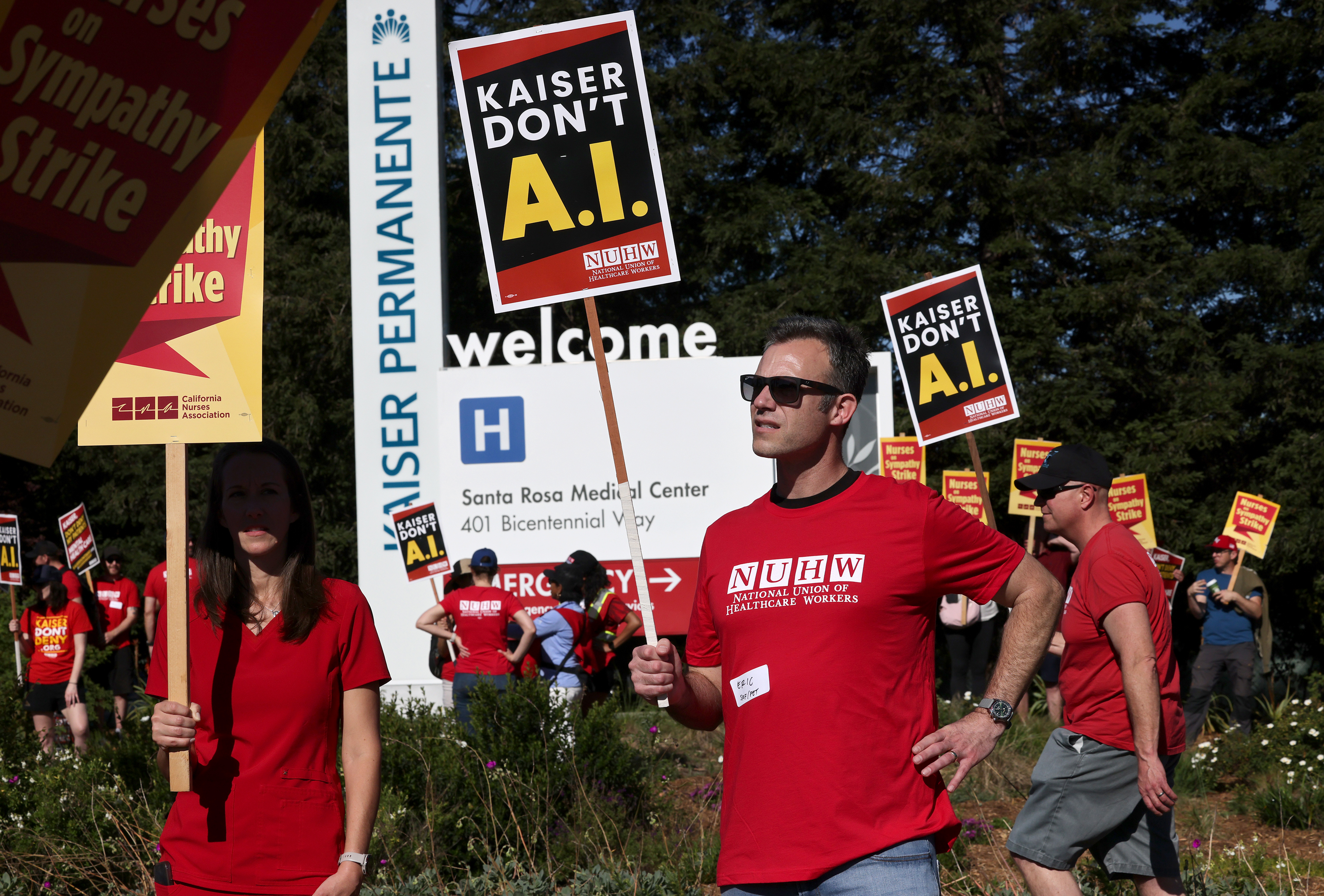
Dr. Eric Hanley, Kaiser Permanente phycologist, joins nurses and Stationary Engineers holding a sympathy strike outside Kaiser Permanente Santa Rosa Medical Center in Santa Rosa Wednesday, March 18, 2026. (Beth Schlanker / The Press-Democrat)

Nurses and Stationary Engineers hold a sympathy strike outside Kaiser Permanente Santa Rosa Medical Center in Santa Rosa Wednesday, March 18, 2026. (Beth Schlanker / The Press-Democrat)

Nurses and Stationary Engineers hold a sympathy strike outside Kaiser Permanente Santa Rosa Medical Center in Santa Rosa Wednesday, March 18, 2026. (Beth Schlanker / The Press-Democrat)
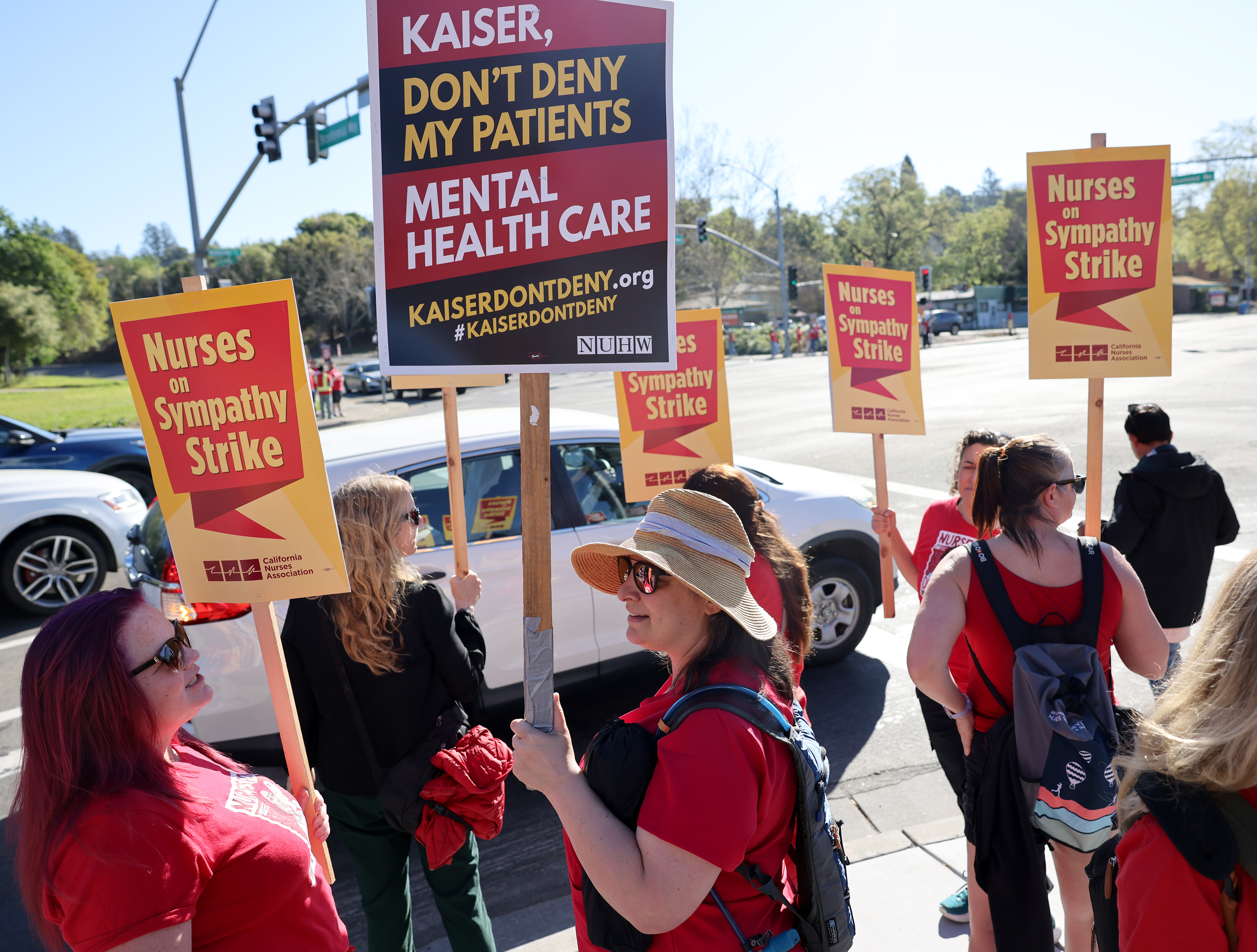
Nurses and Stationary Engineers hold a sympathy strike outside Kaiser Permanente Santa Rosa Medical Center in Santa Rosa Wednesday, March 18, 2026. (Beth Schlanker / The Press-Democrat)

Nurses, including Debra Tiffany, right, and Stationary Engineers hold a sympathy strike outside Kaiser Permanente Santa Rosa Medical Center in Santa Rosa Wednesday, March 18, 2026. (Beth Schlanker / The Press-Democrat)
Show Caption
1 of 5
Dr. Eric Hanley, Kaiser Permanente phycologist, joins nurses and Stationary Engineers holding a sympathy strike outside Kaiser Permanente Santa Rosa Medical Center in Santa Rosa Wednesday, March 18, 2026. (Beth Schlanker / The Press-Democrat)
NUHW workers are currently in contract negotiations with Kaiser. Their contract expired in September and workers on Wednesday said Kaiser is looking to outsource jobs and replace therapist jobs with artificial intelligence.
Willow Thorsen, a licensed clinical social worker and behavioral medicine specialist, said the strike was triggered by Kaiser’s elimination of licensed triage staff who provide the first contact with mental health patients.
“Instead, they have unlicensed telephone representatives doing some of the baseline mental health triage,” Thorsen said. “That is a decrease in clinical accuracy of initial assessments to people getting into the right care the first time.”
Thorsen said Kaiser is also doing more “e-visits,” where patients do a quick questionnaire. She said some patients are being directed to “next steps” for treatment without speaking to a licensed triage worker, resulting in a delay of care or the wrong type of care.
NUHW workers said the elimination of licensed, mental health triage staff is part of a larger move to automate care and reduce human workers. The union said Kaiser is resisting including language in the new contract that would assure workers technologies such as AI would be used to support workers, not replace them.
Thorsen said that language was included in NUHW’s 2025 contract with Kaiser Permanente’s Southern California region.
Lionel Sims, senior vice president of human resources for Kaiser Permanente Northern California, said in a statement this week that striking workers are “pushing a false narrative” that the provider wants to replace clinicians with AI.
“At Kaiser Permanente, AI does not replace human assessment, and it does not make care decisions,” Sims said. “Our care teams are always at the center of decision-making with our patients.”
Sims said Kaiser’s objective is the reach agreement with NUHW that allows workers to use new technologies for the benefit of their patients.
“Many AI tools have the potential to help our clinicians spend more time focused on serving our members and patients,” Sims wrote in his statement.
Ray Messinger, a licensed addiction medicine and recovery services therapist, said Kaiser’s changes to its triage process has led to incorrect referrals.
“I’m getting calls from people who are desperate for care because they’ve been bounced around to four or five different call centers and they end up with me and I might not even be the right person that they’re meant to talk to,” Messinger said.
Colleen Gibbons, a medical-surgical nurse at Kaiser Permanente San Rafael Medical Center, was among the nurses who picketed in Santa Rosa in solidarity with the NUHW workers.
Gibbons, who has been a Kaiser employee for 31 years, said she’s seen a lot of patients seeking crisis mental health care at Kaiser hospitals because they’ve not unable to get timely preventative care.
“In talking to co-workers, they’ve had families that had to wait eight months for an appointment, that they can’t get in unless they’re in crisis sooner,” Gibbons said. “Working here as long as I have, I’ve seen the deterioration of access, especially to mental health.”
Sims, the Kaiser senior vice president, pointed out in his statement that CNA nurses were not currently in contract negotiations.
“Sympathy strikes will not bring us closer to an agreement with NUHW or help CNA with their forthcoming bargaining,” he said in his statement. “It is unfair to our members and patients to disrupt their care when they need our employees to be there for them.”
NUHW, in a statement Wednesday, pointed out that despite Kaiser reporting tens of billions of dollars in reserves, the health care giant “remains a serial violator of mental health parity laws.”
The union said that in 2023, the Kaiser agreed to a $200 million settlement agreement with the California Department of Managed Health Care for inadequate mental health services, including excessive wait times.
In February, Kaiser agreed to a $31 million settlement with the U.S. Department of Labor over the provider’s failure to provide timely and appropriate access to mental health and substance use disorder services.
You can reach Staff Writer Martin Espinoza at 707-521-5213 or martin.espinoza@pressdemocrat.com.