
Who’s your favorite brain rot? Maybe it’s Tralalero Tralala, a shark wearing three sneakers. Or Tung Tung Tung Sahur, a log holding a baseball bat. These ridiculous AI-generated characters show up in memes, videos, Roblox games and more.
Brain rot also refers to any mindless or compulsive online habit, such as zombie scrolling. But could any of this stuff actually rot your brain?
Yes — but it’s complicated.
Brain rot is a lot like candy, says Kris Perry. She’s the executive director of Children and Screens. This New York-based group works to make the public aware of how digital media can affect kids. Like candy, a little brain rot now and again won’t hurt you. But the more you partake, the bigger a problem it can become, argue Perry and other experts.
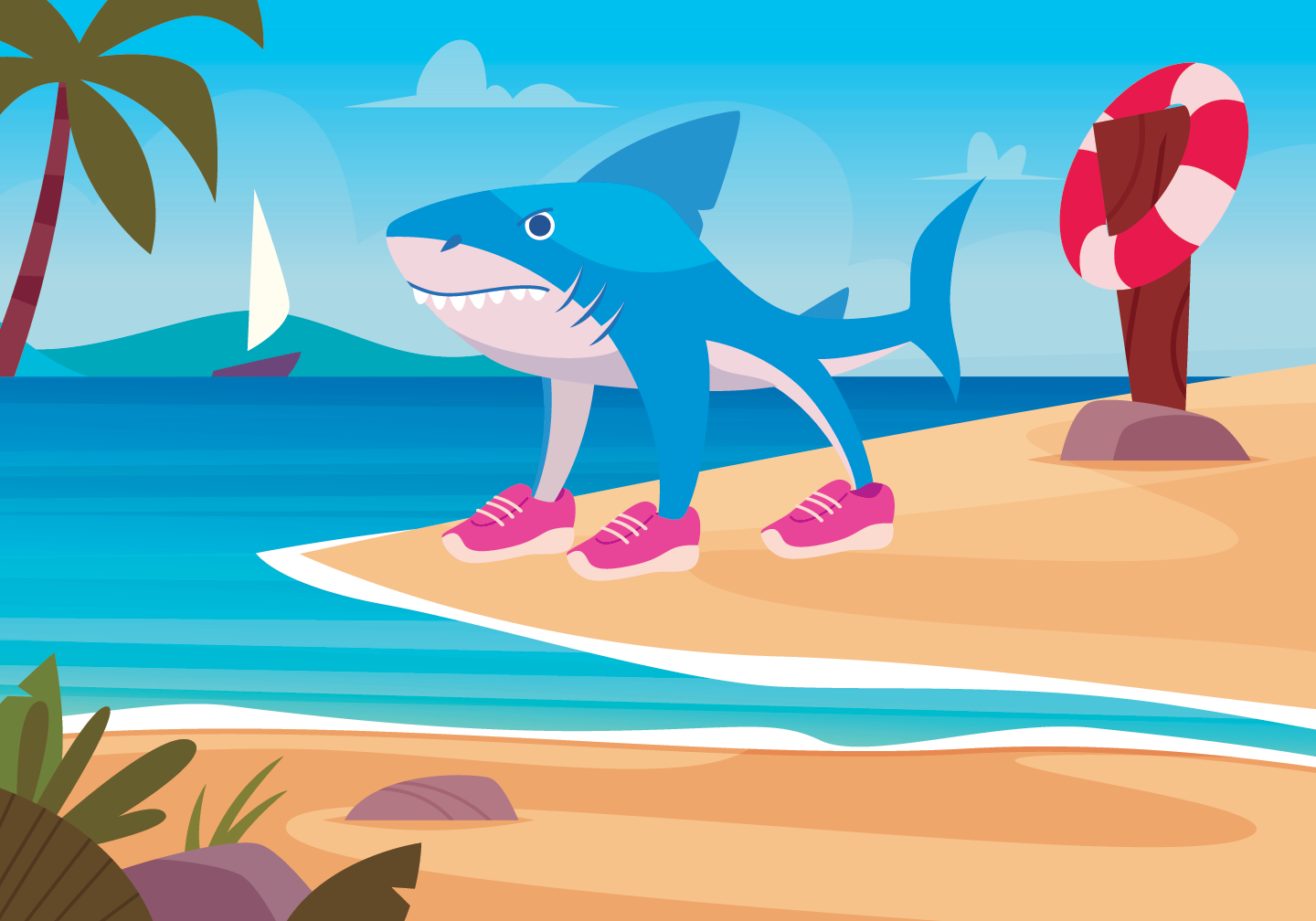 Brain rot characters, such as Tralalero Tralala, are ridiculous on purpose. Laughing at brain rot every so often won’t hurt you. But the more time you mindlessly spend online, experts are finding, the more risk you have of harming your brain development and mental health.ONYXprj/iStock/Getty Images Plus
Some of those experts have recently sounded an alarm about what can happen when young people consume too much brain rot. Says Perry: “This stuff can really impair your memory, your ability to plan, your ability to focus, your ability to pay attention, your ability to make decisions.”
Others point out that, although some data along these lines are emerging, the effects are not that strong.
Talk about brain rot has been trending recently. The idea that digital media might make us dumber? That’s not new at all.
Large numbers of underage kids are on social media, study finds
Back in 2010, Eric Schmidt was the chief executive officer at Google. “I worry that the level of interrupt, the sort of overwhelming rapidity of information … is affecting deeper thinking,” he said.
Everything you do helps build up new brain pathways and trim back others. The fancy science term for this is neuroplasticity. A plastic brain allows you to learn and grow from experiences. It also allows those experiences to mold and change you. This is especially true for adolescents, whose brains are undergoing rapid change.
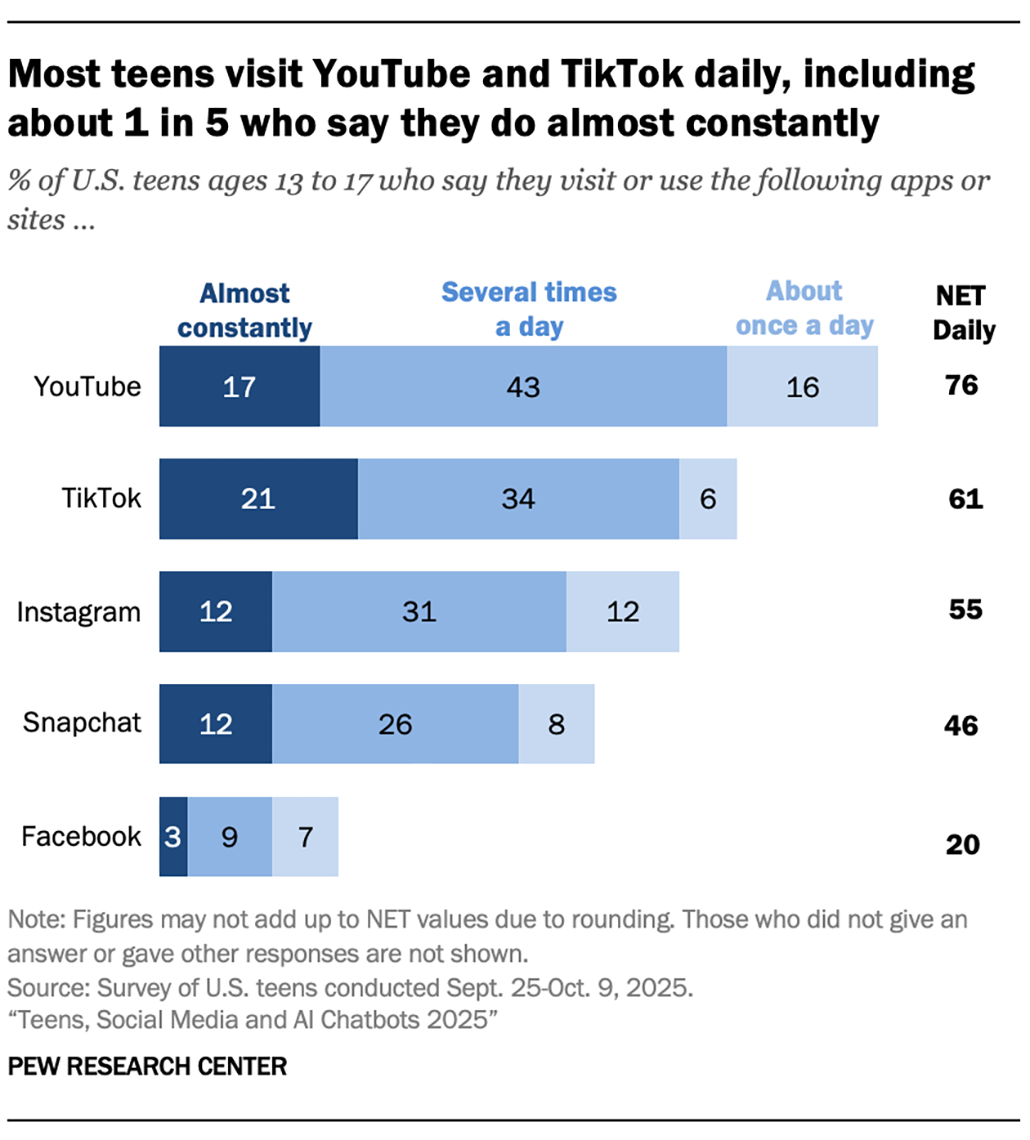
Many of our brain-molding experiences now take place on screens. In 2021, when the COVID-19 pandemic was still keeping many people home, kids ages 8 to 12 were spending an average of 5.5 hours on screens each day. That number jumped to 8.5 hours for 13- to 18-year-olds. And in a 2025 Pew Research Center survey, four in 10 U.S. teens said they are online “almost constantly.”
 Pew Research Center
Of course, you can do healthy, creative or practical things on your favorite device. You can connect with faraway family and friends, make art or play educational games. These things can help develop a healthy brain. But it’s often far too easy to get distracted and sucked into brain rot.
Like a huge bowl of candy sitting right in front of you, the apps on your phone or tablet offer up endless tempting distractions. And you don’t even have to be on your phone for it to distract you. One study found that just having your phone in the same room as you — available but not in use — can make it more difficult to think and process information.
Another study tracked what apps young people opened and used while in school. And — spoiler alert — educational tools were at the very bottom of the list. Instead, “the top apps were social media, YouTube videos and video gaming,” says Jason Nagata. He led the research. He’s also a doctor who specializes in teen health and digital media at the University of California, San Francisco.
 As you scroll through TikTok, YouTube and many other popular apps, short videos, bright colors and shocking headlines compete for your eyeballs. Many experts argue that consuming media in this way leads to shorter attention spans.lixu/iStock Unreleased/Getty Images Plus
Addicted to screens?
If you’ve ever wanted to put down your device but felt like you couldn’t, you’re not alone.
Social-media apps, chatbots and most video games are designed to keep you engaged. This can lead to symptoms similar to those seen with addiction to drugs or alcohol, says Nagata. In one 2021 study of almost 500 16- to 19-year old students in India, more than one in every three showed signs of addiction to their phones. These included feeling pain in their wrists while using their phone or constantly checking for updates on social media.
Addictive — or at least habit-forming — smartphone use also interferes with sleeping, studying and friendships.
 After Emma Lembke overcame what she describes as a social-media addiction, she launched the Log Off Movement. At this spring 2025 event at Washington University in St. Louis, Mo., she and other young people wrote their reasons for taking breaks from their devices on sticky notes.LOG OFF Movement
Emma Lembke knows those signs well. She first joined Instagram at age 12. Soon, she found herself “scrolling mindlessly for hours, addicted to gaining a certain number of likes, a certain number of comments.” She often wanted to stop — but couldn’t. It left her feeling guilty and ashamed.
The Log Off Movement uses its Instagram account to share tips on how young people can use tech more mindfully. In this video, a teen named Tariq reads a poem he wrote. One powerful line: “We didn’t truly live. We lived vicariously through clips of the curated lives of others.”
That compulsion wasn’t really her fault. Choosing to put down or ignore a bowl of candy or a tempting device requires using a brain area called the prefrontal cortex. Among other things, it deals with “self-management and impulse control,” explains Perry. But this brain area doesn’t develop fully until relatively late in adolescence. And adolescence may stretch all the way to our early 30s, new data suggest.
So it’s harder for young kids or teens to control their screen use than it is for adults, says Torkel Klingberg. This neuroscientist at the Karolinska Institute in Stockholm, Sweden, studies how kids’ brains develop.
In addition, teen brains respond strongly to rewards. Likes and comments activate the same reward pathways in the brain as chocolate or winning money, research has shown. This sensitivity normally decreases as teens age. But when young people checked social media constantly, one study found, their brains remained highly sensitive to rewards.
Eventually, at age 15, Lembke managed to make a change. She started by deleting the Instagram app from her phone. “I felt really freed,” she says.
Two years later, in 2020, she founded the Log Off Movement. It empowers young people to think critically and make mindful decisions about how they engage with social media and other online content.
Her group is now launching a newsletter called The Feed. Tweens and teens can use it to share stories about their struggles with screen time.
In Lembke’s case, deleting Instagram didn’t undo changes that had already happened in her brain. Her early compulsive social media use left “deep scars,” she says. In college, she struggled with an eating disorder. She thinks it was largely due to images and interactions she experienced on Instagram as a young girl. She says they had changed “the relationship I had with myself and my body.”
Cause and effect
Personal stories and activism help bring attention to an issue like problematic social media or phone use. But it takes scientific research to understand how screens might alter a teen brain. Researchers have to tease apart the effects of screens and normal changes during development.
Scientists Say: Correlation and Causation
One very important research project is known as the ABCD study. Those letters are short for Adolescent Brain Cognitive Development. It’s been collecting data from more than 11,500 U.S. kids since 2017. At its start, they were all 9 or 10 years old. Each year since then, these young people and their parents answer surveys about their health and screen use. And every other year, the participants go through medical tests. These include a brain scan.
In 2025, Nagata and his team reviewed what scientists learned from the ABCD data. They linked higher amounts of screen time to a higher risk of numerous health issues. These included depression, attention deficit/hyperactivity disorder (ADHD) and eating disorders.
It’s one thing to link health problems and screen time. It’s far tougher to show one causes the other. Here, following the same teens over a course of several years helps. Researchers can study whether more screen time actually leads to health problems at some later date.
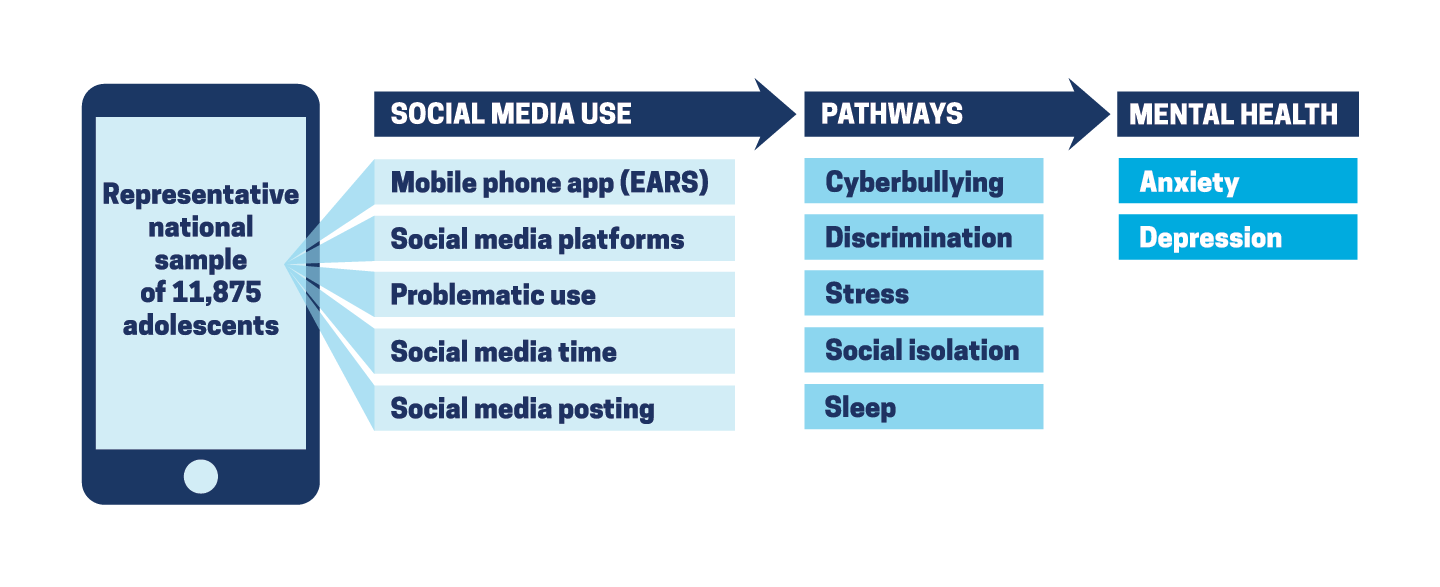 How can scrolling on a phone lead to mental health problems? Experts have identified several pathways. Even if you don’t encounter bullying, using a phone instead of studying or sleeping or hanging with friends can increase your level of stress and isolation.J. Nagata
Nagata’s team used a subset of the ABCD data to see what happened to kids and teens with problematic patterns of phone and social-media use. One year later, these young people were more likely than their peers to experience depression, attention issues, sleep problems and several other health issues. The team shared its findings February 11 in the American Journal of Preventive Medicine.
Klingberg, at the Karolinska Institute, was part of a team that analyzed four years’ worth of ABCD data. Rising social-media use led to a greater likelihood of attention problems over the course of four years, they found. But the opposite was not true. Attention problems did not lead to more social-media use. They reported these findings January 16 in Pediatrics Open Science.
Klingberg’s group also looked at brain scans collected by the ABCD study. High social-media use — around two hours per day or more — slightly stunted the development of one part of the brain, these showed. It was a very small effect, Klingberg notes. But “the trend was towards increasing changes.” So over the next few years, he expects to see an even stronger effect.
That brain region, the cerebellum, has many different roles. It’s important for body control, language and emotions. But it also “has been linked to attention before,” Klingberg points out. So this brain change could help explain attention issues experienced by teens who increase their social-media use.
Importantly, social media was the only screen use showing a negative impact on brain development in this study. Video games can actually help make kids smarter, Klingberg’s previous research has shown. He cautions, however, that gaming might still pose some risks. One example, he says, might be “if you get so hooked that you can’t control the amount of gaming.”
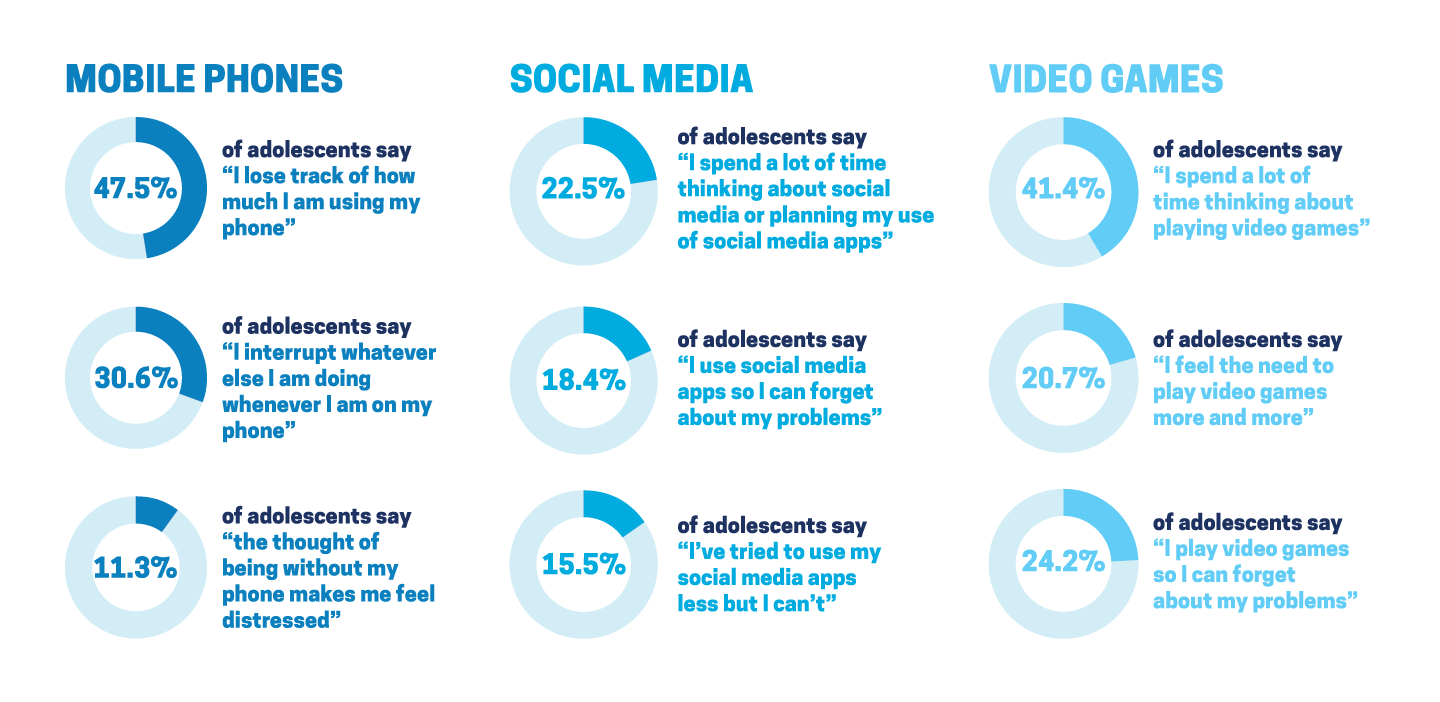 If you agree with any of these statements, you’re not alone. A huge number of children and teens have unhealthy or problematic relationships with their screens.Jacqueline Hur
Your brain on ChatGPT
New types of brain rot pop up and spread quickly. Chatbots such as ChatGPT — which use AI to answer questions — now have some experts concerned.
Using AI to do work for you could be a new form of brain rot. It might also prove especially harmful to adolescents, whose brains are undergoing a natural rewiring.
Last year, researchers put this theory to the test in people 18 to 39 years old. They measured brainwaves as these people wrote essays during four sessions over a four-month period. One group couldn’t use any tools for help. A second group had access to Google. The last group used ChatGPT.
Those using ChatGPT lagged behind the others in their level of brain activity and their ability to remember the essays they’d written. Researchers shared these new findings last June on arXiv.org.
Your brain “doesn’t really struggle when you use [chatbots],” explained study author Nataliya Kosmyna in a podcast. She’s a neuroscientist and expert in human-computer interactions at the Massachusetts Institute of Technology in Cambridge.
Chatbots may make learning feel easy — but it’s shallow
A second team compared brain activity in adults and young children as both used ChatGPT. Among the kids, control systems in their brains turned on even less than they did in adults, the team reported last November on arXiv.org. This suggests chatbots could pose a danger to kids’ brain development, concludes Tzipi Horowitz-Kraus. This neuroscientist at the Johns Hopkins School of Medicine in Baltimore, Md., was an author of that study.
Because neither group’s findings have yet gone through peer review, they’re considered preliminary. However, a peer-reviewed study from October 2025 compared how much people learn when using either Google or a chatbot to research a topic. Those using Google were able to explain their topic more deeply and thoroughly.
When you get an easy answer from AI, worries Horowitz-Kraus, “you’re not developing the basic skills that you need in order to perform as an adult in this world.” She points out that you go to the gym to stretch your muscles. Your brain, she says, also needs to work and stretch. Brain work involves “asking questions,” she notes. It should also include “looking at the world, running outside after birds and cats and dogs and playing with your friends.”
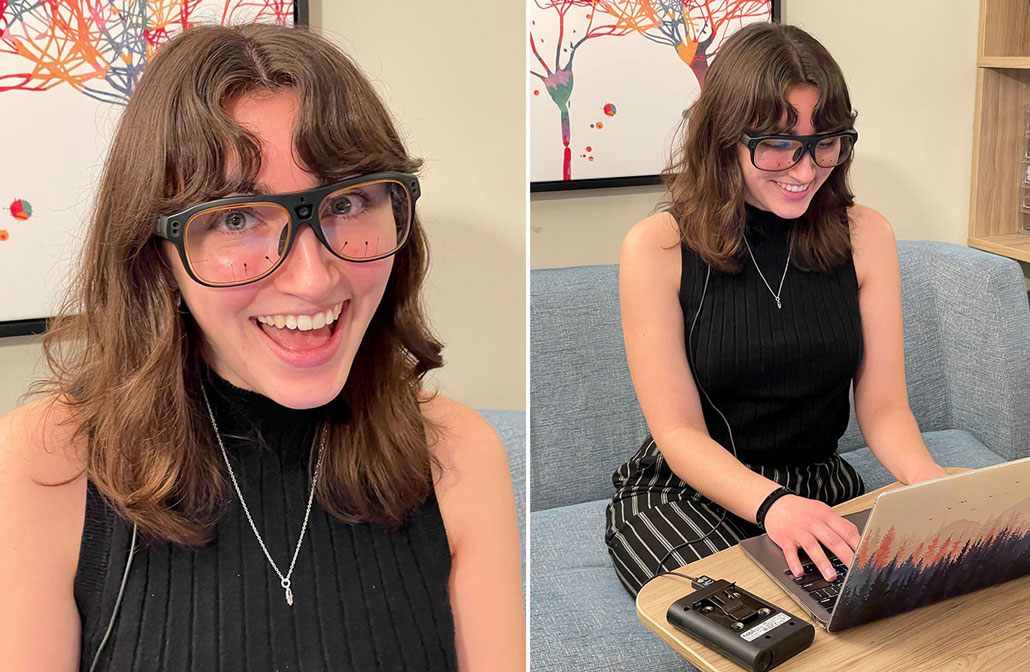 Caroline Cahill of the Winston Center on Technology and Brain Development shows off a pair of glasses that track eye movements. “This allows researchers to see what people are paying attention to in everyday situations,” she says, “[like] during a Zoom call or while scrolling on social media.” Winston Center on Technology and Brain Development
Adapt and fight back
If everyone grows up gobbling brain rot, any problems it causes with thinking or attention or mental health could become an epidemic, says Klingberg.
“If we have constant distractions in the entire population year after year, we will have long-term effects,” he worries. “We will have cognitive decline.”
New study links early smartphone ownership to health risks
That sounds scary. But don’t expect a brain-rotted zombie apocalypse any time soon.
“Children adapt to new media quickly,” says Susanne Baumgartner. This media psychologist studies how people use technology at the University of Amsterdam in the Netherlands. Teens who use their phones a lot while also doing other things will say they can’t focus, her research finds. However, when they are not trying to multitask, they can still focus as well as their peers. This suggests to her that screens impact kids’ motivation to pay attention, not their ability to do so.
We will adapt and maintain our intelligence and ability to focus, she believes. So, she concludes, brain rot “does not completely ruin your brain.”
Still, Baumgartner notes, brain rot can easily steal two hours of your day. And that’s a big problem if that screen time is replacing things such as homework, sports, sleep or social time. In many cases, it’s not brain rot itself that’s hurting kids, but the healthy activities they’re missing out on while they zombie scroll.
Lembke agrees. The Log Off Movement is not about completely removing yourself from the online world, she says. That’s just not practical. Rather, she says, it’s about building a relationship with technology “that serves you.” You should be choosing how and why to engage with your screens, she says — “not just be consuming brain rot.”
 Screen time can be healthy, especially if you’re using a device socially or for creative or educational projects. “If you’re using media in a way that’s making you feel better about yourself, so that you’re learning, you’re connecting with people, that’s great,” says Jason Nagata. Klaus Vedfelt/DigitalVision/Getty Images Plus
Nagata agrees. “If you’re using media in a way that’s making you feel better about yourself, so that you’re learning, you’re connecting with people, that’s great,” he says. “If you feel bad about the content that you’ve been seeing, then that is maybe a signal [to stop].” And if you feel like you can’t stop, talk to your doctor or another trusted adult.
Stressed by tech? Here’s how to find help
In the end, though, it’s not fair to put total responsibility for managing screen time entirely on young people — especially since their brains haven’t fully developed the wiring to do this. Perry and Lembke argue that tech companies shouldn’t be allowed to sell products that harm kids’ health.
Put simply, Perry says: Addictive social media, videos or chatbots that target kids “should be illegal.” Many other adults feel that way as well. It explains a host of more than 1,500 lawsuits now moving through U.S. courts.
This past February, the first of these went to trial in a Los Angeles courtroom. The algorithm that sends out feeds on Instagram and other social media, it argues, is addicting children and teens to an unhealthy use of screens.
A February 11 news story at CNN explained that this first trial will be an important test. It will show whether U.S. courts may agree with claims that social media companies have harmed kids’ mental health.
In the meantime, another group that Lembke co-founded, Design it For Us, is working toward establishing new laws and rules that would make this tech safer for kids and teens.
Power Words
activate: (in biology) To turn on, as with a gene or chemical reaction.
addiction: The National Institute of Drug Abuse defines this as a complex chronic disorder that is characterized by a difficult-to-control compulsion to use some drug, despite knowing that it will likely have harmful impacts. A first exposure to these drugs is usually voluntary. But repeated use of certain ones, NIDA explains, can create “changes to brain circuits involved in rewards, stress, and self-control.” Those changes can make it very hard to resist the urge to continue using drugs. The term has also been expanded to some behaviors that become dangerous and/or excessive, such as gambling, shopping, video gaming or scrolling through social media.
addictive: An adjective to describe something that become habit-forming in an uncontrolled or unhealthy way. This can include a drug or some habit (such as video game playing or uncontrollable “doom-scrolling” on smartphones). Such addictions reflect an illness triggered by brain changes that occur after using some drugs or engaging in some extremely pleasurable activities. People with an addiction will feel a compelling need to use a drug (which can be alcohol, the nicotine in tobacco, a prescription drug or an illegal chemical such as cocaine or heroin), even when the user knows that doing so risks severe health or legal consequences.
adolescence: A transitional stage of physical and psychological development that begins at the onset of puberty, typically between the ages of 11 and 13, and ends with adulthood. People undergoing this transition are known as adolescents.
algorithm: A group of rules or procedures for solving a problem in a series of steps. Algorithms are used in mathematics and in computer programs for figuring out solutions.
anxious: (n. anxiety) A feeling of dread over some potential or upcoming situation, usually one over which someone feels they have little control.
app: Short for application, or a computer program designed for a specific task.
attention: The phenomenon of focusing mental resources on a specific object or event.
average: (in science) A term for the arithmetic mean, which is the sum of a group of numbers that is then divided by the size of the group.
brain scan: A technique to view structures inside the brain, typically with X-rays or a magnetic resonance imaging (or MRI) machine. With MRI technology — especially the type known as functional MRI (or fMRI) — the activity of different brain regions can be viewed during an event, such as viewing pictures, computing sums or listening to music.
brainwave: An electrical signal produced through the coordinated activity of billions of neurons in the brain of an animal. When charted, the signal typically looks wavy or spiky.
chatbot: A computer program created to seemingly converse with human users. Modern ones (such as Siri, Alexa, Ocelot and Sprinklr) can retrieve information over the internet about news events or classroom topics. Many even work as digital assistants to answer questions about purchases, products or scheduling on behalf of stores, pharmacies or banks.
cognitive: A term that relates to mental activities, such as thinking, learning, remembering and solving puzzles.
cortex: The outermost part of an organ, such as the kidney or brain. Or the outer part of some microbes or plant, such as a tree’s bark or a mango’s rind.
depression: (in medicine) A mental illness characterized by persistent sadness and apathy. Although these feelings can be triggered by events, such as the death of a loved one or the move to a new city, that isn’t typically considered an “illness” — unless the symptoms are prolonged and harm an individual’s ability to perform normal daily tasks (such as working, sleeping or interacting with others). People suffering from depression often feel they lack the energy needed to get anything done. They may have difficulty concentrating on things or showing an interest in normal events. Many times, these feelings seem to be triggered by nothing; they can appear out of nowhere.
develop: (n. development) To emerge or to make come into being, either naturally or through human intervention, such as by manufacturing. (in biology) To grow as an organism from conception through adulthood, often undergoing changes in chemistry, size, mental maturity or sometimes even shape.
digital: (in computer science and engineering) An adjective indicating that something has been developed numerically on a computer or on some other electronic device, based on a binary system (where all numbers are displayed using a series of only zeros and ones).
distraction: Any event or situation that draws someone’s attention away from whatever had been his or her main focus. Distractions can be external events, such as sounds or sights; or they can be internal events, such as thoughts or emotions.
eating disorder: An illness of the mind involving dangerously unhealthy patterns of eating and weight loss or gain.
epidemic: A widespread outbreak of an infectious disease that sickens many people (or other organisms) in a community at the same time. The term also may be applied to non-infectious diseases or conditions that have spread in a similar way.
host: (v.) The act of providing a home or environment for something. A website, for instance, could host photos, news or other types of information.
impair: (n. impairment) To damage or weaken in some way.
intelligence: The ability to collect and apply knowledge and skills.
link: A connection between two people or things.
meme: Any idea, phrase, image or aspect of culture that spreads from person to person — often virally — and usually via conversation or social media.
mental health: A term for someone’s emotional, psychological and social well-being. It refers to how people behave on their own and how they interact with others. It includes how people make choices, handle stress and manage fear or anxiety. Poor mental health can be triggered by disease or might reflect a short-term response to life’s challenges. It can occur in people of any age, from babies to the elderly.
neuroscientist: Someone who studies the structure or function of the brain and other parts of the nervous system.
online: (n.) On the internet. (adj.) A term for what can be found or accessed on the internet.
pediatrics: A field of medicine that has to do with children and especially child health. A doctor who works in this field is known as a pediatrician.
peer: (noun) Someone who is an equal, based on age, education, status, training or some other features. (verb) To look into something, searching for details.
peer review: (in research) A process in which experts in a field carefully read and critique the work of their peers before it is published in a research journal. Peer review helps to prevent sloppy science and bad mistakes from being published.
plasticity: Adaptable or reshapable. (in biology) The ability of an organ, such as the brain or skeleton to adapt in ways that stretch its normal function or abilities. This might include the brain’s ability to rewire itself to recover some lost functions and compensate for damage.
podcast: A digital audio or video series that can be downloaded from the Internet to your computer or smartphone. Some podcasts also are shows that are broadcast on radio, television or other media.
population: (in biology) A group of individuals (belonging to the same species) that lives in a given area.
psychologist: A scientist or mental-health professional who studies the mind, especially in relation to actions and behaviors. Some work with people. Others may conduct experiments with animals (usually rodents) to test how their minds respond to different stimuli and conditions.
reward: (In animal behavior) A stimulus, such as a tasty food pellet, that is offered to an animal or person to get them to change their behavior or to learn a task.
risk: The chance or mathematical likelihood that some bad thing might happen. For instance, exposure to radiation poses a risk of cancer. Or the hazard — or peril — itself. (For instance: Among cancer risks that the people faced were radiation and drinking water tainted with arsenic.)
smartphone: A cell (or mobile) phone that can perform a host of functions, including search for information on the internet.
social media: Digital media that allow people to connect with each other (often anonymously) and to share information. Examples include Twitter, Facebook, Instagram, TikTok and WhatsApp.
survey: To view, examine, measure or evaluate something, often land or broad aspects of a landscape. (with people) To ask questions that glean data on the opinions, practices (such as dining or sleeping habits), knowledge or skills of a broad range of people. Researchers select the number and types of people questioned in hopes that the answers these individuals give will be representative of others who are their age, belong to the same ethnic group or live in the same region. (n.) The list of questions that will be offered to glean those data.
symptom: A physical or mental indicator generally regarded to be characteristic of a disease. Sometimes a single symptom — especially a general one, such as fever or pain — can be a sign of any of many different types of injury or disease.
system: A network of parts that together work to achieve some function. For instance, the blood, vessels and heart are primary components of the human body’s circulatory system. Similarly, trains, platforms, tracks, roadway signals and overpasses are among the potential components of a nation’s railway system. System can even be applied to the processes or ideas that are part of some method or ordered set of procedures for getting a task done.
theory: (in science) A description of some aspect of the natural world based on extensive observations, tests and reason. A theory can also be a way of organizing a broad body of knowledge that applies in a broad range of circumstances to explain what will happen. Unlike the common definition of theory, a theory in science is not just a hunch. Ideas or conclusions that are based on a theory — and not yet on firm data or observations — are referred to as theoretical. Scientists who use mathematics and/or existing data to project what might happen in new situations are known as theorists.
tween: A child just approaching his or her teenage years. Tween is a term usually used for 11- to 12-year olds.
zombie scrolling: The act of mindlessly scrolling through social media or other websites. That mindlessness is what sets it apart from other online activities. Some researchers think it may be due to the brain craving novelty after becoming used to expecting dramatic digital stimulation. Such mindless viewing of digital content may diminish the brain’s ability to focus and be attentive, some studies suggest.
Citations
News: S. Sharp. Mark Zuckerberg testifies in L.A. trial over claims social media makes kids addicted. Los Angeles Times, February 18, 2026.
News: C. Kang. What to know about the social media addiction trials. The New York Times. January 27, 2026 (updated February 18, 2026).
News: New York Public Radio. The social media addiction trials begin. On the Media. February 13, 2026. Audio available; written transcript here.
News: S. Delouya and C. Duffy. Instagram chief denies social media can be ‘clinically addictive’ in landmark case. CNN. February 11, 2026.
Journal: J.M. Nagata et al. Prospective associations between early adolescent problematic screen use, mental health, sleep, and substance use. American Journal of Preventative Medicine. Published online February 11, 2026. doi: 10.1016/j.amepre.2025.108248.
Journal: S. Nivins et al. Digital media, genetics, and risk for ADHD symptoms in children: A longitudinal study. Pediatrics Open Science. Vol. 2, January 16, 2026. doi: 10.1542/pedsos.2025-000922.
Journal: J.M. Nagata et al. Smartphone use during school hours by US youth in the adolescent brain cognitive development study. JAMA. Vol. 335, January 5, 2026, p. 453. doi: 10.1001/jama.2025.23235.
Report: M. Faverio and O. Sidoti. Teens, social media and AI chatbots 2025. Pew Research Center. December 9, 2025.
Journal: A. Mousley et al. Topological turning points across the human lifespan. Nature Communications. Vol. 16, November 25, 2025. doi: 10.1038/s41467-025-65974-8.
Preprint: T. Horowitz-Kraus et al. Lower engagement of cognitive control, attention, modulation networks and lower creativity in children while using ChatGPT: an fMRI study. bioRxiv.org. Submitted November 12, 2025. doi: 10.1101/2025.11.07.687207.
Journal: S. Melumad and J.H. Yun. Experimental evidence of the effects of large language models versus web search on depth of learning. PNAS Nexus. Vol. 4, October 2025. doi: 10.1093/pnasnexus/pgaf316.
Journal: E.J. Choi, E. Christiaans and E.G. Duerden. Screen time woes: Social media posting, scrolling, externalizing behaviors, and anxiety in adolescents. Computers in Human Behavior. Vol. 170, September 2025, p. 108688. doi: 10.1016/j.chb.2025.108688.
Journal: S.E. Baumgartner. On the stabilization of media effects after repeated exposure: consequences for media effects research. Communication Theory. August 5, 2025. doi: 10.1093/ct/qtaf017.
Preprint: N. Kosmyna et al. Your brain on ChatGPT: accumulation of cognitive debt when using an AI assistant for essay writing task. arXiv.org. Submitted June 10, 2025. doi: 10.48550/arXiv.2506.08872.
Journal: D.A. Christakis et al. Adolescent smartphone use during school hours. JAMA Pediatrics. Vol. 179, April 2025, p. 475. doi:10.1001/jamapediatrics.2024.6627.
Journal: A.M.F. Yousef et al. Demystifying the new dilemma of brain rot in the digital era: A review. Brain Sciences. Vol. 15, March 7, 2025, p. 283. doi: 10.3390/brainsci15030283.
Journal: M. Woodfield, M. Rich & D. Bickham. Aspects of screen media use associated with reduced hours of nightly sleep in adolescents. Journal of Adolescent Health. Vol. 76, March 2025, p. 573. doi: 10.1016/j.jadohealth.2024.11.157.
Report. B. Zablotsky et al. Daily screen time among teenagers: United States, July 2021–December 2023. National Center for Health Statistics, Hyattsville, Md. Data Brief #513. October 30, 2024. doi: 10.15620/cdc/168509.
Journal: S. Nivins et al. Long-term impact of digital media on brain development in children. Scientific Reports. Vol. 14, June 6, 2024. doi: 10.1038/s41598-024-63566-y.
Journal: M.T. Maza et al. Association of habitual checking behaviors on social media with longitudinal functional brain development.JAMA Pediatrics. Vol. 177, January 3, 2023, p. 160. doi: 10.1001/jamapediatrics.2022.4924.
Journal: B. Sauce et al. The impact of digital media on children’s intelligence while controlling for genetic differences in cognition and socioeconomic background. Scientific Reports. Vol. 12, May 11, 2022. doi: 10.1038/s41598-022-11341-2.
Report: V. Rideout et al. Common Sense census: Media use by tweens and teens, 2021. March 9, 2022. Common Sense Media. San Francisco, Calif.
Journal: D.J. Bhanderi et al. Smartphone use and its addiction among adolescents in the age group of 16–19 years. Indian Journal of Community Medicine. Vol. 46, Jan-Mar 2021, p. 88. doi: 10.4103/ijcm.IJCM_263_20.
Journal: D.A. Sbarra, J.L. Briskin & R.B. Slatcher. Smartphones and close relationships: The case for an evolutionary mismatch. Perspectives on Psychological Science. Vol. 14, April 19, 2019. doi: 10.1177/174569161982653.
Journal: L.E. Sherman et al. The power of the Like in adolescence: Effects of peer influence on neural and behavioral responses to social media. Psychological Science, Vol. 27, May 31, 2016, p. 1027. doi: 10.1177/0956797616645673.
Journal: A.F. Ward et al. Brain drain: The mere presence of one’s own smartphone reduces available cognitive capacity. Journal of the Association for Consumer Research. Vol. 2, April 2017, p. 140. doi: 10.1086/691462.
Journal: S.E. Baumgartner et al. The relationship between media multitasking and executive function in early adolescents. The Journal of Early Adolescence. Vol. 34, November 2014, p. 1120. doi: 10.1177/0272431614523133.

Kathryn Hulick is a freelance science writer and the author of Strange But True: 10 of the World’s Greatest Mysteries Explained, a book about the science of ghosts, aliens and more. She loves hiking, gardening and robots.