
Following decades of substance use and periods of homelessness, Mark Knox tested positive for HIV during a period of incarceration. When he returned home several years later, he tested positive again.
“I was on the street for a long time,” Knox said. “I just kept floating through, and, finally, I realized what was wrong.”
Knox’s second positive HIV test came from Prevention Point Philadelphia, a Kensington-based nonprofit. Knox, now 62, has been a client of Prevention Point for the past 15-20 years, receiving HIV and substance use treatment. The biggest hurdle to treatment, Knox said, is people deciding they want help.
“A lot of times, as a drug addict, you don’t want help,” Knox said. “But I finally realized that I needed it.”
Prevention Point has provided low-barrier services to residents of Philadelphia and the surrounding area since its founding in 1991 at the height of the HIV/AIDS epidemic in Philadelphia, according to Hilary Disch, communications manager at Prevention Point.
“We came about in response to the AIDS crisis, learning directly from people experiencing substance use disorder, listening to their immediate needs around prevention,” Disch said.
The organization now employs over 160 staff members, many of whom have experienced homelessness, mental health challenges or substance use in some capacity. Its motto is to meet people where they are.
With six in-house departments — medical services, behavioral health services, homeless services, community engagement and volunteer services, prevention services and a drop-in center — Prevention Point offers a wide range of services. It also aims to integrate care across departments and adopt a person-centered approach.
“Taking care of the whole person is really important to us, and making sure that people can take care of their mental health is absolutely critical to helping people towards their health-related goals and just goals they want for themselves in their life,” Disch said.
Prevention Point sees a large number of clients who are Black, Hispanic and Latinx — communities disproportionately impacted by HIV, housing instability and barriers to health care, according to Sage Touré, integrated health care case management lead.
“People of color slip through the cracks in other social services, and we, in a lot of ways, are a net that can catch them,” Touré said. “Our team is primarily people of color, too, which is great because then we can relate to our clients in ways that other social services potentially at other organizations can’t.”
In 2023, the highest rates of new HIV diagnoses in Philadelphia were among non-Hispanic Black people (38.7 per 100,000), followed by Hispanic/Latinx people (25.9) and non-Hispanic white people (11.3).
Since its founding, the organization has expanded to include drug treatment and medication for opioid use disorder; HIV, Hepatitis C and STI prevention, testing and care; primary care and wound care; shelter and housing support; and Narcan distribution and training.
Today, clients can enter through any of those doors. Someone might come in for wound care or to pick up Narcan and later be connected to housing support, substance use treatment or HIV care, according to Disch.
HIV services
As of June 30, 2024, 18,177 people were diagnosed with HIV in Philadelphia, with roughly 1,500 estimated people with HIV who are either undiagnosed or unaware of their status.
For people who test positive for HIV, support from Prevention Point begins almost immediately.
Within 92 hours of a positive test, Moses Santana, a medical case manager at Prevention Point, and his team verify lab work, gather information about a client’s housing status and other needs, and connect them to primary care if they are not already established. From there, clients can enroll in the Medical Case Management program, which currently serves about 95 people.
If someone doesn’t have insurance, Prevention Point helps get them on a plan.
“We make sure that anybody comes through here, whether they’re or housed or unhoused, if they don’t have insurance, we make sure that we can get them on insurance so that the medications are paid for, and we don’t have this rigmarole or any issues of trying to get them healthy,” Santana said.
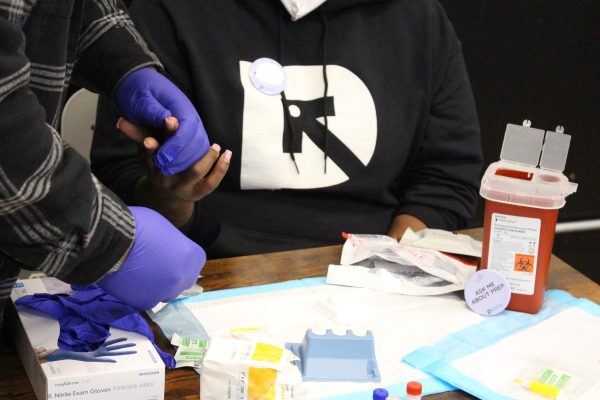 Prevention Health Care Coordinator Kareem Mims and tester Monica Hillard demonstrate an HIV test at Prevention Point Philadelphia’s HIV testing event Feb. 6.
Many clients opt for Cabenuva, a long-acting injectable HIV medication, rather than Biktarvy, a daily pill — a choice that can be especially helpful for people experiencing homelessness.
“It’s easier for them to get the injectable once every other month than to carry around a bottle of pills that they may lose or someone may steal,” Santana said.
Within the first week of starting medication, clients’ viral loads drop significantly. Within two weeks, many reach an undetectable level, meaning the virus is suppressed to the point where it cannot be transmitted to others. As long as patients remain on treatment and keep their viral load suppressed, Santana said, they can live long, healthy lives — including having children — without passing on HIV.
One of the biggest challenges for treatment, Santana said, is building trust with clients.
“A lot of people don’t trust the medical system,” Santana said. “Us going, ‘Hey, there’s medication, this injection we can give you that will help you,’ they’re kind of like, ‘It’s kind of weird that you would just offer me that off the bat.’”
To build that trust, Santana said Prevention Point tries to “roll out the red carpet” for anyone seeking services.
“You’re coming out into a place where people don’t judge you, regardless of how you look, who you love, what you believe in, whether you’re housed or unhoused,” Santana said. “Nobody judges you for that.”
Mental health support
Additionally, Santana works closely with other in-house departments to address housing, substance use and mental health needs. One of those departments is behavioral health services.
In their role in case management, Touré carries a caseload of about 20 to 25 clients, many of whom struggle with depression, anxiety or personality disorders alongside substance use.
Touré and their team connect clients to mental health providers, coordinate care with other departments and help address barriers that might prevent someone from staying engaged in treatment.
“Everything that we do, in some way, is going to impact our clients’ health,” Touré said. “If they’re not housed, we get them housed … If we can get them into primary care, they’re going to have better health outcomes. So, there’s a lot that we do that all eventually ties back into their health.”
Philadelphia faces a significant shortage of behavioral health providers, particularly those experienced in working with people who have substance use disorder or chronic mental illness.
As of 2019, Pennsylvania had a ratio of 600 patients to one mental health care professional and is expected to face a shortage of more than 6,300 mental health professionals by this year.
“Finding those good providers is always the struggle for us,” Touré said. “But once we do, we can get really good relationships with them so we can keep that connection happening, so we can get other people connected to those providers.”
Over a decade after his positive test, Knox is now an ambassador for Prevention Point’s services and helps others who are also HIV-positive by sharing his story and encouraging people not to wait to seek care.
“If you have this disease, there are people out there that will help you,” Knox said.
Knox spoke at Prevention Point’s HIV testing event Feb. 6 in honor of National Black HIV/AIDS Awareness Day, where he expressed his gratitude for Prevention Point.
“Prevention Point saved my life,” Knox told the audience at the event. “I’m proud to be part of this.”
This is the fourth story in a series by Cara Santilli ’24, M.A. ’26, about social issues affecting the Philadelphia community, how the media reports on those issues and what the community can do to help.
Members of the St. Joe’s community seeking support are encouraged to contact the following resources:
Counseling and Psychological Services (CAPS), 610-660-1090
Campus Ministry, 610-660-1030
The Office of Student Outreach & Support, 610-660-1149
The Jesuit community, 610-660-1400
Employee Assistance Program, 866-799-2728
 GRAPHIC: ANASTASIA KUNICKA ’28, LUKE SANELLI ’26 AND CARA SANTILLI ’24, M.A. ’26/THE HAWK