
Thursday, March 19, marked the 78th day of Zohran Mamdani’s term as mayor. amNewYork is following Mamdani around his first 100 days in office. We are closely tracking his progress on fulfilling campaign promises, appointing key leaders to government posts, and managing the city’s finances. Here’s a summary of what the mayor did.
Mayor Zohran Mamdani moved one of his core campaign promises closer to reality Thursday, as he created the new Office of Community Safety via executive order, which will initially focus on reshaping the city’s response to mental health crises.
Newly-appointed Deputy Mayor for Community Safety Renita Francois — the latest veteran of the de Blasio era to join Mamdani’s City Hall, and the first Black deputy mayor to become part of his administration — will be tasked with assessing how programs like B-HEARD (the city’s 911 response protocol to mental health events) can be expanded and better supported.
Speaking at City Hall after signing the executive order creating the office and naming Francois to the new post, Mamdani cast the move as the administration’s first concrete step toward the broader Department of Community Safety he promised on the campaign trail — pitched as a $1.1 billion city agency that would take over several responsibilities from the NYPD related to mental health emergencies, victims’ services and gun violence.
Signing the order surrounded by supporters in the City Hall Rotunda on March 19, the mayor said the city could not afford to wait for a longer legislative or charter process and argued that New Yorkers in crisis have too often been met with a patchwork of city programs and an overreliance on police.
Yet specifics on how the Office of Community Safety would achieve its stated objectives remained rather light Thursday.
Pressed on whether the move would actually change how the city handles 911 calls involving people in psychiatric distress, Mamdani said Francois’ first job would be to assess which existing programs have been “hamstrung,” how they can be expanded and what policy changes are needed to better support them. He said the office would bring more policy focus to B-HEARD, the city’s civilian crisis-response program, which he described as underfunded and under-supported.
Mamdani also did not offer a specific timeline or target for how many calls might ultimately be diverted away from the NYPD. Instead, he said the administration first needs to determine where existing programs have capacity, where they do not and what investments are necessary to make them work at scale.
Francois echoed that approach, saying the city already has expertise and programs in place but lacks a cohesive strategy and that building one “is not going to happen tomorrow.”
The appointment also gives Mamdani his administration’s first Black deputy mayor, after criticism that his senior administration lacked Black representation more than three months into his tenure.
Francois said the city already has “incredible programs and expertise,” but argued they too often operate “without a cohesive strategy,” adding that the administration wants to build “well coordinated responses rooted in dignity and care.”
What Community Safety order means for city government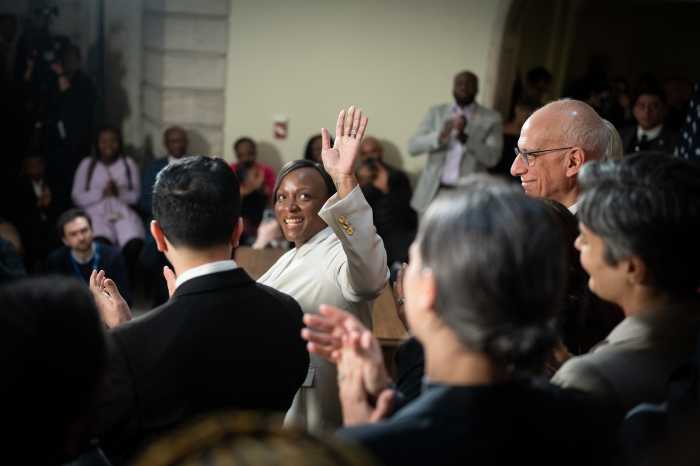 Francois previously served as Executive Director of the Mayor’s Action Plan for Neighborhood Safety within the Office of Criminal Justice under Mayor Bill de Blasio
The executive order establishes the Office of Community Safety within the Mayor’s Office and outlined that it will be headed by a commissioner appointed by the mayor who will report to the deputy mayor for community safety. The order took effect immediately upon Mamdani signing it Thursday; while Francois took office immediately in her deputy mayor role, the new commissioner has yet to be appointed.
An organizational chart released by City Hall shows the new office sitting beneath the deputy mayor and above three divisions: Neighborhood Safety, Community Mental Health and Strategic Initiatives. Mamdani said the neighborhood safety division will oversee violence prevention, hate-crime prevention, domestic and gender-based violence prevention, gun violence prevention and survivor services, while the community mental health division will manage crisis-response policy, including B-HEARD.
A source familiar with the administration’s plans said the new community safety portfolio will initially encompass about $260 million in already allocated funding tied to the programs and agencies now under its umbrella. Additional funding is expected to be proposed in the executive budget, with the final amount shaped by Francois’ review as budget season continues.
The order gives the new office broad coordinating authority.
It allows the Office of Community Safety to develop citywide strategies, supervise and coordinate several existing offices, collect data and briefings from agencies, convene interagency committees, review community safety programs across government and make budget recommendations to the first deputy mayor. It also gives the commissioner contracting authority and directs city agencies to cooperate with the office and provide relevant information, to the extent permitted by law.
In the mental-health space specifically, the order directs the office to coordinate citywide crisis-response programs, including B-HEARD, and to oversee policy development, implementation and service-delivery metrics. But B-HEARD itself will remain under the control of NYC Health + Hospitals and the Fire Department, leaving the new office to shape policy and strategy rather than directly run the program.
The order also brings several existing entities under the new structure, including the Office of Crime Victim Services, the Office of Gun Violence Prevention, the Office to End Domestic and Gender-Based Violence, the Office for the Prevention of Hate Crimes and the Office of Community Mental Health. It also amends the city’s gun violence prevention structure so the task force will be co-chaired by the commissioner of community safety and a community representative appointed by the mayor.
Mamdani said the office will also invest in community-based violence interruption programs and expand the city’s Crisis Management System.
Reaction to Mamdani’s Community Safety order
The move comes after months of pressure on Mamdani to begin delivering on his promise to create a Department of Community Safety, particularly after the Jan. 25 police shooting of Jabez Chakraborty, a 22-year-old Queens man whose family had sought help during a mental-health crisis.
The Legal Aid Society praised Thursday’s announcement, calling the office “a critical step toward reforming a system that has long relied too heavily on criminalization and incarceration to respond to New Yorkers in crisis.” The group said the office should help divert crisis response away from NYPD officers and toward peer-led teams with expertise in mental health, substance use and housing access.
A spokesperson for Speaker Julie Menin said the speaker believes “NYPD officers are asked to take on too much responsibility” and supports reducing the city’s reliance on police in responding to mental-health calls, but said she would “thoroughly review proposals aimed at safely achieving that goal.”
Police Commissioner Jessica Tisch, who was not at Thursday’s announcement, said in a statement that “keeping New Yorkers safe requires more than one approach” and that she looked forward to working with Francois “to ensure New Yorkers get the supports they need, while our officers remain focused on the work they are trained to do.”
On Wednesday, during a budget hearing before the executive order was public, Tisch said the proposal of a full agency had been part of ongoing conversations with City Hall while declining to offer a broader assessment. But when lawmakers pressed her on whether a new Department of Community Safety would come at the NYPD’s expense, her response was unequivocal: “No.”
In January, Brooklyn Council Member Lincoln Restler reintroduced legislation to create Mamdani’s Department of Community Safety after first filing the bill in December with more than two dozen co-sponsors. The measure would establish a new agency led by a commissioner, require at least one office in each borough and assign the department responsibilities including responding to some emergency calls in coordination with law enforcement and medical services, conflict mediation, safety patrols and oversight of contracts for alternatives-to-incarceration, reentry and supervised release programs.
It was referred to a committee on Jan. 29 and has not progressed since.
A City Council source told amNewYork it was not clear until The New York Times reported Wednesday that the administration planned to pursue the initiative through executive order rather than legislation, and said Council leaders had not received a formal proposal to create a full department.
The source said the Council was still waiting for the administration to spell out how such a department would be structured and funded, and disputed the idea that lawmakers had blocked a plan that had never been formally presented. The source said Restler’s bill sets out a legislative framework, but that the administration would still need to provide more detail before the proposal could move forward.
Restler’s office did not respond to requests for comment.