
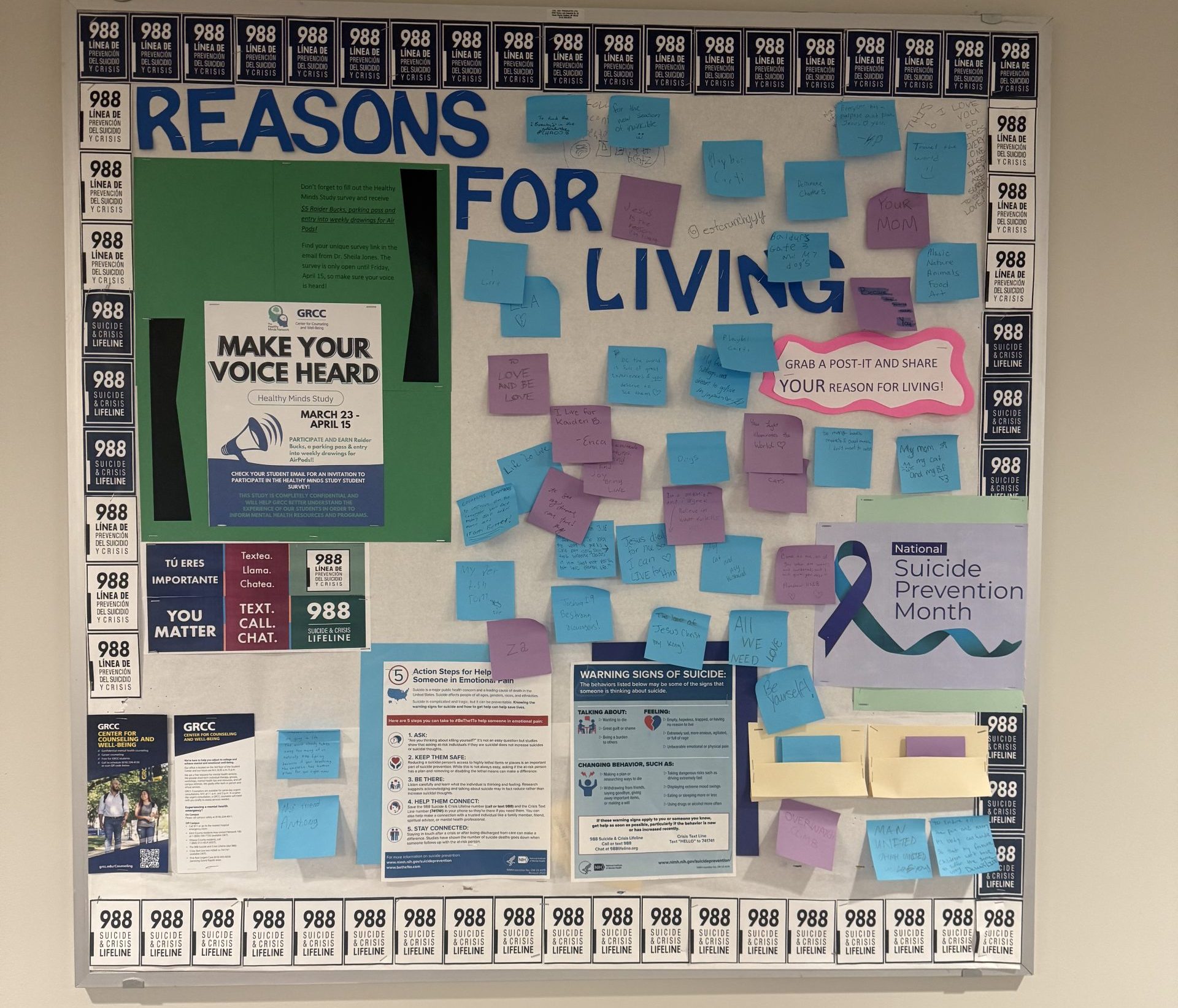
 Photo of Reasons for living board. Ella Ware/ The Collegiate
By Ella Ware
When prompted to write their reasons for living on a suicide prevention bulletin board on campus at Grand Rapids Community College, students had a wide variety of answers.
Animals, religion, family, friends, and new movies, music, and video games were common.
The poster advertised the Center for Counseling and Well-Being at GRCC, as well as the Suicide and Crisis Lifeline. It shared the warning signs of suicide and action steps for helping someone in a mental health crisis. Poor mental health can have significant adverse effects on students. The GRCC Counseling Center and Well-Being offers resources for students experiencing stress and crisis, and provides guidance on coping skills.
Becca Lovell is a counselor at Grand Rapids Community College.
“I think it’s important to acknowledge that a lot of what we’re seeing in the world right now is the result of systemic issues that aren’t always something that we can or should have to cope with,” Lovell said. “What we’re seeing in the world is really distressing, so it’s normal and reasonable for students to experience symptoms of anxiety or depression, or have other strong reactions to the distress.”
Ways to Cope
Lovell emphasized that there are things students can do to care for themselves amidst the difficult times.
“For example, for students, sometimes focusing on long-term goals can be a helpful distraction. It’s a way to keep minds engaged on tangible tasks that they have control over. Some folks find a lot of power in volunteering or participating in activities that support causes that they’re passionate about or fight for changes that they would like to see. Prioritizing time with loved ones or engaging in activities that give them joy can also be helpful. And of course, resources like therapy as a space to not necessarily cope, but process through thoughts and feelings.”
There are multiple ways to utilize the Counseling Center to its fullest potential, Lovell said.
“Some ways that students can utilize our center is by taking advantage of the free counseling services that we offer, attending free workshops, and events that we offer. Students can also utilize online mental health screening tools on our website.”
Recently, additional services have become available at the center as well.
“Something new that our center has offered that students can take advantage of is to apply to be either a peer educator, or a part of our department student advisory council. Students can also request someone from our department to come facilitate a mental health-related workshop or discussion to their club or organization. And then, we also have what’s called “Let’s Talk”, which is kind of like a walk-in informal, casual way for students to talk through maybe some short-term specific problems, learn about resources, or explore some solutions to things they may be experiencing,” she said.
She explained that these options could be a great resource for students who are unsure about counseling, or could benefit from support without necessarily signing up for formal counseling.
Lovell said that the Counseling Center has seen multiple ways that mental health can affect how students perform in classes, as well as how they function in day-to-day living.
 GRCC Center for Counseling and Well-Being Assistant Professor & Counselor, Rebecca Lovell. Kole Meschke/ The Collegiate Kole Meschke | The Collegiate Live
“I think we have seen that mental health and how the student is managing their mental health impacts their experience in their classes. Mental health can impact a student’s capacity to manage just, like, everyday responsibilities that come from being in college, and trickles into their experience in class. For example, folks may have decreased motivation or increased procrastination or perfectionism, which could impact their ability to start assignments or get themselves to class. And folks who are struggling with their mental health could also be neglecting basic needs, like sleep, or diet, or exercise. And that can impact their ability to focus or concentrate in class or (on) assignments.”
She added that mental health struggles can lead to isolation, social withdrawal, or avoidance. These are symptoms that could prevent students from seeking academic help from their professors, tutors, or peers, as well as from connecting with their friends or family. This is detrimental to academic and everyday life.
Reasons to Live
There are things students can do to keep themselves motivated and hopeful in difficult times.
In honor of suicide prevention month in September, GRCC students took the opportunity to share some reasons for living on post-it notes stuck to a poster board.
“My pet fish Tom,” one student wrote.
Others cited their mothers, significant others, dogs, baby cats, favorite television shows, Jesus Christ, and dreams to live in Japan, among other things.
Becca Lovell explained some tips for staying optimistic and coping with stress, although she said it varies depending on a student’s unique life experience and circumstances.
“Staying hopeful and motivated, it comes in waves,” she said. “Striving for balance between our individual lives and the external world we’ve seen can be helpful for some students. This could involve things like monitoring the time spent reading the news and kind of redirecting focus to the comforting aspects of our lives, like our hobbies that give us joy, or relationships so we feel loved and supported. Prioritizing what students can control and focusing on basic elements of self-care like diet, sleep, physical activity, social connection, that kind of stuff.”
Lovell said focusing on long-term goals and identifying things that they’re looking forward to, no matter how big or small they may seem, can be helpful.
“But, I think it’s normal to not feel helpful or motivated all the time. Sometimes it’s okay to disconnect. Simply validate the feelings that you’re noticing, or the challenges that you’re experiencing. That’s really normal, you know.”
Getting Help in a Crisis
If a student is experiencing a mental health crisis or suicidal thoughts, there are many options and resources available. Lovell says that it depends on what feels most safe, accessible, and comfortable for the individual student. For some students, that may be reaching out to a trusted person in their community or a loved one. This could be a family member, friend, a leader in their community, or someone at a church or mosque. For others, reaching out to a mental health professional may feel more comfortable.
“If students are on GRCC’s downtown campus and feel they are in crisis, they are welcome to utilize our department’s brief same-day urgent walk-in consultations. We have that Monday through Friday between 9 a.m. and 4 p.m. in the student center on the third floor. The students can drop in.”
If students need help off-campus, Lovell added that there is the Behavioral Crisis Center in Downtown Grand Rapids providing mental health services regardless of insurance or lack thereof, that’s located right down the street from campus. If students are in Ottawa County or the Lakeshore, there’s also Holland Hospital Behavioral Health Services that is available 24/7. If students are unable to transport themselves somewhere in person, reaching out could look like contacting 988, the 24-hour Suicide and Crisis Lifeline.
“For the students who are reading this article, anything that they read about what is shared or if they have follow-up questions or concerns, or perhaps they want to learn more… they can always stop by our office and talk to any of our counselors,” Lovell said. “Students are always welcome to reach out and connect with us. We’re always happy to help and continue the conversation.”