
Sandra Chaffin’s heart was broken 13 years ago when she learned her 22-year-old grandson, Aaron Gower, was found unresponsive at University Behavioral Health of Denton. Three weeks had passed since she’d convinced him to admit himself voluntarily. He had been struggling with depression since shortly after Christmas, she says. He wasn’t bathing, eating or studying at North Central Texas College. He even quit playing video games.
He had been staying with his grandparents at their cabin in Marietta, Oklahoma. Chaffin says he seemed down and different. A few weeks after Christmas, he told her he had spoken with his great-grandparents, who were dead.
“‘Well, Granddaddy, he said, ‘Aaron, you’re just like me,’” Chaffin recalls Aaron saying. “‘My daddy was a schoolteacher and a very smart man. He believed in education.’”
Then Aaron told her, “Mimi spoke with me … and said, ‘If you go with them, they will kill you.””


Aaron Gower, who died in February 2013 at the age of 22, is shown in a family photo.
Courtesy photo
Later that evening, Chaffin found her grandson in the kitchen, looking out the window for someone who wasn’t there. Then, she says, he started spinning, jerking every which way and hearing voices.
He was taken to University Behavioral Health of Denton, a subsidiary of Universal Health Services, one of the nation’s largest health care management companies with more than 300 behavioral health in-patient facilities nationwide.
A few weeks later, Aaron would be dead.
“He died alone in that room,” Chaffin says. “No one checked on him. If he had been sent to the ER sooner, there is so much they could have done, and once it [a blood vessel] burst, blood flooded his brain.”
Thirteen years later, Chaffin is still driving from Oklahoma to Denton to hold silent protests in front of UBH Denton, despite the settlement she says Aaron’s father, John Gower, reached with UBH Denton and UHS in late 2017. She holds them twice a year around the time of Aaron’s birthday in August and near his death in February.
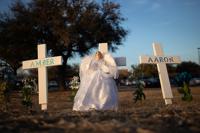
During a demonstration on Feb. 6, 2023, crosses were set up along University Drive to remember Amber Mace, Monique Payne and Aaron Gower.
Maria Crane/North Texas Daily
Chaffin held one earlier this month, delayed because of her back surgery in February.
“The reason why I protest is because I want to warn others,” says Chaffin, who is now 76. “I want to warn them to stay away from that place.”
Denton police and firefighters take people experiencing mental health issues to UBH Denton, as do other law enforcement and fire agencies around the county. UBH Denton is contracted by Denton County MHMR to provide in-patient mental health services, Derek Bradford, Denton’s interim assistant police chief, told the Denton Record-Chronicle on Thursday.
Since 2022, the number of 911 calls from UBH Denton to Denton first responders have doubled and remained high, growing from 238 in 2021 to 439 in 2022, records show, followed by 492 in 2023, 483 in 2024 and 402 by November 2025.
Between 2020 and late November 2025, those 911 calls included approximately 35 under the code for sexual assault, 119 coded as assault and 71 coded as overdoses.
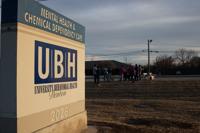
A protest and vigil was held outside the UBH Denton building on Feb. 6, 2023. A group gathered to remember those who were neglected and died in residential treatment.
Maria Crane/North Texas Daily
Bradford says UBH Denton began accepting patients from Mayhill Hospital in June 2022 after it “shut down their contract” with Denton County MHMR, the local mental health authority, leaving UBH Denton as the sole provider.
Mayhill Hospital, which provided behavioral health care, shut down permanently in September. It was also owned by UHS.
Last year, UBH Denton reported it had more than 3,400 patient admissions.
Bradford also said that the 911 calls coded for sexual assault, assault or overdose don’t mean that a crime occurred, or that one occurred at UBH Denton or that a victim was a patient. It could have been a staff member or happened elsewhere, only for care workers to discover it at the facility.
There were no arrest reports associated with 29 calls coded for sexual assault between June 28, 2019, and Jan. 23, 2025, according to Denton police.
Not all of the sexual assaults in the 911 reports occurred at the facility, a Denton police spokesperson confirmed Friday.
“Probable cause is a much lower barrier than sentencing someone and finding them guilty beyond a reasonable doubt,” Bradford says. “[So if] no arrest was made, that would indicate that there’s not probable cause to make an arrest in those cases. I just want you to know that we look into every single case. We’re going to investigate them. We’re going to do our due diligence as law enforcement that is charged with protecting this community.
“We just can’t make an arrest because someone’s reported it.”
UBH Denton CEO Matthew Bertagnole says most of the 911 calls “are initiated from the intake area on behalf of individuals with conditions present prior to the arrival at our facility.”
“While all calls are taken seriously and investigated, a majority turn out to be unsubstantiated outreach by individuals in crisis,” Bertagnole wrote in a Friday afternoon email to the Denton Record-Chronicle.
“Denton County has experienced an increase in need for mental health services, leading law enforcement to transport to us higher volumes of individuals in crisis and at higher levels of acuity.”
UHS didn’t respond to a request for comment.
In a 2020 settlement with the Department of Justice for $122 million, UHS pointed out that a settlement is not an admission of guilt but a resolution to a civil claim. It also “unequivocally disputes any allegation that it engaged in wrongdoing of any kind.”
In February, UHS reported net revenue of $4.5 billion in the fourth quarter of 2025, up from $4.1 billion in the fourth quarter of 2024.
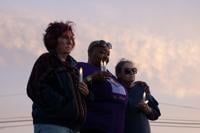
Three women stand together during a vigil and protest on Feb. 6, 2023, outside University Behavioral Health of Denton. The group gathers regularly to remember those who have been neglected and died in residential treatment facilities.
Maria Crane/North Texas Daily
Beyond Denton
Chaffin’s protests aren’t only in remembrance of Aaron Gower but also others like him who were negatively affected by their stays at residential treatment facilities. Some of their photos have appeared on flyers for the silent protests, with hashtags such as #PeopleOverProfit and #StopUHSAbuse.
Chaffin has been gathering with their loved ones in front of UBH Denton over the years, including Evelyn Guzman and her son, Patrick. They met in 2024, and Guzman alleges that Patrick suffered a brain bleed at UBH Denton in June 2023.
Guzman, who works as a psychiatric nurse in Oklahoma, says she has been trying to get information from the Denton police who took her son there and struggling to find an attorney to take her case, in part due to the $250,000 medical malpractice cap in Texas and the expense of a long court case.
“As a nurse, I know what should have been done,” Guzman says. “As a mother, I live with the pain knowing that I told my son to get help.”
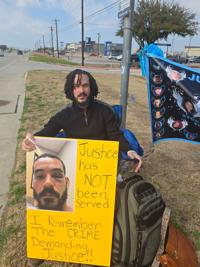
Evelyn Guzman’s son, Patrick, sits with a poster showing his own photo during a March 10 protest in front of UBH Denton on University Drive.
Courtesy photo
John Gower’s lawsuit against UBH Denton and UHS took four years before Chaffin says he settled and signed a nondisclosure agreement in 2017 because he couldn’t afford to keep fighting it.
Gower didn’t speak with the Record-Chronicle for this story. Contacted earlier this week, Gower’s Dallas attorney, Dawn Smith, was unavailable for comment.
Chaffin says, “They settled nearly for nothing because they have a cap in Texas, and the lawyer got most of it.”
Chaffin traveled to Washington, D.C., in 2022 to attend a protest and candlelight vigil outside the Capitol, where she met loved ones and survivors impacted by residential treatment facilities, including Paris Hilton, who was raising awareness about the sexual abuse and mistreatment she faced as a teenager by staff at a private youth facility in Utah.

A young Aaron Gower is shown in a framed family photo. Gower died in 2013 at the age of 22 after checking into University Behavioral Health of Denton, a residential treatment facility.
Courtesy photo
In June 2024, Chaffin shared Aaron’s story with senators who had conducted a two-year long investigation into four companies: Universal Health Services, Acadia Healthcare, Devereux Advanced Behavioral Health and Vivant Behavioral Healthcare.
The Senate Finance Committee’s June 2024 report, “Warehouses of Neglect: How Taxpayers are Funding Systemic Abuse in Youth Residential Treatment Facilities,” reported that residential treatment providers fill their “large facilities to capacity and maximize profit by concurrently reducing the number and quality of staff in facilities.”
Child patients were “at risk of physical, sexual and emotional abuse at the hands of staff and peers, improperly executed and overused restraint and seclusion, inadequate treatment and supervision, and non-homelike environments.”
“These harms amount to acute safety concerns and have long-term effects, including suffering, trauma and even death. Taken together, the Committee finds that these harms are endemic to the RTF operating model.”
A bipartisan bill that was supported by Sen. John Cornyn, R-Texas, the law seeks to establish federal best practices and improve oversight and data transparency in youth residential treatment programs.
“Some children in residential youth programs have faced unimaginable abuse and neglect, and I am proud to have introduced this legislation to help ensure institutional child abuse comes to an end,” Cornyn said in December 2024.
But it does little to help college students like Aaron.
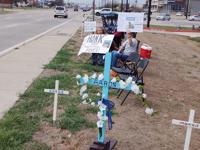
Crosses bearing the names of Aaron Gower and Monique Payne stand alongside University Drive during a March 10 protest outside UBH Denton.
Courtesy photo
The scientist
Working at the Large Hadron Collider in Switzerland, where scientists collide subatomic particles at near light speed, was Aaron’s dream job. His loved ones say he had a brilliant mind — he could do calculus in his head.
An animal lover, especially for Maggie the farm horse, Aaron had a way with them.
Raised by his loved ones in Lewisville, Aaron graduated from Lewisville High School in 2008. His father, John Gower, worked with forklifts in Euless. His mother left when Aaron was 18 months old.
He was also an enrolled member of the Comanche Nation in Lawton through Chaffin’s mother. Though he didn’t grow up among other members, Aaron attended the powwows, a contemporary tradition with dances that celebrate, honor and reflect tribal history.
Chaffin, whose family also has roots in Denton, worked as a nurse at a nursing home in the late afternoon and evenings. Her youngest daughter, Lisa Wilcox, would get Aaron’s bottle ready and help with him. She was 15 in the early ’90s when Aaron was born and says he was “kind of like my little brother, and I got older and had kids; and he was like my child. He was just a kind young man and very smart.”
Though Wilcox says Aaron didn’t show any signs of mental health issues when he was younger, Aaron was agitated, exhibiting bizarre behavior, severe anxiety, suicidal ideation and synthetic marijuana abuse, according to court documents.
Aaron also reported a history of depression and chemical dependency and was diagnosed with bipolar disorder with psychotic features and K2 and marijuana abuse, Dr. Leo Borrell, a board-certified psychiatrist and expert witness, reported, according to court documents.
In early February 2013, Wilcox says, she was the first of the family to arrive at Texas Health Presbyterian Hospital Denton since she lived in Justin, closer than her parents to Denton.
She recalls seeing a disarrayed hospital room, Aaron’s clothes — a hoodie and pants — in the chair and thinking, What is going on?
Someone from UBH, she says, was there.
“She was surprised that he was in there,” Wilcox says. “If I would have known then, I would have asked her more questions because I was in shock. They brought him back in, and he was not coherent. I called my parents back. ‘You all have to get here quick. He doesn’t look good.’”
Sedated earlier that morning, Aaron was found unconscious at UBH Denton with vomit in his mouth and eyes fixated and dilated, Borrell wrote in court documents. Initially prescribed Depakote and Seroquel, he refused to take them because he was worried about the side effects. He was then given Vistaril, an antihistamine, and later the blood pressure medicines lisinopril and clonidine.
“[Aaron’s] blood pressure and heart rate were above the normal range on several occasions during his time as an inpatient,” Borrell wrote. “On each of these occasions, [Aaron’s] blood pressure and heart rate should have been re-checked, a nurse should have been notified, and nurse intervention should have occurred. The staff failed to do this.”
Aaron suffered severe brain damage due to a lack of oxygen for an extended period of time leading up to when he was found, according to court documents.
He died Feb. 6, 2013, four days after he was transferred to the hospital from UBH Denton.
UHS couldn’t be reached for comment.
In October 2013, WFAA-TV reported receiving a statement from UHS in response to Aaron Gower’s death and rape allegations from a 17-year-old patient at UBH Denton and another former patient at Mayhill Hospital.
UHS told WFAA that the alleged sexual assault cases occurred prior to the company purchasing Ascend Health Corp. in 2012 and that its Denton facilities “were committed to providing the highest quality care and treatment to our patients.
“Each of these facilities is licensed by the state, nationally accredited or certified and in good standing.”

Crosses are on display at sunset during a protest and vigil on Feb. 6, 2023, outside the University Behavioral Health of Denton building.
Maria Crane/North Texas Daily
End game
Thirteen years later, Chaffin is recovering from back surgery at home in Marietta, planning her next protest on Aaron’s birthday in August and still haunted by guilt for taking him to UBH Denton. He had changed his mind when they got to the facility on that January morning and didn’t want to voluntarily sign himself in for care.
“I said, ‘Aaron, it will be all right. I think you should,’” Chaffin recalls.
The first year she protested, Chaffin says her friends joined her, but they’re in their mid-70s now and don’t get out, especially since it’s cold in February and hot in August. Her daughter also joined her but only that year.
“I don’t know, the fight just went out of me,” Wilcox says. “I needed to get back to my life, my family and not have this overcome me.”
Over the years, Chaffin says she has also made a couple of trips to UHS’ corporate offices in King of Prussia, Pennsylvania, to attend protests with people up north. She says she also tried to meet with Michael Burgess when he represented the area in the U.S. House of Representatives, and Jane Nelson, the area’s former state senator who’s now Texas’ secretary of state.
Chaffin wants the state to provide more oversight — such as conducting unannounced visits frequently, looking into allegations that people have been forced to sign voluntarily with the threat of a judge who would have the sheriff’s office pick them up if they didn’t, and strengthening communication about patient care with the patients’ loved ones.
Wilcox says her mother’s endgame is making changes so that medical staff do better checking on patients and listening to them when they say they don’t feel good.
“She is like a dog with a bone on this,” Wilcox says. “She is not letting go and doing what she can.”
While Denton police will investigate criminal complaints, interim Assistant Chief Derek Bradford suggested that if you or someone you know isn’t happy with services at UBH Denton, you can file a complaint with the Texas Department of Health and Human Services, the regulatory agency.