
By AJ Muonagolu
Reporting Texas
With around 13 clinics in Austin alone, ketamine clinics are rising as an alternative to traditional psychotherapy.
Increasingly, Texans are exploring psychedelic therapy in hopes of treating depression, anxiety or other chronic mental health issues. But experts worry about ketamine being used as a one-size-fits-all approach to psychiatric care because of concerns over safety and lack of robust research.
“I’m not a big fan of ketamine at all. I think the data is extremely weak,” said Dr. Charles B. Nemeroff, co-director of Charmaine and Gordon McGill Center for Psychedelic Research and Therapy at the University of Texas at Austin. “Let me be clear about this,” he said: “ketamine administered intravenously or any other way is not FDA approved for any psychiatric indication.”
Ketamine is a Schedule III non-narcotic substance approved for medical use as an anesthetic or, more recently, as a nasal spray for treatment resistant depression, according to the Drug Enforcement Administration.
Unlike true psychedelics, which aren’t legal in Texas, ketamine use can be prescribed by a doctor — and therapy with the drug can be paid through insurance.
Jimmy Nguyen, founder and CEO of Psychedelic Passage, a national psychedelic guidance and referral service, said that the expansion of ketamine therapies can be linked to its profitability.
“Ketamine clinics in general are selling infusion packages anywhere from four to six infusions and that’ll probably cost $3,000 to $6,000 like an end to end,” Nguyen said.
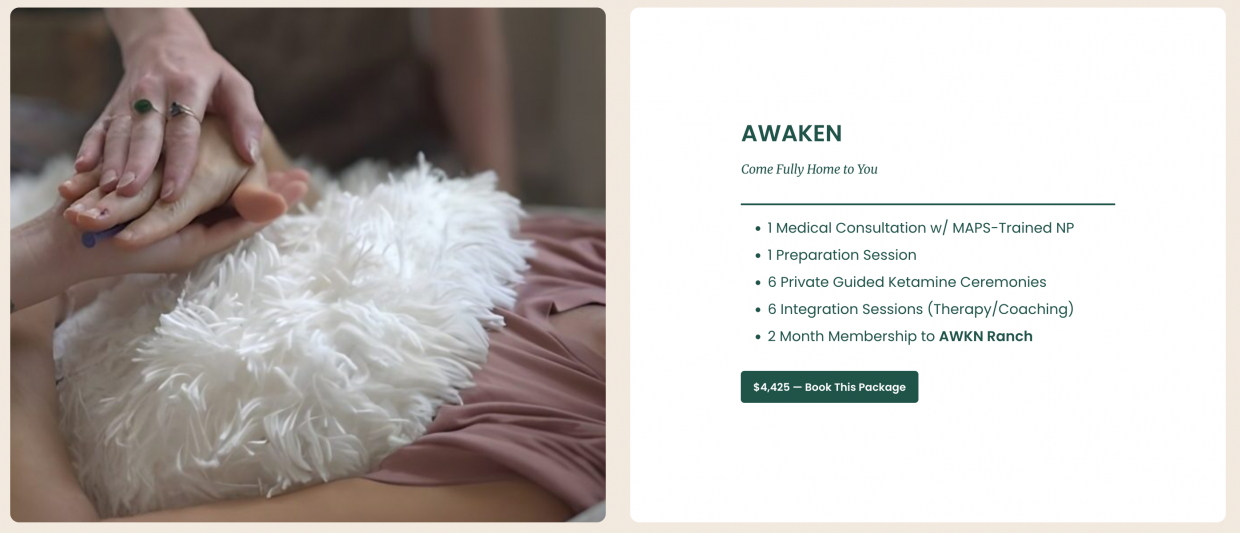
A detail from the website for the Within Center, a ketamine clinic.
Ketamine has side effects that include addiction and ketamine-induced cystitis, inflammation of the bladder.Concern over the safety of ketamine grew after the death of ‘Friends’ actor Matthew Perry in 2024 and more recently controversy over Elon Musk’s use of the drug.
Nemeroff and the DEA said that ketamine is a drug of abuse, most notably in Asia, under the nickname “Special K.” With the likelihood of abuse, Nemeroff said that ketamine may not be worth the risk and that it’s unlikely it will actually help with psychiatric symptoms.
“There’ve been a number of analyses suggesting that ketamine’s efficacy is at best transient,” Nemeroff said. The National Institutes of Health, he said, “found that the addition of repeated injections of IV ketamine to conventional therapy did not compare to placebo and did not improve depression at all.”
Nemeroff and other psychiatric facilities are studying psychedelics like Ibogaine, psilocybin, LSD, MDMA and ayahuasca as alternative treatments for PTSD and refractory depression through a research waiver.
Though experts may not agree, some patients said the use of ketamine helped them get over the initial anxiety that they felt in standard therapy.
“Ketamine therapy was just more open,” said Sadie Jeffery, a 24-year old from Dallas. “I felt like my thoughts could have more space.”
Jeffery said that in past therapy sessions she felt she couldn’t connect with her therapist and that traditional therapy was a struggle.
For most patients, clinics will administer the drug through a tablet or nasally before engaging in counseling with a professional.
“I’ve also tried antidepressants before and it didn’t work for me.” Jeffery said. “I got off of that, but it felt like the ketamine therapy was able to open up that spot in my brain that I was kind of missing.”
Still, experts who work with psychedelics and ketamine therapy are cautious about administering the drug.
“I’m looking for psychedelic therapy and I also want to have the most legal option,” Nguyen said. “But I would never suggest ketamine as the first substance that people should engage with therapeutically.”
Nguyen said ketamine clinics can be an alternative to psychedelic therapy since ketamine usage is already legal in medical settings.
He said that ketamine usage can fit in the current mental health and medical environment such as payment through insurance and administering the drug with a physician unlike psychedelics.
Nemeroff said whether it’s students who are curious or adults seeking relief in chronic conditions, it’s important to do research into the drugs, the people running these clinics and the ways people administer it.
“I’m concerned about the indiscriminate use of psychedelics, and as you know, certain states have legalized psychedelics,” Nemeroff said. “We’re just going to need, like with all medications, to be judicious.”