
 Stress often doesn’t strike dramatically but quietly stacks up, leading to persistent tiredness and a full mind. This cumulative strain, unlike acute stress, builds slowly and blends into daily routines. Doctors call this ‘stacked stress,’ where the body remains in a mild alert state, impacting sleep, immunity, and focus over time. Most people expect stress to feel loud. A racing heart. A bad day. A clear trigger.But for many, it feels quieter. It shows up as tiredness that never quite leaves. A mind that feels full, even on calm days.That is because stress often doesn’t spike. It stacks. And when it stacks, it becomes harder to notice, and easier to ignore.
Stress isn’t always dramatic
The popular idea of stress is a single event. A deadline. A conflict. A sudden problem.That is acute stress. It rises fast and usually fades.But the more common form today is different. It builds slowly. It stays longer. It blends into routine.A long commute. Late-night scrolling. Skipped meals. Poor sleep. None of these feel extreme alone. Together, they create a constant background strain.Over time, the body stops asking for attention. It simply adjusts.
What doctors mean by “stacked stress”
Doctors often describe this pattern as cumulative or stacked stress. It is not about intensity. It is about duration.As one doctor explains “I often meet patients who say, ‘I’m not stressed, just constantly tired.’ Most people imagine stress as a single, dramatic moment. But stress rarely arrives for people in one hit. It builds gradually, what we call stacked stress.”The body stays in a mild state of alert for too long. It does not fully switch off.And that is where the real strain begins.Why doing nothing feels stressful today: Doctors explain the brain science behind restlessness and how to retrain your body to relaxWhy naps sometimes make you feel worse: The science of sleep inertia and how to nap the right way 
This “stacked stress” keeps the body in a prolonged state of alert, affecting sleep, focus, and long-term health.
The biology behind the build-up
When stress lingers, the body keeps releasing hormones like cortisol. These are helpful in short bursts. They help you react and stay alert.But when they stay elevated, they start to interfere with basic functions. Sleep becomes lighter. Immunity weakens. Focus drops.The National Institute of Mental Health explains how chronic stress affects brain function, mood, and physical health over time.Similarly, the Centers for Disease Control and Prevention highlights how long-term stress raises the risk of heart disease, high blood pressure, and mental health conditions.This is not sudden damage. It is slow wear and tear.
The signs people miss every day
Stacked stress rarely announces itself clearly. It hides in small changes.You may feel tired even after a full night’s sleep.You may struggle to focus on simple tasks.Headaches may become more frequent.Irritability may rise without a clear reason.These signs feel ordinary. That is what makes them easy to dismiss.But they are often early signals that the body is not recovering properly.
Why “being used to it” is risky
The body is very good at adapting. That is useful in the short term. But in the long run, it can mask problems.People begin to accept constant fatigue as normal. They stop questioning it.They push through days that should have included rest.The real issue is not just stress itself. It is how long it stays unaddressed.
What this means for long-term health
When stress keeps stacking, it starts affecting systems that seem unrelated at first.Sleep becomes fragmented.Blood pressure may slowly rise.Anxiety may feel more constant.Energy levels drop, even on easier days.Research from the National Institutes of Health shows links between chronic stress and conditions like cardiovascular disease and metabolic disorders.This is why doctors focus on early signs. Not just major symptoms. 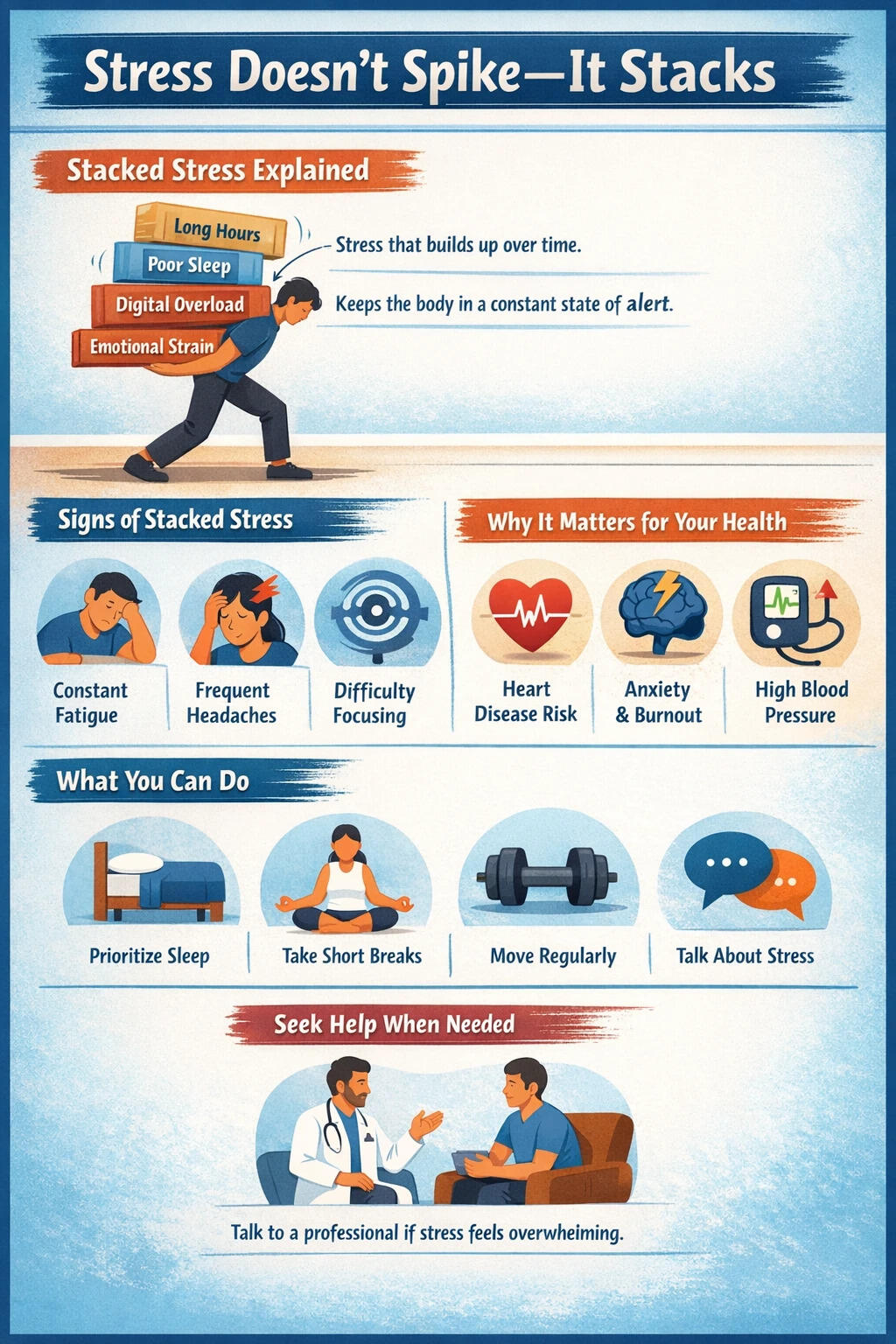
Recognising early signs like fatigue and irritability can help prevent deeper health issues. Small, consistent changes can reduce this hidden burden.
What doctors want you to do differently
The advice is often simple, but it works when done consistently.“Stress management must be proactive, not reactive. You don’t need drastic lifestyle changes. Small, consistent habits can make a meaningful difference.”That means small resets through the day.Short breaks between tasks.Less screen time at night.Regular movement, even if it is light.Sleep matters more than most people realise.So does talking about emotional strain before it builds up.The goal is not to remove stress completely. That is not realistic.The goal is to stop it from quietly piling up.
Pay attention to the quiet signals
Stress is not always loud. Often, it is repetitive and subtle. It builds in the background, day after day. Recognising it early changes everything. Because once you see it, you can interrupt it. And sometimes, the most important health decision is not a big one. It is noticing that something small has been going on for too long.Medical experts consultedThis article includes expert inputs shared with TOI Health by:Dr Murali Krishna, Consultant – Psychiatry & Counselling Services, Aster RV Hospital, Bangalore.Inputs were used to explain how stress often builds gradually rather than appearing suddenly, and why recognizing this pattern early can help you manage it more effectively with the right guidance.