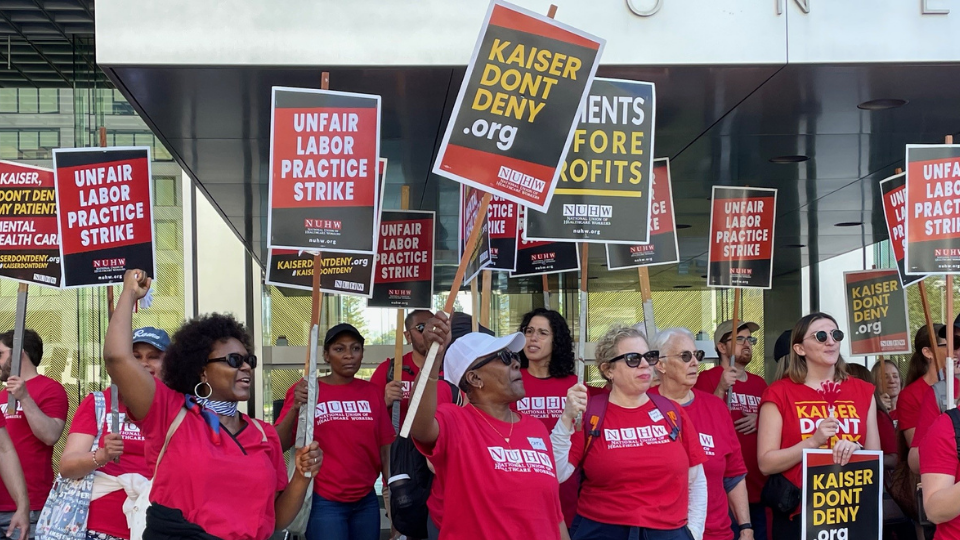
2,400 mental health professionals at Kaiser Permanente took to the picket line in northern California and the Central Valley on March 18, 2026| Marilyn Bechtel/ People’s World
OAKLAND, Calif.—Some 2,400 mental health professionals at Kaiser Permanente took to the picket line in northern California and the Central Valley on March 18, in a one-day unfair labor practices strike aimed at upholding and strengthening patient care safeguards they won in a 10-week strike four years ago, and meeting new challenges posed by technology.
The therapists, represented by the National Union of Healthcare Workers, have been without a contract since September. The union says Kaiser is seeking to roll back improvements the therapists won in 2022, including more time for patient support work and measures to ensure that, after the intake process, patients can receive timely follow-up for ongoing care. NUHW says the healthcare giant also looks to open the door to replacing therapists’ work with artificial intelligence and subcontracting more care to providers outside Kaiser.
The psychologists, social workers, chemical dependency counselors, and other mental health clinicians were joined on the picket lines by some 23,000 registered nurses represented by the California Nurses Association/National Nurses United, and by stationary engineers represented by International Union of Operating Engineers Local 39. Picket lines were launched in Santa Rosa, Fresno, Sacramento, and Santa Clara, as well as Oakland.
As she stood alongside picketing workers and their supporters outside Kaiser’s flagship hospital here, Dr. Emma Olsen, a clinical psychologist at Kaiser in Vallejo, said the healthcare giant’s contract proposals would make it much harder for her to handle essential patient care tasks that must be done outside therapy appointments, like responding to patients’ calls and messages, keeping proper records of their treatment sessions and coordinating care with patients’ other medical providers.
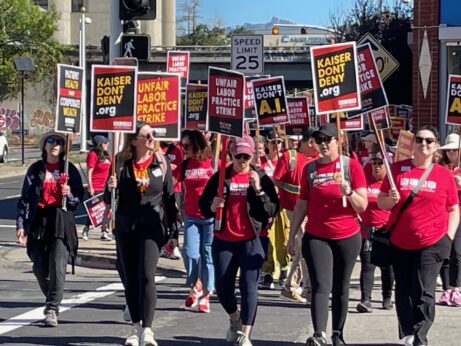 Marilyn Bechtel/People’s World
“We know that AI cannot replace a therapist,” Olsen said. “I know Kaiser is going to be interested to see how and where they can save money using AI, but we have to make sure that any interventions we’re using are proven to work and to be helpful, and there’s not that evidence right now.”
Olsen added, “Kaiser is always going to come up with some new way to try and circumvent the actual solution, which is just hiring more therapists and investing in the therapists they already have.”
Carolyn Staehle, a clinical social worker at Kaiser in San Francisco, said that in the intake and assessment work she used to do, a triage therapist would talk briefly with new patients to determine if they were suicidal, homicidal or in an immediately life-threatening situation, and would help patients in crisis get immediate care. Other patients would be shifted to a therapist who would do a thorough intake assessment and help them connect to the right treatment – “and that worked pretty well.”
But, said Staehle, Kaiser has now shifted the triage function to workers who are not professionally licensed and who don’t have any experience with mental health treatment.
“They’re just reading off a little script, and/or it was being given, basically, to algorithms and a little questionnaire, so the patient literally would not even talk to a living soul at the beginning.”
Once this began to happen, Staehle said, “it was really hard for new patients to call, and be struggling, and then not talk to a real person.” And at the same time, patients who really were in an immediate crisis were not getting the help they needed.
Now Staehle works as a crisis therapist and says sometimes people who are not in crisis are incorrectly referred to her and her coworkers, taking time, skills, and energy away from their work to help people experiencing a crisis.
The therapists and their union also point out that even though Kaiser has some $67 billion in reserves, and reported a combined $22.2 billion in profits over the years 2024 and 2025, the corporation continues to violate laws at the state and national level requiring insurers to cover mental health treatment in a manner that is equivalent to their coverage for physical health.
In 2023, Kaiser acknowledged in a $200 million settlement agreement with California’s Department of Managed Health Care that “it lacks sufficient behavioral health providers” and that “This lack of clinical staff has resulted in excessive wait times for enrollee individual therapy appointments …”
 NUHW President, Sophia Mendoza.| Marilyn Bechtel/People’s World
And in February, Kaiser entered into a $31 million settlement agreement with the U.S. Department of Labor over violations of mental health parity laws.
As noon drew near, hundreds of therapists, nurses, and labor and community supporters who had been picketing outside the hospital marched down Oakland’s main thoroughfare, Broadway, and gathered outside Kaiser Permanente’s corporate headquarters in downtown Oakland.
There, they heard from NUHW members and labor and community supporters, including several East Bay elected officials, and responded with tumultuous applause and cheers.
First up was Dr. Matt Hannan, psychologist at Kaiser South San Francisco Medical Center, and an NUHW steward and bargaining committee member. Hannan told the crowd that the union has participated in over 26 bargaining sessions and has presented a proposal “that will provide better patient care for years to come. But in response, Kaiser won’t give us language protecting our jobs from AI.”
As the crowd shouted, “Boooo!” Hannan asked, “Who here thinks a bot is smarter than them?”
California Nurses Association Executive Director Puneet Maharaj declared, “We are out here to send Kaiser a clear message: When you take on one of us …” and the crowd joined in: “You take on all of us!”
Said Maharaj, “We must make it clear that AI cannot and must not replace the human-to-human interaction within healthcare. And Kaiser, listen to us, loud and clear when we say that we will keep fighting for our patients and not allowing the hallucinogenic AI technology to put the lives of children and adults alike at risk, because when we fight …” and the crowd roared back, “…We win!”
Alameda County Supervisor Nikki Fortunato Bas, whose district includes Berkeley, Emeryville and several other East Bay communities as well as a large part of Oakland, said her main message to the workers was “to keep fighting. More than ever before,” she said, “we have to care for every single person in our communities, and that means building human-to-human contact, human-to-human care, building a community that will really center care, as this federal government is trying to strip away healthcare, food security, and every single thing that we know makes us whole.”
“Shame on the Trump administration! And shame on any of our healthcare providers that would seek to take away your ability to care for our community!”
As she wrapped up the rally, NUHW President Sophia Mendoza said the union is “going to be everywhere that Kaiser is,” leafleting at upcoming events including the Oakland Marathon and a gathering at San Francisco’s Chase Center. “We will be like flies to them!” she declared.
“I’m here to send Kaiser a very clear message: that we and our supporters are not going to give up, because – who has the power?”
And the crowd roared back: “We have the power! What kind of power? Union power!”
We hope you appreciated this article. At People’s World, we believe news and information should be free and accessible to all, but we need your help. Our journalism is free of corporate influence and paywalls because we are totally reader-supported. Only you, our readers and supporters, make this possible. If you enjoy reading People’s World and the stories we bring you, please support our work by donating or becoming a monthly sustainer today. Thank you!
CONTRIBUTOR