Everyone working on James Perry Jr.’s murder case had come to accept that when he fatally shot his daughter as she stopped by to deliver cookies, he was legally insane.
Holed up in his Newbury home during the height of the pandemic, Perry was consumed by paranoid delusions and had become convinced that shadowy forces were conspiring against him. “Floridly psychotic” was how doctors described the 70-year-old’s state of mind, according to Judge Daniel Richardson, who ruled last year that Perry was not guilty by reason of insanity.
Richardson’s verdict put to rest the question of Perry’s criminal culpability for the May 2021 death of Karina Rheaume, 38.
It also raised a thorny follow-up question: What to do with Perry now?
The acquittal meant that Perry could no longer legally be held in prison. Yet his mental health had improved enough during his four years in confinement that the state Department of Mental Health was adamant he no longer qualified for a prolonged hospitalization.
His attorneys ultimately finagled an 11th-hour solution: They landed him a bed at a long-term residential program run by the Rehabilitation Services of Southeastern Vermont in Springfield, where he’s remained since last year. The facility provides around-the-clock care, and someone accompanies Perry if he leaves the grounds. But the doors aren’t locked, and if doctors believe he can be safely treated in the community, then he could eventually be released without any state supervision.
A bill pending in the state legislature seeks to provide a more permanent solution for people such as Perry by establishing a “forensic facility,” likely inside an existing prison. It would house people who are deemed unfit to stand trial or who have been determined to have been legally insane at the time of their crime. State officials estimate that three to five defendants facing potential life sentences would be eligible for commitment each year.
The bill would grant the state expanded authority to detain people for extended periods of time, so long as it can convince a judge that releasing them would pose a serious risk to the public. It calls on the Department of Corrections to establish a competency restoration program for defendants who are deemed unfit for trial. But the measure leaves many specifics unanswered, including where the facility would be located and how many beds it would have.
The Vermont Senate is expected to vote on the bill next week, but it could run into trouble in the House, where some committee chairs have opposed similar measures in the past.
Supporters say the bill has been narrowly tailored to target a dangerous and long-standing gap at the intersection of Vermont’s criminal justice and mental health systems.
“We have a system right now where a person who’s manifesting a high level of danger can simply be returned to the street, untreated and unsupervised,” said Jared Bianchi, a deputy state’s attorney in Bennington County who testified in favor of the bill.
We have a system right now where a person who’s manifesting a high level of danger can simply be returned to the street, untreated and unsupervised.
Jared Bianchi
But civil liberties advocates argue that housing mentally ill people long-term within prisons when they haven’t been convicted of a crime runs afoul of both the conscience and, potentially, the U.S. Constitution.
“There’s an impetus to lock people up and throw away the key,” said Jack McCullough, director of Vermont Legal Aid’s Mental Health Law Project, which represents defendants who would be eligible for the new facility. “I’m very concerned that this is where this is heading.”
Police and prosecutors have long held that Vermont’s laws for handling crimes committed by people with severe mental illnesses can leave the public at risk. The problem begins when questions arise about someone’s fitness for trial, or competency.
Unlike the legal defense of insanity, which considers a person’s state of mind at the time of the crime, competency refers to their current fitness. To be found competent, a defendant must be able to understand the court proceedings they face and be able to aid in their own defense.
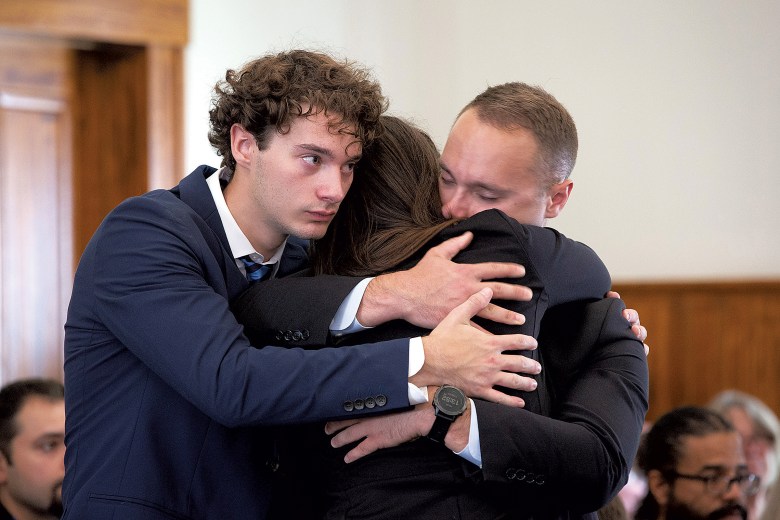 Joshua Rheaume (left) and Mason Rheaume hugging their aunt Emilie Perry after listening to her victim impact statement Credit: Courtesy of Valley News/Alex Driehaus
It is a fluid concept that can change repeatedly over the course of a criminal case: One month, someone might be competent; the next, not.
Vermont is one of the only states in the U.S. without a program designed to restore the competency of criminal defendants so they can stand trial, according to state officials. Competency concerns have loomed over numerous high-profile cases in recent years, including the ax murder of a mental health worker in Brattleboro and the shooting of three Palestinian college students in Burlington.
A finding of incompetency kick-starts a complicated and time-sensitive legal process, as defendants must be transferred out of the Department of Corrections’ custody within 21 days.
The judge’s first task is to decide whether the person has a diagnosable mental illness in need of treatment, which would make them eligible for placement in the custody of the Department of Mental Health.
From there, the department can hold the person at a residential psychiatric facility, or it can place the person on an “order of non-hospitalization,” putting them under the supervision of a community mental health agency.
The bar for hospitalization is high in Vermont, said Karen Godnick Barber, chief legal counsel for the Department of Mental Health.
“We have an acute care system,” Barber said. “Just like if you went into the hospital for a broken leg, as soon as you no longer needed to be in the hospital but could be treated on an outpatient basis, you would be discharged. Same for a mental hospital.”
Orders of non-hospitalization, on the other hand, are voluntary and designed with treatment, not public safety, in mind. “It’s not like a probation order or a condition of release,” Barber said. “You don’t go to jail if you don’t take your medicine exactly as prescribed.”
Prosecutors have long argued that Vermont needs a third option: a facility to hold someone who does not require hospital-level care but is too dangerous to live free in the community.
Lawmakers have taken up the issue several times in recent years. One proposal, for instance, would have carved out a section of the state psychiatric hospital for so-called forensic patients.
S.193 instead proposes creating the facility within the state prison system, on the belief that it is already providing supervision to many of the people who would ultimately wind up in one of the new treatment beds.
The bill would commit people accused of crimes carrying potential life sentences who are deemed incompetent and would enroll them in a newly established competency restoration program. Exactly what that program would look like is not clear, though state officials say best practices include coupling treatment with civic lessons about how the justice system works.
Defendants would be reevaluated at least every six months until they’re either restored to competency or their charges have been dismissed — perhaps because they have been determined to have been insane at the time of the crime.
Legally insane defendants would remain committed until a judge decided they could be safely released back into the community. The same standard would be applied to people who cannot be restored to competency, such as those with progressive dementia or an untreatable traumatic brain injury.
The bill also spells out the process for discharging someone from the facility. Defendants could be recommitted at any time if they fail to comply with mandated treatment plans; if the state corrections commissioner has “reason to believe” they’re incompetent again; or a judge finds that they pose a risk to the community.
The Senate Judiciary Committee endorsed the bill by a vote of 4-1 last week after more than a month of testimony. The lone no vote came from Sen. Tanya Vyhovsky (P/D-Chittenden-Central), a clinical social worker, who said she was troubled by the idea of housing the facility within the Department of Corrections.
“As someone who has volunteered in our prisons, that is not a therapeutic environment,” she said. She also expressed concerns about the state’s prison health care contractor, Wellpath, which has been plagued by accusations of providing inadequate care in jails across the country.
“I am not denying that there may be a gap within our system that needs to be solved,” Vyhovsky said. “My concern is the way the bill proposes solving it.”
McCullough, the legal aid attorney, said he’s not convinced a gap even exists. People can already be hospitalized in Vermont if a court determines that their mental illness makes them a danger to themselves or others. Some of those people wind up competent as a result of the psychiatric treatment they receive, he said.
As for defendants found insane, McCullough pointed to the Perry case, which he himself worked on, as a win-win resolution.
“Having someone receive adequate services outside of a locked facility is the way we should be going for people who can do that,” he said.
The attorney added that he’s represented numerous people over the years who would have been thrown into the proposed facility but instead were released and are now living in the community.
“They’re receiving services and are not posing any more danger to society than you or I,” he said. “You could walk right past them and not even know it.”
But the prospect of Perry returning home one day has left his family terrified. Speaking at a court hearing last year, Joshua Rheaume, one of Karina’s four sons, asked the judge to consider what happens when his grandfather is released and has to face the “stresses and triggers of the outside world.”
“The risk is too great,” Rheaume said, according to the Valley News. “Our family, community and any potential future victims deserve the assurance of a more permanent solution.” ➆
The original print version of this article was headlined “A Question of Competency | Lawmakers are again considering creating a secure facility for mentally ill people accused of crimes”
This article appears in March 25 • 2026.