

March 26, 2026 — 5:00am
Save
You have reached your maximum number of saved items.
Remove items from your saved list to add more.
Save this article for later
Add articles to your saved list and come back to them anytime.
Got it
AAA
Lambrina Gimian, 38, always wanted to be a mother. But after meeting her now-husband and deciding to start planning a family, instead of excitement, she felt something else: anxiety.
“I felt constantly on edge, I had difficulty sleeping and a mind that struggled to switch off,” says Gimian, who is based in Melbourne and works in community mental health.
While postnatal anxiety is a widely recognised mental health issue, prenatal or pre-pregnancy anxiety – an intense or prolonged feeling of worry, stress or fear that some people experience when planning or trying for a baby – still isn’t commonly understood or acknowledged.
However, a recent survey by Perinatal Anxiety and Depression Australia (PANDA) found that the condition is widespread, with all 125 Australian respondents reporting it, making it the biggest stressor for women during the perinatal period, which spans from conception to the first year after birth.
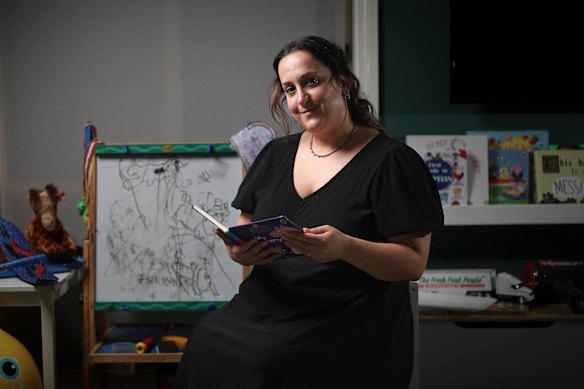 Lambrina Gimian “felt constantly on edge” while planning for a family.Eddie Jim
“What’s striking is that this ranked above anxiety about birth (55 per cent), sleep (57 per cent) or even feeding (60 per cent),” says Julie Borninkhof, clinical psychologist and chief executive of PANDA.
“For many people, the moment they decide to try for a baby is the moment uncertainty becomes very real. Questions about fertility, miscarriage, what they eat and drink, age and whether their body will ‘cooperate’ can quickly dominate thinking.”
Related Article
For Gimian, much of this anxiety stemmed from concern about Huntington’s Disease, an inherited neurodegenerative disorder, which her mother was diagnosed with in 2013.
“We found out there was a 50 per cent chance of my brother and me inheriting it, so when my husband and I were planning to start trying for a baby, having that in the back of my mind … was obviously very anxiety-inducing.”
With Huntington’s disease, along with other genetic conditions, able to be screened for through IVF, the couple decided to pursue that pathway. Now mother to a five-year-old son, Gimian says this was helpful, but also further compounded her anxiety, even after receiving reassuring test results.
“The waiting was definitely the hardest part: waiting between appointments for test results, waiting for outcomes that were completely out of your hands.”
Other factors, like the pressure to have a “perfect birth” also took a toll, exacerbated by social media, which pushed content about “natural” deliveries and blissful postpartum periods.
Dr Melanie Hemsley, general practitioner at Jean Hailes for Women’s Health, says social media can portray a very glossy image of falling pregnant, pregnancy and parenting. “This can result in unrealistic expectations and significant distress when an individual’s actual experience is markedly different to what they are seeing,” she says.
Unfortunately, while prenatal anxiety is common, experts say the health system isn’t set up to support parents during this period.
“Preconception doesn’t come with structured care or routine mental health check-ins,” says Borninkhof. “Individuals and couples are largely left alone to navigate their feelings and worries, especially those who have been trying to get pregnant for an extended period.”
This was the case for 36-year-old Daniel Osgood who, along with his ex-partner, faced difficulty conceiving and pregnancy loss, which contributed to his prenatal anxiety.
“After trying for over 12 months and getting pregnant, we lost the baby,” says the Central Coast-based father of one. “That was a pretty big kick in the guts. It was like, why isn’t this working? Is my universe telling me something?”
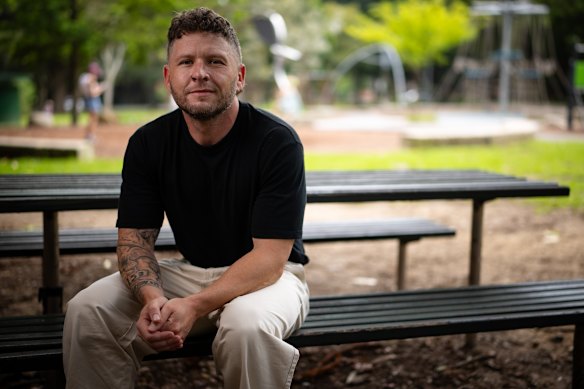 Central Coast-based father of one Daniel OsgoodAudrey Richardson
Ultimately, the couple found success with IVF, but through the pregnancy, Osgood says his anxiety intensified, fuelled by his socially disadvantaged upbringing and deep fears about whether he would repeat the patterns of his own father.
“I had a shitty childhood. I moved around a lot. My parents drank lots, and there was domestic violence; I saw lots of things that kids shouldn’t ever see in their lifetime,” says Osgood, who works as a disability and social inclusion manager. “My biggest fear was turning out like my dad.”
Catastrophic thinking and comparing himself to others were two of the main ways Osgood’s anxiety showed itself. He says that once his son was born, lack of sleep and the traumatic birth his then-partner experienced made the postnatal period even tougher.
Hemsley says this is common, with early experiences of worry and anxiety often carrying over into the pregnancy and newborn periods, affecting early bonding and general mental health.
“We know that one of the biggest predictors of postnatal depression and postnatal anxiety is preceding anxiety or depression,” she says.
But it is also important to note that there is a difference between normal worry and anxiety.
“Anxiety differs in that it is often longer lasting and often has significant cognitive, emotional and even physical manifestations,” she says.
Related Article
It can also present differently in men and women, says Mathew Aquilina, a psychologist and clinical team manager at Gidget Foundation Australia.
“Women will generally have a bit more of an internalising presentation, such as a sense of overwhelm, where a man tends to be more irritable, withdraw socially or have problems in other contexts, like work.”
During the first three months after his son’s birth, Oswood says he struggled at work and socially. His relationship with his partner broke down.
“I’d forget to have showers, I’d forget to do my groceries, and I’d make up excuses not to go out with friends,” he says.
It wasn’t until he confided in a friend that he sought professional help. “He was like, men talk about their feelings – boys don’t. So, I spoke about it with a counsellor, and it really helped,” he says.
Seeking support is critical, agree the experts, so too is starting conversations about mental health before trying to conceive.
“Early conversations help normalise mental health as part of routine reproductive care, not something addressed only in crisis,” says Borninkhof. “Support can begin through a conversation with a GP visit, a psychologist, a fertility specialist or an obstetric provider.”
Make the most of your health, relationships, fitness and nutrition with our Live Well newsletter. Get it in your inbox every Monday.
Save
You have reached your maximum number of saved items.
Remove items from your saved list to add more.
From our partners