
Liza Li, a UCLA Luskin social welfare alumna, is building a career centered on community-based behavioral health, culturally responsive care and mental health equity. In this Q&A, she reflects on receiving a fellowship, the value of her MSW training, and her commitment to serving older adults and AAPI communities.
Congratulations on being named a fellow in the National Mental Health Workforce Acceleration Collaborative, a program supporting early-career clinicians working toward licensure. What does this recognition mean to you at this stage in your career?
This fellowship represents a meaningful affirmation of my commitment to becoming a Licensed Clinical Social Worker. At this stage in my career, as I work toward clinical licensure, this recognition reinforces my dedication to serving older adults, particularly older adults of color, and advancing mental health equity within underserved communities. It not only validates my passion but also provides critical support and guidance as I navigate my post-MSW path toward licensure and clinical practice.
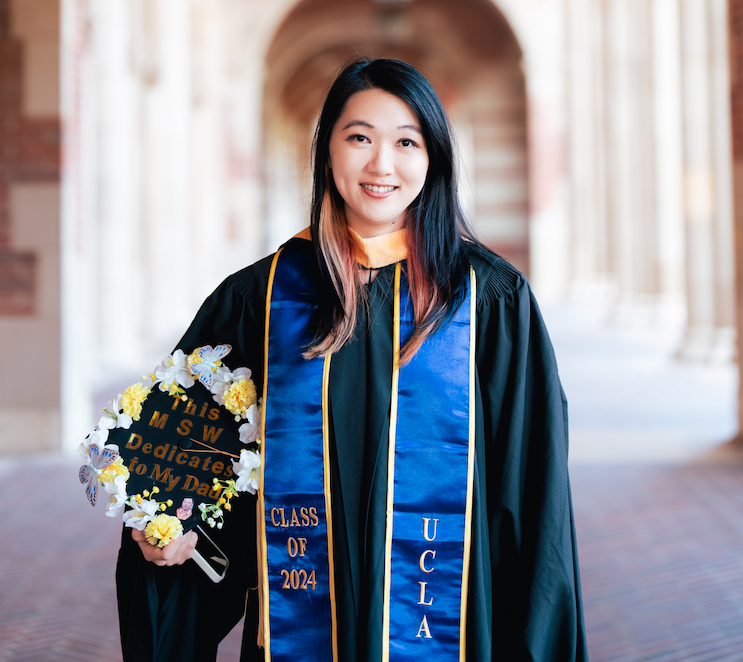
Liza Li
How has your Luskin MSW education prepared you for work in community-based behavioral health and clinical settings?
My MSW education at UCLA Luskin has provided me with a strong foundation in clinical theory and practice, along with a deeper understanding of the structural factors that shape mental health outcomes. Through my internship, I gained hands-on experience navigating the Los Angeles County behavioral health system, particularly in serving older adults and communities of color. I developed skills in client engagement, care coordination, interdisciplinary collaboration, and connecting clients to community resources.
Luskin’s emphasis on cultural humility has shaped my commitment to providing culturally responsive, person-centered care. Overall, my journey at Luskin has prepared me to effectively integrate clinical skills with community-based practice to serve diverse and underserved populations.
Your work focuses on mental health equity for older adults and AAPI communities. What personal or professional experiences have shaped this commitment?
My commitment to mental health equity for older adults and AAPI communities comes from both my personal background and professional experiences. Growing up as a first-generation AAPI immigrant, I witnessed how mental health stigma affected my own family, especially older relatives, who often struggled in silence due to cultural expectations and limited access to community-based care. These experiences made me acutely aware of the barriers faced by people of color, particularly older adults, and inspired me to pursue a career where I could make a meaningful difference.
Through my MSW training and fieldwork, I have gained a deeper understanding of the systemic challenges these communities encounter, which continues to fuel my dedication to providing culturally informed, person-centered care and advocating for mental health equity.
As a trilingual clinician, how do language and cultural responsiveness show up in your day-to-day work with clients and families?
As a trilingual clinician, language and cultural responsiveness are central to my day-to-day work with clients and families. Being able to communicate in a client’s preferred language helps build trust, foster rapport, and ensure they feel truly heard and understood. Beyond language, I pay close attention to cultural values, norms and personal experiences that shape how clients perceive mental health, seek support and engage in care.
I strive to understand each client as a whole person, considering all aspects of their life, not only cultural background, so that my approach is comprehensive, respectful and person-centered.
What advice would you give to current UCLA Luskin MSW students or recent graduates who are interested in clinical licensure and community mental health work?
I would advise current UCLA Luskin MSW students and recent graduates to seek diverse clinical experiences early and explore where their passion lies, including placements that offer both individual therapy and community-based work. Ultimately, the communities we serve need dedicated social workers, and with commitment and perseverance, you can make a meaningful impact.