
Alicia Wagnon’s job as the Lincoln County Clerk keeps her busy. Along with managing payroll and benefits for county employees, her office in Chandler is in charge of filing records that date back to the land run.
But when Wagnon learned the attorney general was accepting bids for the state’s share of opioid settlement funds, she figured it couldn’t hurt to add applying for a grant to her plate.
“The need is so big in Lincoln County,” she said. “We had to do something.”
Local governments in Oklahoma are taking an active role in funding mental health care with opioid settlement funds, but some are struggling to manage new responsibilities while existing services are cut.
“It has been hard on some counties on just knowing what to do with those funds,” Wagnon said. “What do we do with it? Where can we go?”
Oklahoma’s opioid settlement funds are designed to prevent overdose deaths and expand access to treatment. The funds are disseminated by a governing board to ensure the money is spent on evidence-based best practices and in line with the provisions of the lawsuits that brought the money to the state.
Cities and counties, like Lincoln County, can apply for Oklahoma’s opioid settlement funds, but many don’t have experience providing mental and substance abuse services for their residents.
“If I would have had to do this myself, it would not be where it is today,” Wagnon said.
She knew opioids and addiction were hurting her community, but she needed help. Wagnon recruited Judy Smith, who had previously helped the county secure funding for its fairgrounds. Smith spent the better part of a decade as a director of equine therapy at Utah State University, and she quickly recognized the gap in care locally.
“We have such a need for just mental health services in the county,” Smith said. “Our disparity is so big.”
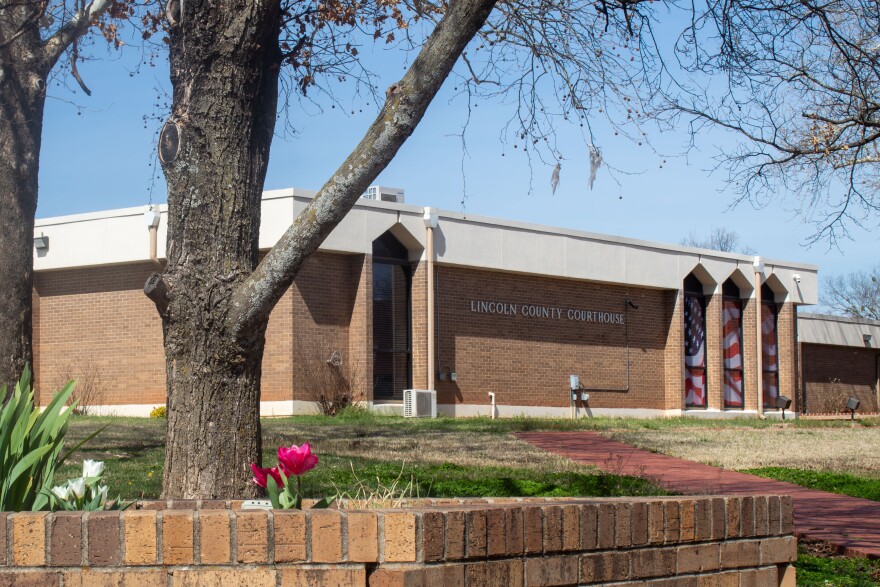
The Lincoln County Courthouse in downtown Chandler.
County officials create a task force
Before applying for the state’s opioid settlement grant, Wagnon and Smith set up a local task force to identify the county’s most urgent needs. Weekly meetings brought together local law enforcement officials, health care workers, community leaders and treatment providers.
Smith said it was the first time many of them had all been in the same room.
Together, the group identified some of the community’s most pressing necessities. The county reports over 95% of its jail bookings in 2024 were linked to substance use or mental health. Care tends to be piecemeal, and there aren’t enough resources to support people who are struggling with addiction, Smith said. The area’s few behavioral health care providers are stretched thin.
“We all have an employee shortage,” she said. “It’s hard to find professionals to come stay and pay them enough to keep them here.”
Josh Maxey is a peer apprentice at the nonprofit Gateway, Chandler’s primary substance abuse service provider. Before working at Gateway, Maxey used to be a client. He said relapse prevention classes and therapy helped him stay sober after being incarcerated, and he wanted to be a part of that process for others.
“This is a small town. I know a lot of these people,” Maxey said.
But like Smith, Maxey said resources for addiction are slim. For example, there are no Narcotics Anonymous meetings in town, and he hopes to start one soon.
“I’d just like to see more resources and focus put into getting addicts into recovery and breaking the cycle of addiction rather than sending them through a system that’s not really going to address the root cause,” he said.

Judy Smith leveraged the opioid settlement grant to keep essential substance abuse services open for people living in Chandler.
Lincoln County officials decided to partner with Gateway for the opioid settlement grant. Gateway has an office in Chandler and an agreement with the local treatment courts so that people can complete court-ordered treatment that keeps them out of prison and jail. Smith said having the nonprofit on their application made it strong.
“Because the last thing we want to do is do something and as soon as the grant is over, it just all goes away,” Smith said. “We’ll cause more harm than good.”
State budget cuts threaten progress
Smith worked with the county and Gateway to build an application to expand services and bring new resources to the community, including a case manager for families involved in court. The Oklahoma Opioid Abatement Board awarded the county a $150,000 two-year grant.
But last year’s sweeping state cuts to mental health providers threatened Lincoln County’s progress.
“Gateway was going to have to close the Chandler office,” Smith said.
The Department of Mental Health and Substance Abuse Services, which funds many local providers through state contracts, put hundreds of programs on the chopping block last year after extreme financial mismanagement at the agency came to light.
Officials said decisions weren’t made lightly, and that only “non-essential” or “redundant” services were cut. But Smith said it was deeper than that.
“Because we know that relapse could mean death,” she said.
“Monthly, there were close to 90 active clients that we thought all services were going to have to go out of county for, that were in the middle of whatever stage of recovery.”
Many of those people don’t have reliable access to transportation, Smith said. She has a hard time talking about the cuts because of how much stress she was under to make things work. She was brought on to bolster the community’s approach to mental health, not keep it afloat.

Josh Maxey (right) and his coworker Donisha Carter (left) smile for a photo outside Gateway’s office in Chandler.
At Gateway, the opioid settlement grant from the state was funding medication-assisted treatment for opioid use disorder and case management. Smith leveraged those responsibilities to convince the county to pay nearly $41,000 to cover the nonprofit’s operational costs and rent for three months, until the provider could get funding reinstated.
“What started out as a grant application has become so much more,” Wagnon said.
If it weren’t for the grant, Gateway wouldn’t have been able to support its staff in Chandler or pay for the building’s lease. Maxey said seeing Smith’s dedication made him want to come back to the nonprofit as an employee.
“Seeing how imperative it is that we have these services, it played a big part in me dedicating my life to this stuff,” he said. “They’ve helped me a lot in my journey.”

A quiet sidewalk in downtown Chandler, Oklahoma.
‘A hard walk uphill in a snowstorm’
Other localities are struggling to spend settlement money at all. Local officials focused on paving roads and balancing budgets are now navigating a complex behavioral health system — often with a limited staff.
This month, the attorney general’s office rescinded ten grants given out in 2024 because grantees still hadn’t used the money they were awarded. Opioid Abatement Board members said they reached out multiple times to provide technical support, but saw little to no movement.
“They just get distracted. They get someone to do the grant, but there’s no one to carry it forward,” said Terry Simonson, who’s in charge of outreach and collaborations for the board. “They need someone in-house that carries the ball.”
Wagnon said Lincoln County is focused on setting up sustainable pathways to continue care once the attorney general’s cash infusion runs out. They were just approved for a second round of funding from the board and are seeking out federal grants.
“It’s taken us this long to get where we are,” she said. “And just to see the need and be able to address it. Now, we definitely don’t want to lose that.”