
When people on the spectrum are vulnerable to society ostracizing them because of their autistic traits, unfortunately, in some cases, it means that their mental health can deteriorate, as well. Indeed, autistic people have two to 10 times higher rates of mental health conditions than neurotypicals, and that is incredibly concerning (Beck, 2024).
Where do I fall here? I’ve struggled a lot mentally in my life to the point where I’ve had days where I just lay down, do almost nothing and feel that everything is too hopeless no matter what I do and no matter how hard I try to improve. Workplace issues, friendship fallouts, social rejection, guilt over past mistakes and a general feeling of being behind others in life have greatly contributed to this kind of mental state that I’ve often had since my teens and still do sometimes experience. There’s, thankfully, a bigger fish to distract and override these mental health issues once I’ve had enough time to make sense of it all, and that is special interest
It’s important to be aware that special interests may not always work for every autistic person who struggles, as the spectrum is so broad to the point that you can’t say that too many things about the condition are universal (Chiang et. al, 2021).
Are Special Interests Linked to Improved Mental Health?
A special interests study indicates that while some neurotypical people may not understand why special interests are beneficial to autistic people, many autistics who participated in the study say they bring so many benefits (Long, 2025). In fact, the study says special interests can help autistic people not only improve their mental health but help them communicate with others better, which challenges a common assumption that autistic people having special interests always means that they are completely isolated in society focusing on them. One participant said, “Special interests are something that I’m motivated to do, even when I’m not motivated to do things. Like when I’m depressed, they give me a reason to get out of bed. … They give me structure and often in times where I feel very hopeless or overwhelmed, or stressed or burnt out,” while another said, “When you’re able to grasp on to a special interest, I think it’s a lot easier, mental-health wise, and ability-to-live wise.”
Building Online Friendships Through a Shared Interest in Weather
Going back to the early 2010s when I graduated from high school and started my first college program, although I did try to be more social after being nearly completely isolated in high school, I did have some rocky friendships. I had some academic difficulties in college plus friendship fallouts back in the 2011 to 2013 period, and by then, I didn’t have much going for me other than my special interest in weather. It all truly shook me. However, that interest, which started in 2006, I started to explore further by early 2014. I would read social media comments on a weather site, read weather blogs, read weather forums and track weather through models, and through these comments, I found online friends (many who I still have today) who not only share my weather interest but have the same kind of weather preferences that I have (generally warm, dry weather).
During the mid-to-late 2010s, with these new online friendships combined with meeting people at a warehouse/office job, a supermarket service clerk job and a college journalism program, my mental health took a dramatic rise from the complete isolation I once badly experienced just several years prior. Meeting those online friends through commenting on social media weather posts by chance was, admittedly, not the only contributor, but it played a big part. I wasn’t only finding great joy in my special interest, but I was able to find people who shared it with me.
Rediscovering My Love for Piano During the COVID-19 Pandemic
Despite a generally strong period in my life from 2014 to 2019, like with many people, the spring of 2020 was not fun for me, to say the least. It wasn’t even just the whole everything is closed down, and you can’t meet up with people thing, my mind took a spiral from spending so many days at home. I wasn’t only focused on the presence of the COVID-19 lockdown situation, but I kept cringing at old memories from my younger years (specifically high school) to the point I kept going on about them with my parents. It badly affected my mental health to the extent that I was fighting my thoughts and resting pretty much constantly.
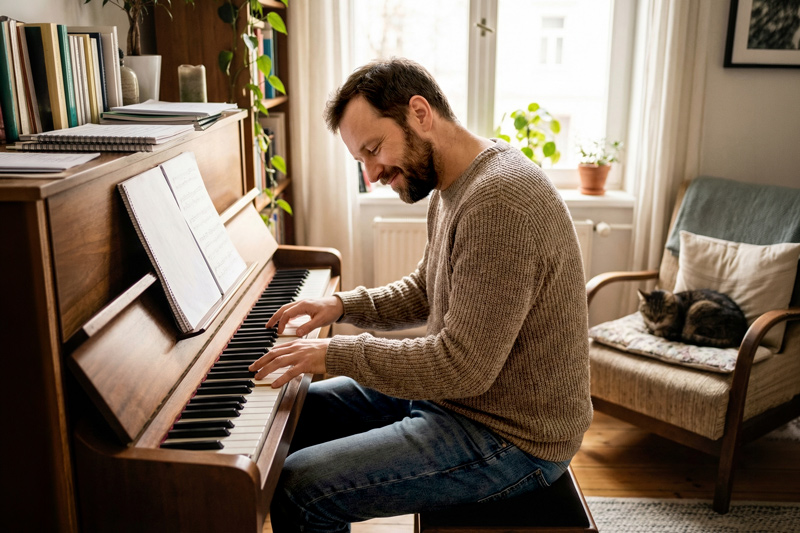
Finally, on a hot summery day in late May 2020, my father came down to my room (my room was in the basement in the house I lived in from 2002 to 2025) to talk to me about everything I was feeling. He looked at my keyboard piano, noting that I’ve barely touched it in years (I was an avid piano player during my pre-teen and teen years but lost interest in it for reasons I won’t go on about here). Then, he looked at me and said, “You really need to start getting into piano again. You’re so good at it.” I took his advice to heart, and I started my own series on my Facebook and Instagram accounts where I post shortened piano covers of popular mainstream songs roughly twice a week. I haven’t given up on this series either, as I now have hundreds of covers from the past six years. All this new joy because the pandemic brought me to an exceptionally low point in my life. I acknowledge how common it was for people to reunite with long-lost hobbies or discover new passions during the pandemic, though, and I was fortunate to be a part of that crowd.
How Special Interests Impacted My Childhood
I had many conflicts with peers and adults that affected my mental health in some adverse ways during my childhood, but I can’t say these kinds of thoughts were as persistent as they were in my teen and adult years. Still, do special interests help temper any negative feelings? They almost always did because as an autistic child, special interests especially felt strong and rewarding (like a kid getting excited for Christmas). Even when adults in my life reminded me not to do the same things repeatedly, I didn’t want to move away from these interests. This is partially because I didn’t have the social wherewithal to understand why having extremely narrow interests can be socially difficult in the long run, especially if they weren’t things well-liked by children around my age.
On the other hand, during my preteen years, I was at a stage where I knew some of my interests in certain computer or video games deviated from what many of my peers liked. I still thoroughly enjoyed these interests, but whenever someone criticized me for liking them or being “stuck” on them, I would get extra sensitive (sometimes to the point of crying or distancing myself from them for days). At 10 and 11, there was one online game, in particular, that I was so into that I unintentionally annoyed almost everyone around me about it (despite some of my peers also playing it), and that combined with dealing with some rude people in that online community drove me to slowly stop playing the game.
From a distracting me from schoolwork struggles or social isolation struggles standpoint, these interests distracted me immensely during my childhood. However, it came with the cost of being bullied or shut down by people, and how I responded greatly depended on how socially aware I was at the time.
Understanding the Power of Special Interests on the Autistic Mind
The way my brain has processed special interests has been an eye-opener in a way that has helped me get through the worst storms of my life. If it weren’t for them and the support from some incredible people in my life, I probably would not have much motivation to do the kind of things I have been doing in the past and present. It’s evident that this is true for many other autistic people, too, and I fully accept that. Although I had some extremely difficult times, things sometimes must get worse before they get better, and that was evident with the online friends I made who have my shared weather interest, as well as my motivation to start my piano series.
Cory Morrison is a Freelance Writer. He can be reached by email at [email protected] or phone at (647) 338-9095.
References
Beck KB. Trauma and Social Adversity in Autism: Considerations and Directions for Clinicians and Researchers. Pa J Posit Approaches. 2024 Sep;13(2):23-32. PMID: 40236681; PMCID: PMC11997697.
Chiang AH, Chang J, Wang J, Vitkup D. Exons as units of phenotypic impact for truncating mutations in autism. Mol Psychiatry. 2021 May;26(5):1685-1695. doi: 10.1038/s41380-020-00876-3. Epub 2020 Oct 27. PMID: 33110259.
Long R-EM. Access Points: Understanding Special Interests Through Autistic Narratives. Autism in Adulthood. 2025;7(1):100-111. doi:10.1089/aut.2023.0157