
 Source: Grok
A large study of Finnish youths who sought care from gender clinics has found evidence challenging the prevailing claim that gender-transition interventions are tied to improvements in mental health. Quite the contrary. This new study found that the use of specialist psychiatric care—an indication of severe mental health problems—increased dramatically among those adolescents and young adults who underwent gender-transition interventions.
Among such youths, the proportion who had appointments with specialist psychiatrists prior to attending the gender clinic, compared with the proportion who had such appointments during later years, rose: among natal males, from 10 percent to 61 percent; and among natal females, from 22 percent to 55 percent.
The study, published Saturday in Acta Paediatrica, included data on nearly 2,100 Finnish people who first sought care from a gender clinic before age 23 between 1996 and 2019. Thirty-eight percent underwent gender-transition interventions.
Youths who first presented to gender clinics in 2010 or later had much worse mental health than those who presented previously, the researchers found.
The study gave credence to the theory, anathema among proponents of gender-transition interventions for minors, that for some adolescents, gender dysphoria may be an outgrowth of deeper psychological problems and that their adoption of a transgender identity may amount to a maladaptive coping mechanism.
The study authors concluded that, among some youth presenting at gender clinics, gender dysphoria “may be secondary to other mental health challenges.” They continued: “The notable increase in those contacting [gender clinics] and the increased psychiatric morbidity among them since the 2010s may also suggest that, for some, mental health challenges may manifest as concerns related to gender identity.”
After controlling for differences in the prior use of specialist psychiatric treatment, the study authors found that regardless of whether they underwent gender-transition treatment, youth who went to gender clinics had much higher use of specialist psychiatric treatment during follow-up compared with age-matched controls from the general population—about three times higher than females and five times higher than males.
Given the study’s robust and comprehensive data set, long follow-up time and use of age-matched controls, it addressed key limitations seen in various other studies that have found such interventions are linked to improvements in mental health outcomes. Most studies of youth who undergo gender-transition interventions are small, have short follow-up times, no control groups, and suffer from substantial loss to follow-up.
The Finnish study’s four coauthors have published some of the strongest scholarship challenging the assertion that providing them to adolescents improves their mental health and is life-saving. All of these Finnish investigators were also coauthors of a paper published in 2024 that found that there was no independent, statistically significant association between taking cross-sex hormones and the rate of suicide deaths among youths attending gender clinics.
One of the coauthors, Dr. Riittakerttu Kaltiala, a psychiatrist at Tampere University in Finland, was tasked with founding one of the nation’s two pediatric gender clinics in 2011. Over the years, she became increasingly concerned that her patients were not improving on gender-transition interventions. So she began to systematically document what she observed. In 2023, she wrote an article for The Free Press entitled: “Gender-Affirming Care Is Dangerous. I Know Because I Helped Pioneer It.”
‘Gender-Affirming Care Is Dangerous. I Know Because I Helped Pioneer It.’
Dr. Riittakerttu Kaltiala, 58, is a Finnish-born and trained adolescent psychiatrist, the chief psychiatrist in the department of adolescent psychiatry at Finland’s Tampere University Hospital. She treats patients, teaches medical students, and conducts research in her field—publishing more than 230 scientific articles…
Read more
2 years ago · 1667 likes · 577 comments · Riittakerttu Kaltiala
Dr. Kaltiala, whom I met when she presented her suicide research at the 2023 conference of the Society for Evidenced Based Gender Medicine and who I have interviewed a few times, is frequently pilloried by transgender activists as a supposed bigot driven by animus toward transgender people. I have never detected any veracity to this claim.
 ‘Rubbish’—Finland’s Top Pediatric Gender Psychiatrist Derides Exposé Claiming Her Clinic Provided Shoddy, Cruel Care
 Systematic literature reviews—the gold standard of scientific evidence—have all found that the research backing the use of puberty blockers and cross-sex hormones to treat gender dysphoria in youths is weak and unreliable. It was due in part to Dr. Kaltiala’s influence that Finland conducted its own systematic literature review of pediatric gender medicine. Given the review’s findings, the nation has sharply restricted youths’ access to gender-transition interventions.
Dr. Kaltiala and her colleagues found in their new study that among youth who presented at gender clinics, those who did not ultimately undergo gender-transition interventions had a much higher rate of previously attending specialist psychiatric appointments. The study authors theorized that part of the reason for this difference could be that severe mental illness is a contraindication for such interventions in Finland. So those who showed up at the clinic already severely mentally ill would have been less likely to be approved for gender-transition drugs.
The study is buttressed by the robust health data that Finland keeps on all citizens, from birth to death. The authors’ task was simplified by the fact that gender-identity assessments for potential gender-transition interventions are centralized at two university hospitals.
The study examined health data on youths who first presented at these clinics between 1996 and 2019 and who did so before they hit age 23. The follow-up period began after that first appointment and continued until either June 2022 or the death of the patient.
Each of the 2,083 youths who presented at the gender clinics (who I’ll refer to as the “gender-dysphoric youths”) was matched with four male and four female controls from the general population according to age and the municipality in which they were born.
The average age of the youth at their first appointment at the gender clinic was 18.5 years old. About two thirds were between 16 and 20 years old at that point. There was an average of 5.5 years of follow-up data, including a median of 5 years and a maximum of 25 years.
A total of 481, or 23 percent, of the youths with gender dysphoria were natal males and 1,602, or 77 percent, were natal females. Such a lopsided sex ratio became typical of youth gender clinics across the Western world starting in the mid-2010s. Prior to then, youths at these clinics were predominantly natal males.
The study looked at the use of specialist psychiatric treatment, which in Finland is reserved for those with severe mental health problems. So this metric stood as a proxy for serious mental illness.
Among the gender-dysphoric youths, 46 percent had specialist psychiatric treatment prior to the date when they first attended the gender clinic and 62 percent did so during the period beginning two years after that date. This compared with 15 percent and 15 percent who did so, respectively, among the controls.
Over their lifetimes, just 23 percent of the gender-dysphoric youths had no appointments with specialist psychiatrists, compared with 74 percent of the controls. Twenty-two percent of the gender dysphoric youths had 26 to 100 lifetime appointments and 28 percent of them had more than 100. This compared with a respective 6 percent and 4 percent of the controls who did so.
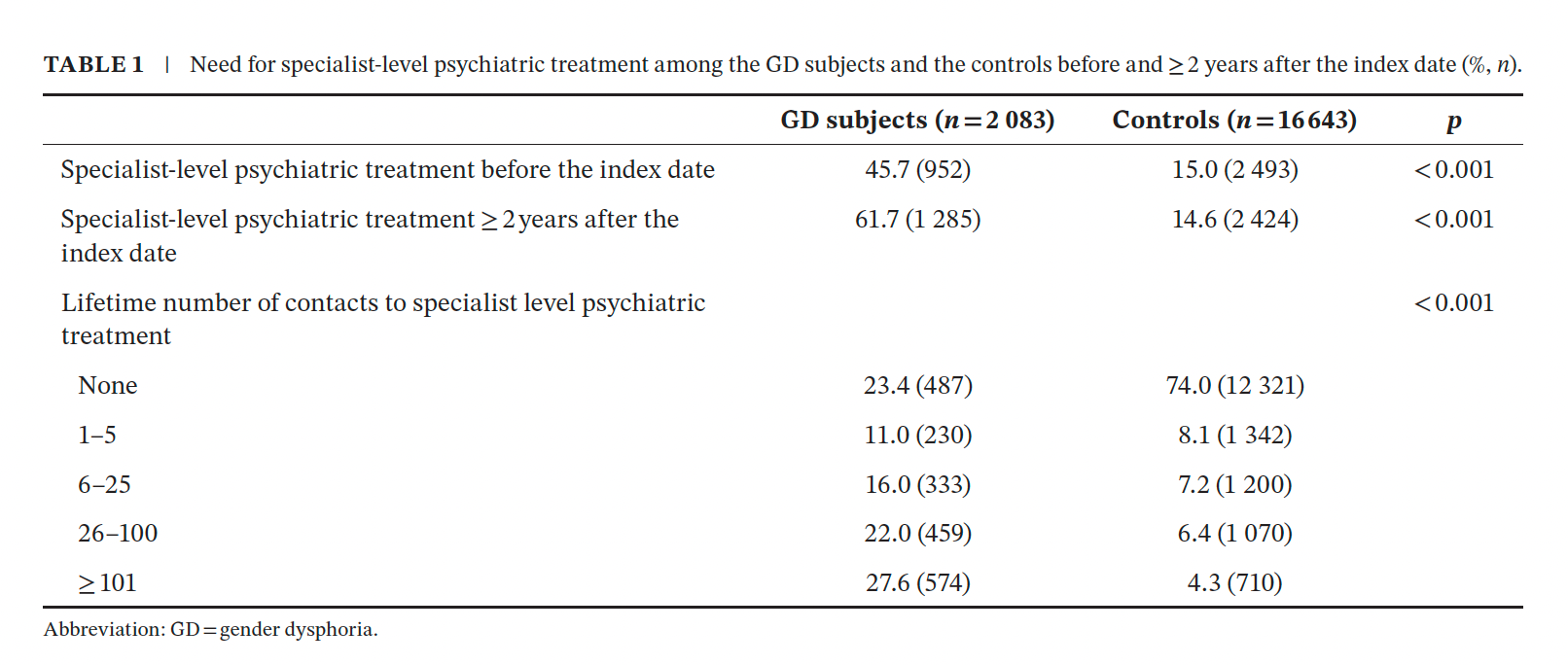 The “index date” is the date of a youth’s first appointment at the gender clinic. The first figure in each column is the percentage and the figure in the parenthesis is the number of people. The “p” stands for p-value, which is a measure of statistical significance. All the p-values in this chart were below the study’s threshold for statistical significance of 0.01.
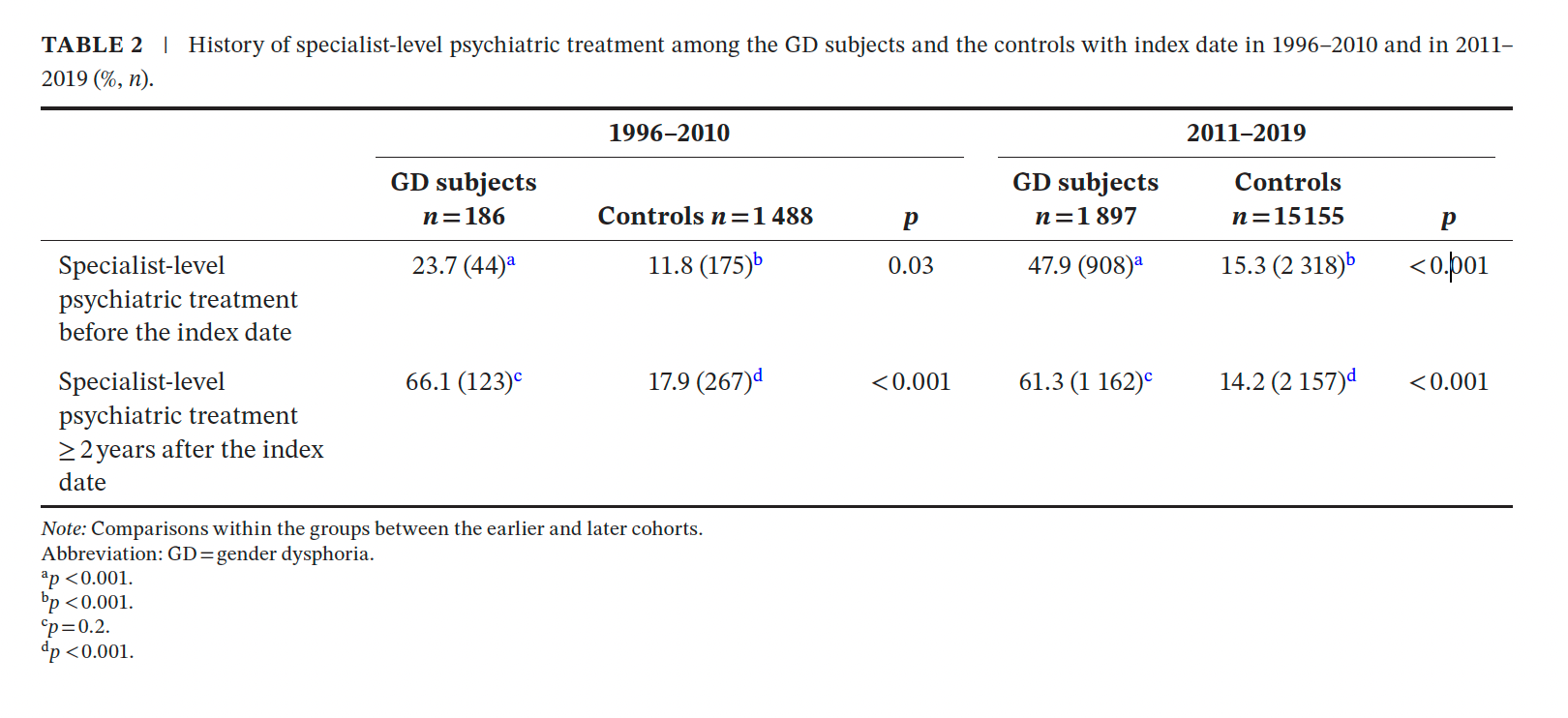
For those who first presented at a gender clinic between 1996 and 2010, 24 percent of the gender-dysphoric youth and 12 percent of the controls had specialist-level psychiatric care before the date of that first appointment—a difference that did not quite meet the study’s threshold of statistical significance.
By stark contrast, among those who first presented at a gender clinic between 2011 and 2019, 48 percent of the gender dysphoric youth had had such psychiatric care, compared with 15 percent of the controls—a difference that was statistically significant.
Those youth who presented at gender clinics but who did not undergo gender-transition interventions had a very high rate of previous specialist psychiatric care, including 53 percent of the natal males and 65 percent of the natal females. Their rate of psychiatric treatment during the period two or more years after that first gender-clinic appointment didn’t change much: to 60 percent and 67 percent, respectively.
The gender-dysphoric youths who did undergo gender-transition interventions arrived at the gender clinics with a much lower rate of previous use of specialist psychiatric care: 10 percent among natal males and 22 percent among natal females. But notably, two years or more after their first gender-clinic appointment, this group’s use of specialist psychiatric care shot up, to 61 percent among the natal males and 55 percent among the natal females.
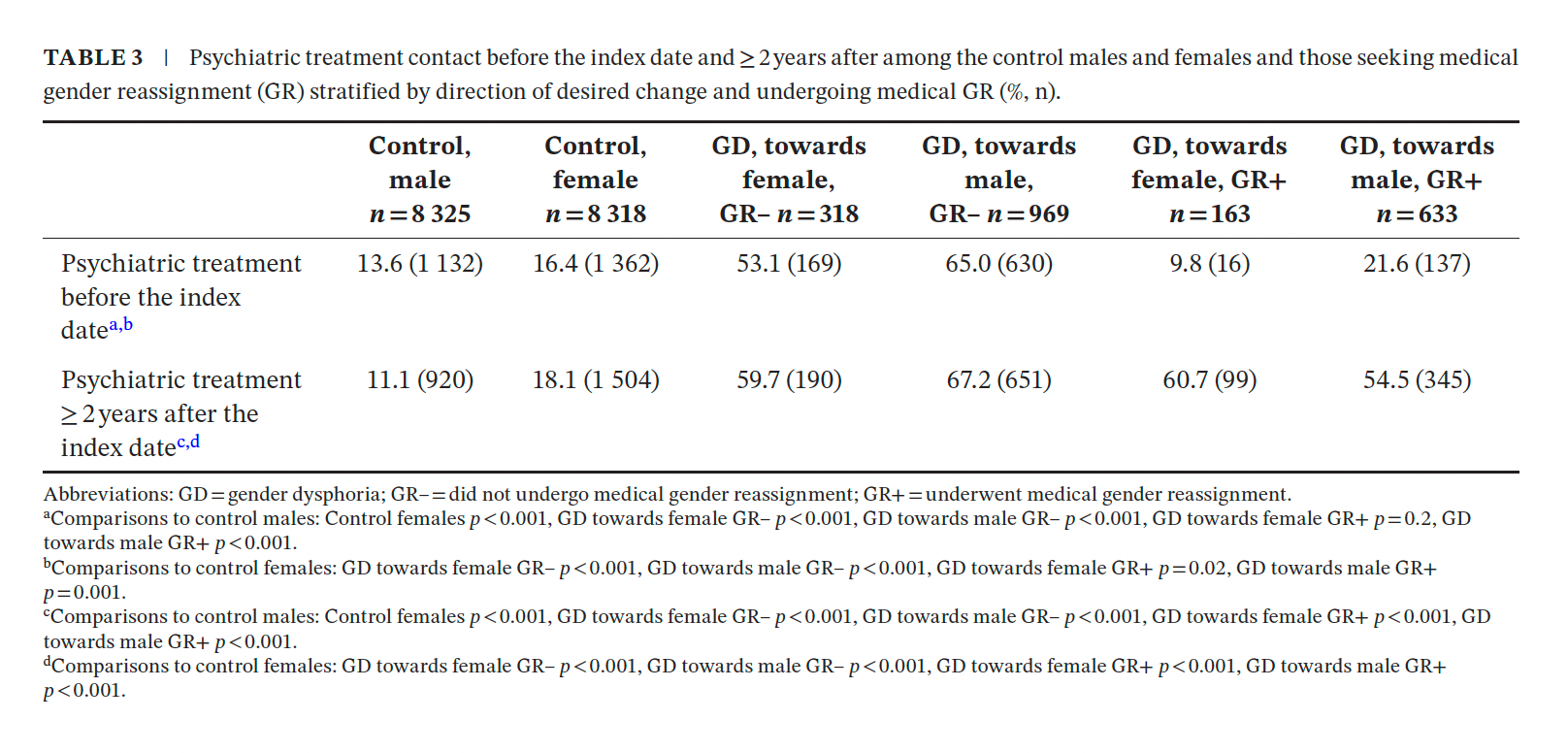 “GD towards female” are the natal males with gender dysphoria and “GD towards male” are their natal-female counterparts. “GR-” means they did not undergo gender-transition treatment and “GR+” means they did. The first figure in each column is the percentage and the figure in parentheses is the number.
When comparing all the rates of use of such psychiatric care both before and after the date of the first gender-clinic appointment, there were only two pairs of comparison that were not statistically significantly different. This included between both the control males and control females and the pre-gender-clinic rate seen among the natal males who ultimately received gender-transition treatment.
The study authors found that being born more recently was associated with somewhat worse mental health. A more recent first appointment at the gender clinic was also tied to worse mental health
The investigators controlled for differences in the use of specialist psychiatric mental health care prior to the first appointment at the gender clinic, for the year of birth, and for the date of first gender-clinic appointment. They then found that there were no substantial differences in the subsequent use of such psychiatric care based on whether youth received gender-transition treatment.
The study authors noted that “increasingly, adolescents with severe psychiatric morbidity are referred” to youth gender clinics. “The change is hardly attributable to improved recognition of mental disorders, as no similar rise was observed in the control group.”
The investigators addressed a common theory that poor mental health outcomes among youth identifying as transgender are attributable to what’s known as minority stress—or the stress stemming from stigma toward and mistreatment of transgender people. They noted that with improving attitudes toward transgender people in more recent years, one would have expected, under this theory, to see a decrease in psychiatric problems in youths attending gender clinics; but the opposite occurred. This, along with the surge of youth seeking gender-identity services since the 2010s, they wrote, “may also suggest that for some, mental health challenges may manifest as concerns related to gender identity.”
“Mental health challenges may manifest as concerns related to gender identity.”
Looking at the greater increase in the use of specialist psychiatric treatment among the natal males who received gender-transition interventions compared with their natal-female counterparts, the study authors theorized that this might have been driven in part by the fact that estrogen treatment has been found to potentially cause depression in both transgender and cisgender women.
The study authors wrote in their conclusion: “When prior psychiatric morbidity was controlled for, the gender-referred adolescents had a 5-to 6-fold increased need for specialist-level psychiatric treatment two years or more after the index date compared to the male controls, and 3-to 4-fold greater risk compared to the female controls, regardless of the desired direction of change and [gender-transition-treatment] status.”
They continued: “This does not support the suggested improvement in mental health after medical [gender-transition treatment] initiated during developmental years, and in light of the present findings, severe psychiatric disorders do not appear primarily attributable to [gender dysphoria]. Psychiatric disorders require their due treatment regardless of a young person’s gender identity.”
I am an independent journalist, specializing in science and health care coverage. I contribute to The New York Times, The Guardian, NBC News, The Free Press and The New York Sun. I have also written for the Washington Post, The Atlantic and The Nation. Follow me on Twitter: @benryanwriter and Bluesky: @benryanwriter.bsky.social. Visit my website: benryan.net