
While some movies are meant to entertain, and there is nothing wrong about that, a few movies try to change the world, and there is something wonderful about that.
“No One Cares About Crazy People” is among the latter, admittedly smaller, group. It will be shown at 2:45 p.m. Saturday at Columbia College’s Film Row Cinema (1104 S. Wabash Ave.) as part of an ongoing national tour. After the film, there will be a panel discussion that will include director Gail Freedman.
She will surely talk about the film’s strong Chicago connections. Its soundtrack is composed and performed by Jeff Tweedy, the lead vocalist and guitarist of Wilco, who lives on the North Side. The narrating voice you’ll hear is that of Bob Odenkirk, the suburban native and busy star of such shows as “Breaking Bad” and “Better Call Saul” and on and on.
The focus of the film is this country’s shameful and destructive mental health system. There is a chilling intimacy to this film, for it brings us up close to some of the people (and families) suffering. We meet Mark Rippee, a blind man who has been dealing with schizophrenia for more than 15 years. He is somehow managing to live homeless in a California town, even as his sisters attempt to help him by fighting the system and caring for him as they can.
We meet Carmelo and Kendra Burgos, a loving couple trying desperately to find calm waters in the face of Carmelo’s bipolar disorder, rocking the familial boat. We meet a young man shot by the police. We get a solid (if depressing) look at the history of mental illness “treatments.” There is a bit of politics, with California Gov. Gavin Newsom trying to do some right things.
There is a small slice of hope even as we meet Kevin Powers. He was the youngest of the two sons of Ron Powers and Honoree Fleming. Ron Powers was, many of you may remember, the 1973 Pulitzer Prize-winning TV critic for the Sun-Times. He would leave town and write 20-some critically acclaimed and best-selling books, such as a couple about Mark Twain (they were both natives of Hannibal, Missouri) and “Flags of Our Fathers” (the basis for the Clint Eastwood film). He collaborated with Sen. Ted Kennedy in the memoir “True Compass.” He also taught and won an Emmy for commentary on “CBS News Sunday Morning.”
He would marry Fleming, a professor, and they would live in Vermont and raise their boys, Dean and Kevin. To see photos of them when younger is to imagine a happy family. But things did not go that way.
Both sons, Dean and younger Kevin, were smart and creative. Kevin was a guitar prodigy. But his behavior became increasingly unstable and strange, and he had trouble dealing with medications. He was just shy of his 21st birthday when he died by suicide.
Eventually, almost a decade after that suicide (and some troubles with Dean, who would also be diagnosed with schizophrenia), Powers did what he does best, and the result was a book, “No One Cares About Crazy People: The Chaos and Heartbreak of Mental Health in America” (Grand Central Publishing).
The first sentence of the book is “This is the book I promised myself I would never write,” and he later calls it “a call to arms on behalf of these people for any society that dares describe itself as decent.”
Director Freedman heard that call when the book was published in 2017. She and Powers had known one another through their work at CBS, and she credits him and his book as her inspirations for the documentary.
The book was consistently lauded, with Ron Suskind in The New York Times calling it “extraordinary and courageous … (Powers) writes with fierce hope and fierce purpose to persuade the world to pay attention.”
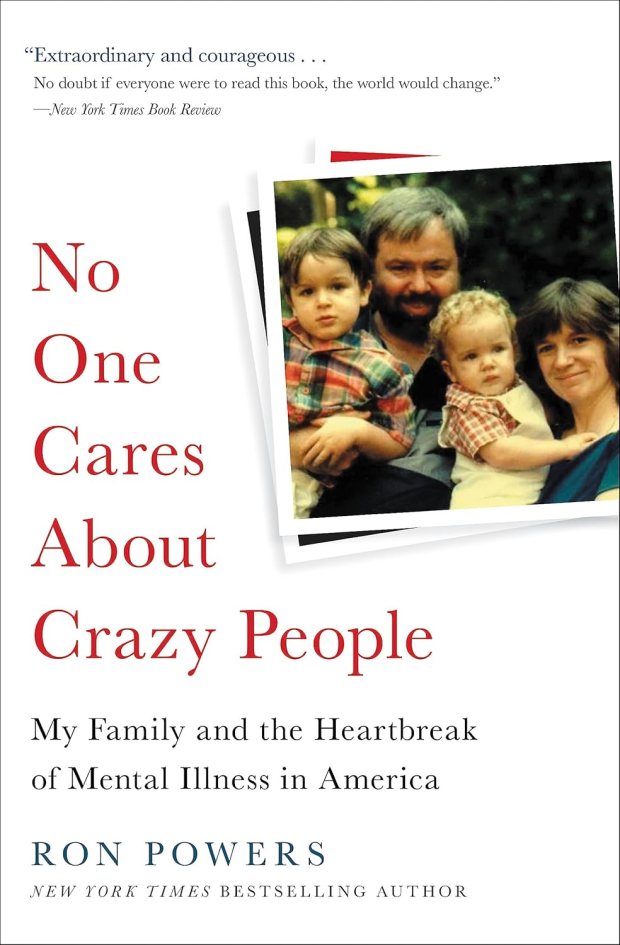 “No One Cares About Crazy People: The Chaos and Heartbreak of Mental Health in America” by Ron Powers. (Grand Central Publishing)
Senator Patrick Leahy (D-Vermont) called it a “gripping and deeply personal story… (Powers’) compelling account helps shake us out of the embarrassment and apathy that have tethered public discourse and lasting action to treat mental illness… (He) explains why we need to move beyond the stigma that still makes progress difficult, and sometimes impossible. The story he tells is not a comfortable one, but it’s an important one.”
Mike Miner was similarly impressed, and moved. The late columnist for the Chicago Reader had known Powers since their college days, and they were newspaper colleagues for a time. They remained friends. His review included this on-target observation: “Mental illness can hide in plain sight because we don’t like to think about it.”
We should, though, as this powerful film and equally potent book will convince you. You will know by the movie’s end that Powers’ son Dean is living a stable life. That will make you happy, I think.
I knew Powers a bit and admired him a lot. He does not ask for your sympathy, and he does not mention that, if his life were not tragic enough, his wife was shot and killed while taking a walk near their home near Castleton, Vermont, in the fall of 2023. There was no suspect and the case remains unsolved, and as Powers told the local paper, “She was a beloved woman on campus. She just had a towering intelligence. She was compassionate, self-effacing, she was devoted to our family.”
I wish him and his son peace.
rkogan@chicagotribune.com