
Machete in hand, Gamaliel Camarena sliced the back of a man who managed to escape by ducking into a donut shop and barring the door.
When Camarena couldn’t get at his victim, he then hacked away at a nearby Honda CR-V before police arrested him.
Orange County prosecutors accused Camarena, 36, of attempted murder, assault with a deadly weapon, vandalism and resisting an officer in the January 2022 machete attack. But those charges were put on hold and Camarena instead was allowed to undergo treatment under California’s controversial mental health diversion program. Prosecutors opposed the move, arguing Camarena posed too large a danger to the public.
Instead of a jail cell, Camarena was assigned a bed at the Union Rescue Mission in downtown Los Angeles, where he would live while undergoing outpatient treatment. If Camarena completed the program, the charges would be dismissed.
But he went on to stab a drinking buddy 34 times outside a Venice 7-Eleven store in May 2024. The victim wore layers of clothing that prevented him from sustaining any major injuries to his torso. Camarena, who told detectives he had been genetically cloned in Orange County, was sentenced to life in prison for that assault.
Camarena’s case is often cited by prosecutors statewide to illustrate what they believe is a mental health diversion system that has come off the rails. District attorneys throughout California are pushing for legislative reforms that would tighten up the requirements under which a judge can grant mental health diversion.
Assembly Bill 46, which is in a Senate committee, is the furthest along of three reform bills in the legislative process. Prosecutors say AB 46 would give judges more discretion, making it easier for them to deny diversion to a defendant who they believe would pose a “substantial and undue risk” to the community.
“California’s mental health system is the definition of insanity — and no one seems to be able to find a cure,” said Orange County District Attorney Todd Spitzer, who is co-sponsoring AB 46. “Mental health diversion is continuing to be exploited by individuals who are looking for a ‘get-out-of-jail-free’ card instead of using diversion in the way it was intended — to provide people suffering from mental illness with the treatment they need to address the underlying issues of why they commit crime.”
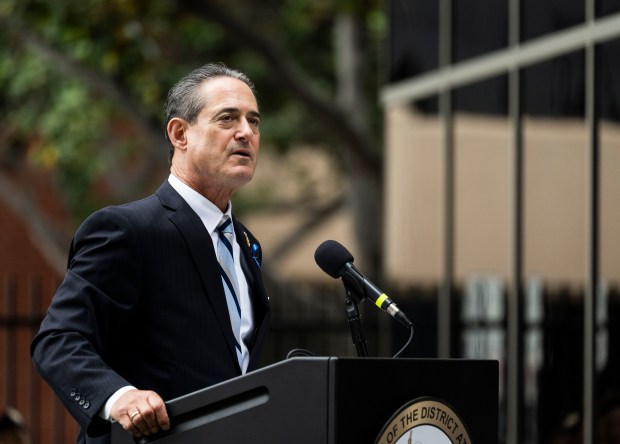 Orange County District Attorney Todd Spitzer (Photo by Paul Bersebach, Orange County Register/SCNG)
Defense attorneys throughout California argue that the bill by Assemblymember Stephanie Nguyen, D-Elk Grove, would make it too difficult for defendants to receive diversion, destroying a mostly successful program. Meanwhile, they say, prosecutors are “cherry-picking” a few horror stories to scare the public into believing the program is out of control. Defendants who go on to commit violent crimes make up a very small portion of people receiving diversion, they say.
“Right now, in California, the crime rate is dropping, not only the rate, but the (raw) numbers are dropping. It’s stunning,” said Kate Chatfield, executive director of the California Public Defenders Association. “And yet DAs and law enforcement and the Republicans and moderate Democrats are attacking a successful program. It’s to demonize people with mental health issues. … All in the name of bloating law enforcement budgets.”
Other mental health diversion reform bills are:
Senate Bill 1373, which, among other things, would add kidnapping, carjacking and human trafficking to the list of offenses for which a defendant would be prohibited from diversion.
Assembly Bill 2275, which, among other things, would require courts to evaluate dangers that a defendant poses, including physical harm and substantial financial harm. It also would prohibit diversion for serious domestic violence cases, unless both sides agree it is appropriate. The bill is co-sponsored by Los Angeles County District Attorney Nathan Hochman.
“We are committed to reforming the state’s broken mental health diversion laws before more violent offenders are released and more victims are predictably harmed,” Hochman said.
Diversion program 8 years old
California’s mental health diversion program was enacted in 2018 under the argument that jailing the mentally ill only makes their condition worse and does not prevent them from committing more crimes upon their release.
Under the program, instead of going through the trial process, criminal defendants whose offenses are significantly tied to their mental disorder can be given community-based treatment. Felony defendants are required to receive treatment for two years and misdemeanor defendants receive one year. Once defendants complete the program, the charges are dismissed. Certain crimes, such as murder and rape, are not eligible for diversion.
Defendants who do not complete the program go back to jail and the trial process.
The program was adopted based on the idea that it would remove the need for costly trials while assuring court-ordered treatment for mentally ill defendants who receive little, if any, psychological care in prison. Without diversion, their mental health would only deteriorate while incarcerated, making them a greater risk to reoffend upon their release.
The numbers show that relatively few defendants statewide are granted diversion.
According to the California Judicial Council, 12,451 petitions were granted statewide from July 2019 to March 2024. Half of them were for felony crimes. The stats do not include Los Angeles and San Diego counties. In Orange County, 609 petitions were granted in that same time period, 279 for felonies; in Riverside County, 882 petitions were granted, 561 for felonies; and in San Bernardino County, 1,009 were granted, 755 for felonies.
Defense attorneys point to a recent Rand Corp. study on Los Angeles County’s rapid diversion program as proof that the system appears to be working. The study, published in September 2024, showed that 53% of those given mental health diversion through the program successfully graduated. Less than 10% of the graduates went on to reoffend.
“It is headed in the right direction,” said Stephanie Holliday, who worked on the Rand study. “We say it’s promising.”
Dozens of shocking examples
Kim Stone, lobbyist for the California District Attorneys Association, agreed that only a small percentage of people given diversion go on to commit violent crimes.
“The overall percentage is low, but the consequences are extreme,” Stone said. “We do have dozens throughout the state of shocking examples. That’s a failure of the system.”
Reformists point to the case of 47-year-old Willie King in Sacramento County, who was granted diversion for burglary charges and assault on a police officer. After his release, King went on to fatally shoot a man who was fixing a fence in March.
And in San Diego County, 34-year-old Grant Parker fatally stabbed a man outside a downtown hotel in February while on diversion for threatening to kill his mother with a knife, carjacking and attacking a cellmate.
Who’s eligible?
There are no guardrails, Assemblymember Nguyen said.
“What we’re seeing is everybody is being granted mental health diversion,” Nguyen said. “Anybody can claim they have some kind of mental health disability. We’re seeing that up and down the state.”
Under the existing law, defendants are eligible for diversion if they have been diagnosed — before or after their crime — with certain mental disorders that played a part in their alleged offense.
The new bill would require that the illness be diagnosed within five years of the offense. The legislative counsel’s digest says the proposal means the defendant must be diagnosed prior to the offense.
That interpretation would have blocked Grammy-winning rapper Lil Nas X from receiving mental health diversion after he was caught in August 2025 wearing only cowboy boots while walking along Ventura Boulevard at 5:40 a.m. Responding officers said he attacked them.
Lil Nas X, whose real name is Montero Lamar Hill, was charged with four felonies and faced up to five years in prison. After his arrest, he was diagnosed with a bipolar condition, making him eligible under existing law to be released on a two-year diversion plan. His case is touted by defense attorneys as a success story for the program.
Rights of victims
Nevertheless, AB 46 would make it easier for judges to deny diversion. Judges would have a broader ability to determine that a defendant is unsuitable for the program. Judges also would have to take into account the rights of the victims.
Under existing law, even if a judge believes diversion is not appropriate, they still might be forced to grant it because of the way the law is written, according to a Senate analysis. A 2022 appellate case — People v. Whitmill — opened the doors for more mentally ill defendants to receive diversion.
Thomas Whitmill was a honorably discharged military veteran with severe mental disorders who was denied diversion for his gun charges. The judge’s denial was overturned on appeal.
“Judges need to be able to do their job, make a decision. Right now their hands are being tied,” Nguyen said. “We’re seeing diversion programs be granted that shouldn’t be granted. This will put the power back into the judges’ hands.”
Chatfield responded that the judges already have plenty of discretion.
“It’s not somebody saying, ‘Oh, I want diversion,’ and they have to give it,” she said. “They need to qualify first.
“Making the diagnosis five years before (the crime), that’s actually going to block the door for a lot of people, a lot of poor people,” Chatfield said. “People don’t get diagnosed as children, it’s when they get into court that a clinical professional can look.”
Opponents note that if AB 46 passes, it would increase the number of defendants declared mentally incompetent to stand trial, meaning they would have to be treated until they can assist in their own defense — adding to the expense of the legal system. Others would face court proceedings, conviction and incarceration, contributing to prison crowding.
“To what end? So they can go to jail and not get treatment?” Chatfield said. “This bill offers no solutions … it’s crime, crime, crime. They cherry-pick one or two cases to take down something.”
Staff writer Sean Emery contributed to this report.