


Caught in the cycle
PART 2
Insufficient care, court delays leave SC victims waiting for
justice in crimes involving mentally ill
By Jocelyn Grzeszczak,
Alan Hovorka and Glenn Smith
April 26, 2026
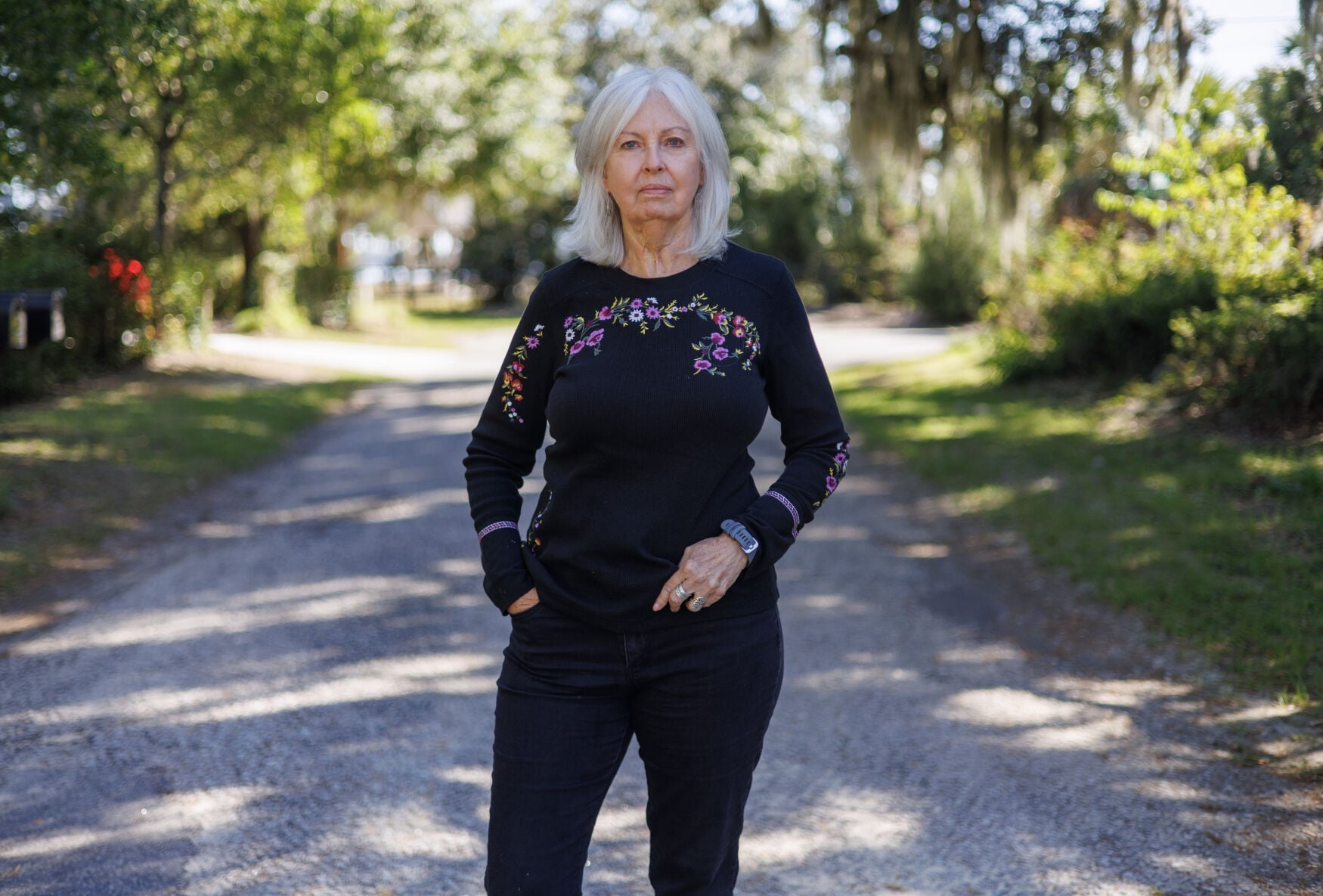
Anne Dickerson stands on the Beaufort Street
where she was shot while jogging in April 2020.
GRACE BEAHM ALFORD/STAFF
Anne Dickerson stands on the Beaufort Street
where she was shot while jogging in April 2020.
GRACE BEAHM ALFORD/STAFF
Anne Dickerson wishes the man who shot her would go to prison.
A Nissan Versa drove up behind her in April 2020 as she jogged through Beaufort’s Pigeon Point, a tranquil neighborhood along the Intracoastal waterway. A man with a mop of reddish-blond hair emerged from the car and pulled out a gun. She saw its glint as he fired three shots.
A single bullet struck Dickerson, then 72, near her right ear. It traveled across her throat, ripping through her trachea, her esophagus and the tangle of nerves in her left shoulder.
As she lay bleeding on the ground, Dickerson had no way of knowing her shooter’s life up until that point had been a tailspin of arrests and mental health treatment. Or that he stabbed someone inside a North Charleston motel room just the week before. Or that she’d still be waiting for justice six years later.
Authorities charged 23-year-old Isaiah Perdue with attempted murder. He was found “not guilty by reason of insanity” — a legal defense that kept him inside a state hospital for nearly three years before a judge agreed to his release.
A retired therapist who specialized in trauma, Dickerson understands better than most that mental illness can cause people to act in ways beyond their control. But a criminal’s mental condition does not diminish the consequences of their actions, she said last June at a hearing concerning Perdue’s release. The shooting left her with permanent disabilities.
“The biggest impact on my life has not been so much the physical or the trauma but the loss of trust in the justice system and the way it works,” she said.

Anne Dickerson was shot close to her home in Beaufort while out jogging in April 2020. Her attacker was found not guilty by reason of insanity.
Grace Beahm Alford/Staff
Dickerson’s frustration underscores an uncomfortable truth buried in many criminal cases where mental illness is a factor: The end result often strips victims of a sense of justice.
Courts and the mental health system can fail both victim and offender before the crime even occurs. Decisions made by hospitals, psychiatrists and court officials — sometimes many years earlier — ripple into the present, damaging lives beyond repair. Then court cases can stretch years, through seemingly endless hospitalizations and assessments, before a conclusion is reached — if it comes at all.
If you or someone you know is experiencing a mental health
crisis, contact the South Carolina Office of Mental Health’s
statewide Mobile Crisis Team, available 24/7/365: 833-364-2274.
South Carolina has a network of 16 community mental health
centers and dozens more local clinics that provide emergency and
outpatient services. To find a location nearest you, here.
National Suicide Prevention Hotline: Call or text 988.
Larry Campbell’s family spent 15 years waiting for closure while the woman who fatally shot him at a Charleston housing project in 2001 cycled in and out of psychiatric care. Like Perdue, a judge found Bridget Williams not guilty by reason of insanity.
In Charleston County, only a sliver of cases ended with an insanity plea. Far more were tossed out because the accused could not participate in their own defense. More than a third of the roughly 1,700 mental competency cases since 1992 were dismissed, according to a Post and Courier analysis of available court records.
Some wound up in probate court to be assessed for additional treatment. There, confidentiality laws caused their trail to go cold in public records.
These open-ended outcomes often leave victims in a state of limbo, never sure what will become of the person who brought them harm.
Sarah Ford, legal director at the South Carolina Victim Assistance Network, said prosecutors need to have frank discussions with victims early on when mental competency comes into play. Some cases won’t ever make it to trial.
“Justice doesn’t always come from a courtroom,” said Ford, a former prosecutor and public defender. “We have to sometimes be OK with not ever receiving that justice and not letting that be the end of us.”
Set up for failure
Perdue told psychiatric examiners his criminal record stretched back to sixth grade. More problems followed, including 2015 arrests for burglary and grand larceny in Dorchester County, where records show his mental competency came into question.
Isaiah Perdue
Charleston County Sheriff’s Office/Provided
In February 2020, Perdue underwent stints at a North Charleston psychiatric hospital and a rehab facility. He had threatened to harm himself and others. He reported hearing voices and seeing things. He had been using meth daily for several weeks.
Less than two months later, North Charleston police officers raced to a low-budget motel on Ashley Phosphate Road, where they found a man beaten and repeatedly stabbed. Investigators obtained a warrant to arrest Perdue in the attack on the same day he shot Dickerson.
Judges in Beaufort and Charleston counties ultimately decided in April 2023 that Perdue didn’t understand right from wrong at the time of the crimes. He left jail the next month for South Carolina’s lone state-owned psychiatric hospital for criminal defendants.
State mental health officials asked a judge on at least four occasions to let Perdue go, according to court records. Months into his inpatient stay, doctors changed Perdue’s diagnosis from schizophrenia to a substance-induced psychotic disorder. He no longer needed psychiatric medications. By February 2025, he had met the maximum benefit of hospitalization, staff wrote in a report.
A judge agreed in March to send Perdue to inpatient rehab at Morris Village, a state-owned treatment center for alcohol and drug addiction in Columbia. Perdue would have another hearing after he completes that stay, according to the judge’s order.
Isaiah Perdue was found not guilty by reason of insanity in the 2020 shooting of Anne Dickerson in Beaufort.
Grace Beahm Alford/Staff
But the judge questioned his insanity plea, saying Perdue’s mental incapacitation was brought on by drugs — not a psychiatric disorder, according to Dickerson, who attended the hearing.
While the judge’s words validated Dickerson’s feelings, they didn’t change the outcome. Perdue will never go to prison for shooting her. He has long demonstrated a disregard for the law and the rights of others, she said. That leads her to believe his release poses a danger to the community — and sets him up for failure.
A Post and Courier investigation found dozens of defendants who bounced back and forth between South Carolina’s criminal justice and mental health systems without receiving long-term care. Many times, they were spit out onto the street to manage severe illnesses on their own. Over time, petty crimes turned into felonies.
And people like Dickerson unknowingly wandered into harm’s way.
Hatchet murder ‘as senseless as it gets’
Sean Strojny and his girlfriend thought they were helping a fellow homeless man in need when they offered him their spare tent on a rainy afternoon in August 2022. The stranger accepted, waiting out the bad weather at the campsite tucked in the woods behind the James Island Walmart on Folly Road.
Charleston Police Department officers stand near the site where 36-year-old Sean Strojny was killed in a hatchet attack in woods behind the Walmart off Folly Road on James Island, Friday Aug. 12, 2022.
File/Gavin McIntyre/Staff
The couple woke a few hours later to the same man’s voice. He asked for a cigarette. Then came the sound of shredding fabric as a hatchet tore through their tent. The steel blade collided with the woman’s arm before she managed to escape. Authorities found Strojny about 40 yards away, dead from multiple head wounds.
Sean Strojny, 36, was killed on Aug. 11, 2022, behind a James Island Walmart.
Amy Strojny/Provided
Police identified their attacker as 42-year-old Theodore Wagner. They accused him of assaulting four victims during a violent 36-hour crime spree on James Island and Folly Beach. In addition to killing Strojny and injuring his girlfriend, investigators charged Wagner with stabbing another man and punching a third.
Bob Norberg, Strojny’s stepfather, thought the carnage would almost certainly land Wagner in prison. It did not. Wagner’s decades-long struggle with mood and delusional disorders, along with substance use, stood squarely in the way.
“Every murder is senseless,” Norberg said. “But goddamn, you gotta know that Sean’s murder was just about as senseless as it gets.”
A psychiatric evaluation for Wagner shows he was treated more than 40 times at hospitals in multiple states stretching back to at least 2008, mostly for suicidal thoughts and substance use. Wagner’s father brought him to the Medical University of South Carolina the week before Strojny’s killing; he grew concerned for Wagner, who reported walking on top of parking garages, claimed people were following him and heard voices telling him to “do things he didn’t want to do.”
Theodore Wagner
File/Charleston County Sheriff’s Office/Provided
Hospital staff discharged Wagner on Aug. 4, 2022, with a plan to offer him multiple outpatient treatment resources. He returned to the emergency room Aug. 9, a day before the violent attacks began. Again, they released him.
There’s no excuse for what Wagner did, Norberg said. But he can’t help feeling like South Carolina’s health care system failed Wagner as much as it did his stepson.
“His actions — long enough and loud enough — should have been addressed, and they weren’t,” Norberg said.
State doctors tried to treat Wagner’s psychosis so his court case could move forward. After four months, however, his symptoms showed little improvement.
A probate judge in August 2024 ordered him to return to the inpatient hospital in Columbia. Wagner will stay there until he no longer presents a danger to himself or others, and can make responsible decisions about his treatment, per state law.
In the meantime, the case has ground to a halt. And Strojny’s family remains in the dark about whether Wagner will ever face his charges.
“Knowledge is power, and we have no power,” Norberg said, “at least at this point.”
They’re not the only ones. The Post and Courier examined the criminal cases of 206 Charleston County defendants, including Wagner, whose ability to stand trial was questioned. About half of those cases were dismissed since 1992. The defendants’ competence likely played a role, according to the newspaper’s analysis.
Roughly 80 defendants entered guilty pleas. Many of them received time-served sentences, reflecting the often lengthy periods already spent behind bars.
Norberg is furious with Charleston prosecutors, who indicated Wagner was going to trial — until he suddenly wasn’t. Officials have assured his family that Wagner could one day be tried if he gets better.
Ninth Circuit Solicitor Scarlett Wilson said she understands and sympathizes with the family’s frustration. That uncertainty is a key reason her office has been reluctant to dismiss charges against some violent offenders who have been found incompetent. Prosecutors want the ability to claw those cases back if a defendant’s mental health improves. A dismissal could mean that person winds up in probate court, which lacks the ability to continuously monitor them, Wilson said.
“You’re telling me this person is OK enough to be let out, to live alone, to run their everyday life, but they’re not competent to stand trial?” Wilson said. “That doesn’t compute to me.”
Failed prosecution in attack on police chief
Victims across South Carolina must reckon with the possibility that their quest for justice may run headlong into the reality that some people can never be tried. This holds true even when the victim is a police officer.
David Hayes, the former police chief in Fort Lawn, Chester County, learned that lesson after a January 2020 roadside attack in his small town left him with more than 200 stitches.
Former Fort Lawn Police Chief David Hayes at police headquarters on Thursday, Feb. 12, 2026, in Chester County. Hayes was attacked by a man in the midst of a severe psychotic episode due to untreated schizophrenia in January 2020.
Grace Beahm Alford/Staff
Hayes responded to a report of a frantic man on the side of a road. The chief spotted 31-year-old Amilleo Mingo and asked if he needed help. Mingo stared back at Hayes, sweat pouring from his body.
“You’re Satan. I’m about to eat you,” Hayes recalled him saying.
Mingo leapt through the passenger window and attacked Hayes, twice biting the chief’s left ear. The pair rolled from the vehicle and into a nearby ditch. They remained locked in a struggle until bystanders intervened to help restrain Mingo, who was charged with aggravated assault and harming a police officer while resisting arrest.
Hayes later learned that Mingo was in the midst of a severe psychotic episode when he attacked.
“He actually swallowed the ear,” Hayes said.
Former Fort Lawn Police Chief David Hayes was attacked by Amilleo Mingo, who was in midst of a severe psychotic episode due to untreated schizophrenia in January 2020.
By Grace Beahm Alford gbeahm@postandcourier.com
Candice Lively, then the Sixth Circuit’s deputy solicitor, vowed to prosecute Mingo to the fullest extent possible. She quickly learned her efforts wouldn’t go very far.
Mingo was too unstable for Chester County’s jail, Lively said. A local hospital stabilized him with medication but couldn’t keep him long-term. He soon unraveled when he returned to jail. Court officials struggled with how to move his case forward.
“I couldn’t believe it, that was one of the first really bad cases I had,” the prosecutor said. “And I was like, ‘You mean to tell me there’s nowhere to put these people?’ ”
Four months after the attack, a judge found Mingo not guilty by reason of insanity, sending him back to jail to wait for a bed at a psychiatric facility in Columbia.
Amilleo Mingo at the Fairfield County Courthouse, Thursday, February, 2, 2026. Mingo was having a severe psychotic episode due to lapsed treatment for schizophrenia when he attacked Fort Lawn Police Chief David Hayes in January 2020.
Grace Beahm Alford/Staff
Mingo told The Post and Courier that he had unsuccessfully tried to get treatment for his schizoaffective disorder prior to the attack. Records show that a day before he tangled with Hayes, a state clinic turned Mingo away. They did so after he became belligerent with staff, Mingo and his attorney said. An area hospital had no room for him.
Mingo has disjointed memories of the attack, but recalls feeling as though he and the chief were locked in a “spiritual war.” He strongly believes medication could have quelled his behavior that day.
“It was totally out of my control. I wasn’t myself, I tell you that,” he said. “That’s something that I would never do to another human being.”
Mingo apologized to Hayes in court. The chief found Mingo to be sincere, which eased his mind a bit. But Hayes still felt the sting of resentment for a wrong that wasn’t righted.
Hayes hoped Mingo could get help and better his life. But he also wanted consequences. And he saw Mingo’s insanity plea as a free pass.
Today, Mingo prays the chief has forgiven him. Mingo said he has forgiven himself twice now as he has worked through treatment. He knows Hayes could have killed him that day, and he wants the chief to understand he is grateful for the second chance.
A judge ordered Mingo’s release from inpatient psychiatric care in February 2021. He has since married and works as a security guard.
As for Hayes, he has hung up his badge. He decided to end his law enforcement career the day Lively told him the case couldn’t be further prosecuted. Why, he wondered, should a civil servant like him continue to risk his life in a system incapable of supporting him in return?
Faces of the cycle
‘Our system is broken.’
Donna Grant’s husband
Ronald terrorized her for years in their Oconee County home,
beating her and unleashing torrents of verbal use. Diagnosed with
schizophrenia, he had been repeatedly arrested for domestic
violence and underwent counseling for his anger, records show.
But Ronald, 73, always came home in short order
with few consequences in the courts for his behavior, his wife
said. And the psychiatric help he received never lasted long enough
to make a difference in her husband, who was a “very mean
individual,” she said.
For the better part of a decade, Donna Grant said, she slept in a
separate, locked bedroom with a chair propped against the door, a
pistol under her pillow and a Belgian shepherd at her side. Still,
her husband forced his way in.
“The atmosphere in the house was so … I almost want to say
possessed,” she said. “It was horrible.”
Donna Grant said she stayed because she refused to give up her home
and abandon the horses, dogs, cats and other animals she cared for
there.
Oconee County sheriff’s deputies hauled Ronald
Grant off to jail again in June 2020 after he stormed into his
wife’s bedroom and tried to strike her with a metal rod. This
marked his fourth arrest since 2018, records show.
This time, a judge found him unfit to stand trial and dismissed his
domestic violence charges. Another judge committed Ronald Grant to
a state psychiatric hospital.
But Grant lingered at the county jail for 81 days, waiting for a
spot to open. He required constant care and supervision, pulling
detention staff away from other duties to meet his needs, jail
officials said.
His health went downhill. The coronavirus likely sapped his
strength. His breath rattled in his chest, and a nurse suspected
his lungs were giving up.
On the evening of Jan. 12, 2021, Grant became unresponsive and
stopped breathing as two officers helped him with a shower after he
defecated on himself.
Grant died at a hospital the next morning from a combination of
maladies: a heart attack, acute renal failure, COVID-19 and a
build-up of lactic acid in his bloodstream.
When Donna Grant heard the news, she felt one emotion above all:
relief.
She said she is happy to be rid of him. But she does wonder why the
state’s criminal justice and mental health systems couldn’t have
intervened sooner.
“Our system is broken,” Donna Grant said. “I mean, once, yes. You
can forgive once. But two times, three times, four times? You know,
there’s something wrong with that picture.”
In the end, she said, she was left to fend for herself.