
A gambling addiction expert has called for prediction markets, which allow gamblers to bet on world events, to be regulated in Ireland.
Prediction markets such as Polymarket and Kalshi have ballooned in popularity since the beginning of the year.
Speaking to RTÉ’s This Week, Professor Colin O’Gara, head of addiction services as St John of God’s Hospital said prediction markets were an example of the “proliferation of gambling”.
“This is the constant non-stop proliferation of the gambling product, from initially sports into casino and then onwards into everyday life and predictions around all kinds of different things such as geopolitics, real human suffering, health outcomes,” he said.
For prediction markets in particular, Prof O’Gara compared them to trading for addiction services.
“It’s really the attractiveness of the intellectual piece, the current affairs, nature of it, and that blurring really, the harms are not necessarily very clear at the outset,” he said.
Prof O’Gara added: “I think this is an accelerated form of trading
“I think it’s a lot more potent and it’s heavily marketed and normalised.
“I think for the general population, I think this is something that we need to be aware of, the dangers of it and the need to regulate it.”
Large bets have been placed on pivotal geopolitical events such as the kidnapping of Venezuelan leader Nicolas Maduro, and the initial assaults on Iran just hours before they took place.
Aides to the White House in the United States have been told not to place bets on prediction markets with non-public information.

A US special forces soldier involved in the operation to capture Nicolas Maduro was charged this week with using classified information about the mission to win more than $400,000 (€342,480).
In Irish politics, more than $1,000,000 (€853,000) has been bet on the two upcoming bye-elections for Dublin Central and Galway West, expected to take place in early summer.
Unlike a bet placed with a bookmaker, in a prediction market the business arranges for another gambler to take the other side of the bet. No one bets against ‘the house’.
“Prediction markets like Polymarket have opened up the opportunity for people to make money off new kinds of information,” explained Karl Whelan, economics professor at UCD.
“In some cases, that’s harmless. Like, ‘Is Ricky Martin going to sing at the Super Bowl?’ And in some cases, like ‘will a certain power plant be bombed’ it’s a lot less harmless,” Prof Whelan said.
Because so much of their data is publicly available, prediction markets are a valuable data tool for economists.
“Markets are now being run on all sorts of political races that there probably may not be good polls for.”
Gamblers winning large sums of money on political events
There have been some high-profile examples of gamblers winning large sums of money on political events using prediction markets. Although opinion polls had the 2024 US presidential election on a very tight margin, prediction markets forecast that Donald Trump would comfortably win the popular vote, which is what happened.
Polling voters is a timely and expensive process.
Polymarket, one of the largest prediction market platforms, claims on its website that the predictions on its platform are “backed by financial conviction that are often faster and more accurate than experts or surveys”.
“You get an unbiased view of what thousands of traders think will actually happen, often more accurate than polls,” the site reads.
For the upcoming byelections in Galway West and Dublin Central, prediction markets are taking bets on who will win and lose.
However, Liz Carolyn, political journalist with TheBriefing.ie is sceptical.
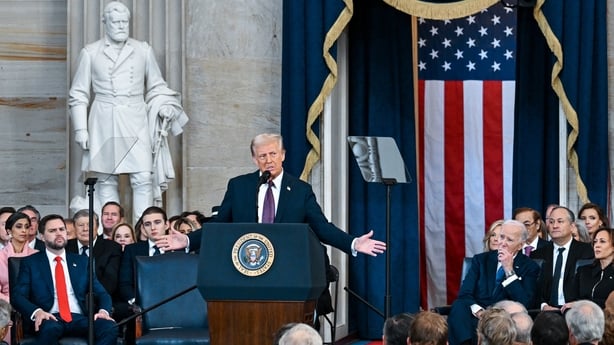
Prediction markets forecast that Donald Trump would comfortably win the popular vote
“Prediction markets in modern politics is a relatively new phenomenon,” she said.
“They only became legal in the US right before the last presidential election, so we don’t have a good body of data on how accurate they are.
“But I imagine that in a very small context like Ireland’s, they’re not going to be hugely helpful.
“There may be small amounts of money that could skew things massively in one direction or another.
“I wouldn’t trust predictive markets over opinion polls,” she added.
“And opinion polls are pieces of, you know, kind of social science that interview people who have their right to bode and who are planning to bode and try and come up with an analysis based on demographics.”
Prediction markets use a cryptocurrency stablecoin on their platforms so all bets can be made anonymously. This means we do not know whose betting.
Because the markets are not regulated in Ireland, any Irish user does not have the same consumer or gambling protections that they have when betting with a bookmaker.
“Firms like Paddy Power and Ladbrokes have to operate in line with responsible gambling rules,” Prof Whelan explained.
“If they see somebody that’s losing a lot of money, there are protocols around trying to contact that person or see does that person have the resources to continue making those losses.
“No such procedures exist once you’re dealing with unlicensed operators.
“Licensed and regulated bookmakers also pay tax.”
Prof O’Gara agrees that financial regulation of prediction markets is needed in Ireland.
He added: “There needs to be clarity around the naming of the market in Ireland in terms of is this a gambling product, and in my view it is.
“At the moment, we have neither.”
In a statement to RTÉ’s This Week, the Gambling Regulatory Authority of Ireland (GRAI) said that prediction markets do “bear the hallmarks of betting activity”.
This means that under the Gambling Regulation Act, they require a license from the regulator in order to operate.
The GRAI began accepting and processing applications for remote betting licences just two months ago
And the first licences arising from this, are not expected to be issued until this July.
It is an offence to provide betting activity without a license from the GRAI and the regulator has the power to go to the High Court to direct a person providing a prohibited gambling activity to stop and can ask the court to block access to providers of prohibited gambling activity, as well as orders to block payments.
When asked about the risk unregulated betting markets could pose to vulnerable gambling users, the GRAI said: “Unregulated markets and unlicensed operators post the greatest risk to society as a whole particularly to children and those vulnerable to excessive or compulsive gambling”.
Most of the obligations of the gambling regulation act only apply once an operator has been licensed.
“When an operator provides unlicensed gambling activities, oversight is removed and the risk of harm is radically increased,” the GRAI said.
Polymarket did not respond to a request for comment.