
Park City’s no-cost, safety-net health clinic is expanding pediatric and behavioral healthcare to meet rising demand.
Dr. Zainab Kagen, a pediatrician who has lived in Park City since 2017, and Denisse Zepeda, a new behavioral health counselor, have joined People’s Health Clinic as part of a broader effort to integrate medical and mental health services for children.
Clinic leaders say the need is growing.
“Volunteer pediatricians are noticing an increase in the number of children they are seeing who have recently lost insurance,” said Dr. Mairi Leining, the clinic’s CEO.
Kagen, who splits her time between the clinic and University of Utah Health, said expanding access to care is a priority, especially as families face uncertainty in coverage.
The need comes amid broader shifts in health coverage. Enhanced Affordable Care Act subsidies — first introduced during the COVID-19 pandemic and extended through 2025 — expired at the end of last year after Congress did not renew them, increasing costs for families and leaving more children uninsured.
“Studies have shown when adults are affected, the children are affected, too,” Kagen said. “We’re expecting there may be more pediatric patients who are uninsured, and we want families to know we’re here as a resource.”
The clinic recorded more than 1,300 pediatric-related visits last year, with wait times for dedicated pediatric appointments stretching up to 10 weeks. Kagen said part of her role is helping shorten that gap, including offering same-day visits for urgent needs.
“Kids get sick last minute,” she said. “We want families to be able to call and be seen that day.”
At the same time, the clinic is expanding behavioral health services for children — an area Kagan said is increasingly urgent as more and more kids are being diagnosed with things like anxiety and depression at younger ages.
Zepeda, MSW, MA, who began working at the clinic in April as a Behavioral health councilor, previously provided therapy services in Park City schools through a University of Utah program that lost funding late last year.
“There’s so much need,” Zepeda said. “I was really happy to come back and help the community that I was supposed to be helping.”
Her path into mental health work has been shaped by personal experience, years in education and a desire to better support children navigating complex challenges, she said.
Zepeda brings an experienced foundation to the role, shaped by years of study and hands-on practice across disciplines. After initially earning a degree in engineering, she obtained a master’s degree in literature from the University of Utah and transitioned into education, spending nearly a decade working in schools.
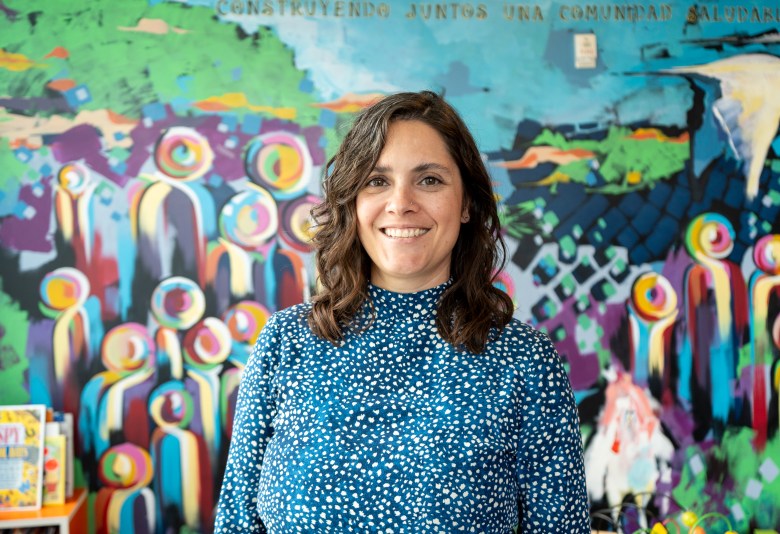 Denisse Zepeda, MSW, MA, stands in the lobby of the People’s Health Clinic, where she now works as a psychotherapist. Credit: Jonathan Herrera/Park Record
Before becoming a therapist, she worked as a teacher in Utah, where students often came to her with problems they weren’t sharing at home.
“I realized how much kids need someone to listen to them,” she said. “They’re often misunderstood, and their problems get minimized.”
Those experiences — including working with students facing trauma, family instability and loss — ultimately led her to pursue a master’s degree in social work.
Her background blends classroom experience, clinical training and cross-cultural perspective, positioning her to support a wide range of patients, particularly children and families navigating complex challenges.
Now at the People’s Health Clinic, she is part of a model aiming to bring pediatric and behavioral health care under one roof, allowing providers to coordinate care more closely and reduce barriers to access.
Zepeda said one of the most meaningful parts of her work is seeing patients begin to open up to the idea of mental health care — especially in communities where stigma remains.
“I’ve seen patients that I would have never imagined considering mental health help,” she said. “I feel honored to be part of that stage in their life.”
She noted that stigma around therapy can still be strong, particularly within Hispanic communities, where seeking help is sometimes misunderstood or discouraged.
“There’s still a lot of beliefs like, ‘You only go if something is really wrong,’ or ‘You should handle things on your own,’” she said.
By offering services in a trusted, community-based and bilingual clinic, Zepeda said the goal is to make care more accessible to families who may not otherwise seek it.
“I think this clinic is really a bridge,” she said. “To create access for the people who have not ever considered therapy before or who don’t have the resources to go to a place in a much more accessible way.”
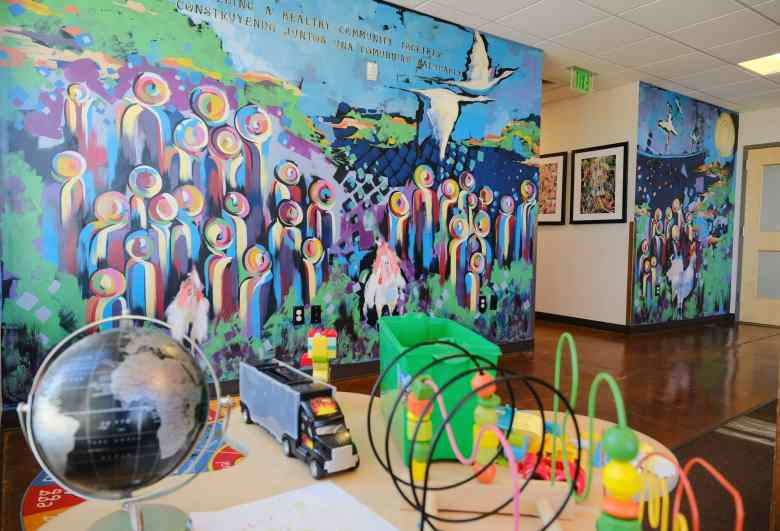 A new mural in the lobby of the People’s Clinic was painted by local artists William J. “Kranny” Kranstover and his daughter, Malia Denali. The title, “Building a Healthy Community Together,” is the People’s Health Clinic’s creed.
She said she hopes to expand access to therapy so more patients can experience the kind of supportive therapeutic relationship that has had a meaningful impact on her own life.
Integration between physical and mental health care is critical, Kagen said, especially as more children experience anxiety, depression and other challenges at younger ages.
“It’s a known trend,” she said. “I want to see how we can integrate pediatric care and behavioral health together, especially for school-age and teenage patients.”
Much of pediatric care, she added, is preventative and extends beyond physical health.
“We’re looking at growth, diet, stress, sleep, vision, their social life,” she said. “How are they handling what’s going on with friends, with family? Pediatric care is really about the whole picture.”
That whole-child approach also extends to parents and caregivers who can find answers to questions about themselves and their children through the clinic. Kagen said this is especially important for families who face barriers to care, including language, cost or access to insurance.
“Oftentimes we are answering a lot of the questions that they have,” she said. “Maybe about themselves or about parenting and understanding the future for their kids, too.”
She added, “I just really love helping people in this community, especially children who may need extra support.”
Kagen has two children in local schools, an experience she said shapes how she approaches caring for patients and families in the community.
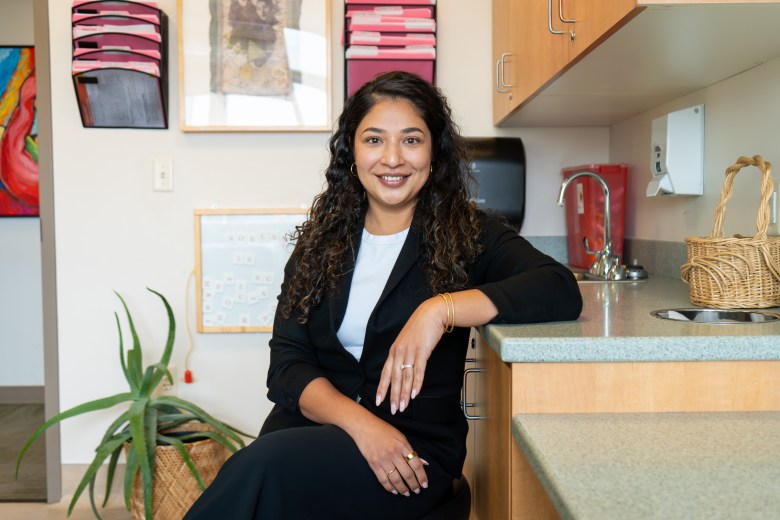 Doctor Zainab Kagen is the newest pediatrician at The People’s Health Clinic. Credit: Jonathan Herrera/Park Record
Leaning on her experience, Kagen brings a strong clinical background that includes training at Indiana University, medical school at the American University of the Caribbean and a pediatric residency in Chattanooga, Tennessee.
Now more than a decade into her career, her work has increasingly focused on early diagnosis and identifying concerns before they escalate, particularly in areas like developmental delays and behavioral health. That emphasis, she said, is critical in pediatric care, where early intervention can significantly improve long-term outcomes for children.
In Zepeda’s experience, the clinic stands out for how quickly families can access behavioral health care, noting that patients are often able to be seen within a few weeks — a significantly shorter timeline than in many other settings, where pediatric mental health appointments can take months to secure.
With the addition of Zepeda, access is expected to improve further, allowing the clinic to reach patients even more quickly.
Zepeda said the work requires both resilience and deep empathy.
“You cannot do this job without passion,” she said. “It’s not an easy job, but I’m happy and honored to do it.”
Looking ahead, she hopes her work can make even a small but meaningful difference.
“I hope I get to be the person who helps someone think that maybe there’s a reason to wake up tomorrow,” she said. “If I do that for one person, that’s enough.”
Both providers said they are focused not only on expanding access, but on listening to families to better understand what the community needs.
“I don’t want to just assume,” Kagen said. “I want to hear directly from families.”
As People’s Health Clinic continues to grow, leaders say the addition of both pediatric and behavioral health providers reflects demand and a broader shift toward more integrated, equitable care in the community.
Related Stories