
Sign up for TPR Today, Texas Public Radio’s newsletter that brings our top stories to your inbox each morning.
Psychedelic treatments are moving closer to federal approval, with the U.S. Food and Drug Administration taking steps to fast-track several compounds under review.
The agency recently said three companies will receive National Priority Vouchers to speed their psychedelic drugs through the approval process.
These include two psilocybin compounds for treatment-resistant depression and major depressive disorder, and methylone, a drug similar to MDMA, for post-traumatic stress disorder. Each previously received Breakthrough Therapy designation, which the FDA awards to therapies for serious conditions that demonstrate a substantial improvement over currently available therapies.
That announcement came one week after President Donald Trump signed a psychedelics executive order, which signaled the federal government’s support for states, including Texas, that are working to create access for psychedelic treatments that show promise for addressing life-threatening conditions, but are currently illegal in the U.S.
So you may be wondering how psychedelic-assisted therapies work, who might benefit from them, and how Texans can access them. Here’s what to know.
Which psychedelics are in clinical trials and how do they work?
Psilocybin, MDMA, LSD, 5-MeO-DMT, and ibogaine are among the psychedelic compounds being studied in FDA clinical trials for mental and behavioral health conditions.
Many researchers believe that psychedelics promote healing by inducing the brain’s ability to change and form new neural connections. In combination with therapy, they may help people develop new ways of thinking and processing trauma.
Lynnette Averill, PhD, told Texas Public Radio that psychedelic-assisted therapy involves one or a few psychedelic experiences which support ongoing therapy, and the effects are felt quickly, within hours to days.
Averill, who leads a psilocybin clinical trial at Baylor College of Medicine and the Menninger Clinic, said this differs from daily antidepressants, which generally take weeks or months to help patients feel better, if at all.
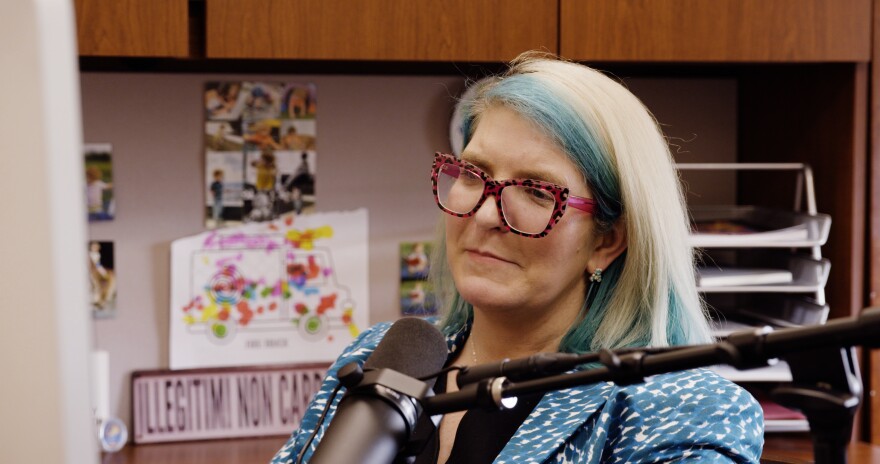
Lynnette Averill, PhD, Associate Professor of Psychiatry, Baylor College of Medicine and Director of Research, The Menninger Clinic, was interviewed in 2025 for Texas Public Radio’s Petrie Dish podcast series, Psychedelics and the Texas Trip.
Filling a void in mental and behavioral health treatments
More than 49,000 Americans died by suicide in 2023. Thousands of veterans, first responders, and civilians have sought psychedelic-assisted therapies abroad after unsuccessful treatment in the U.S. for conditions including depression, PTSD, substance use disorders, and traumatic brain injuries. Many have credited these treatments for saving their lives.
One person’s trip to Mexico for psychedelic-assisted therapy
Garret Coppedge, an Austin attorney diagnosed with complex PTSD and major depressive disorder, said his depression escalated in law school. For several years, he tried talk therapy, took antidepressants, and underwent a series of ketamine infusions. Each intervention helped a little, but none provided lasting effects.
When the stakes of his high-pressure job worsened his depression, he looked for alternative treatments. It was that or wind up his practice to find less stressful work.
“And I love being a lawyer,” says Coppedge, “so it really broke my heart.”
In February, Coppedge and his partner Amanda flew to San Diego where they got in a van and drove an hour south to Mexico with staff from The Mission Within, a clinic that operates an ibogaine and 5-MeO-DMT psychedelic-assisted therapy program.
Before the trip, the clinic’s coaches prepared Coppedge during online therapy sessions. They discussed health risks, discomforts he might experience, and what Coppedge hoped to get out of psychedelic-assisted therapy.

View from The Mission Within, a clinic in Mexico that operates an ibogaine and 5-MeO-DMT psychedelic-assisted therapy program.
During the retreat in Mexico, Coppedge was joined by a cohort of peers, including special operations veterans. On the first day, each of them underwent medical tests to ensure they could safely participate.
Ibogaine, the first psychedelic compound they would ingest, is derived from a shrub native to Africa, and has been used during spiritual and healing ceremonies for hundreds of years.
Marine Corps combat veteran, Ryan Roberts, who underwent an ibogaine treatment at The Mission Within, told Texas Public Radio in an interview last year that the treatment helped him improve his mental health, and he no longer has chronic migraines from a traumatic brain injury he endured during combat. Others say ibogaine treatments helped them end their opioid addictions. Along with health benefits, however, ibogaine and other psychedelics have risks. Ibogaine is associated with cardiotoxicity — and some deaths have occurred related to its use — which is why the treatment requires a trained medical team.
Thi Lam / Texas Public Radio
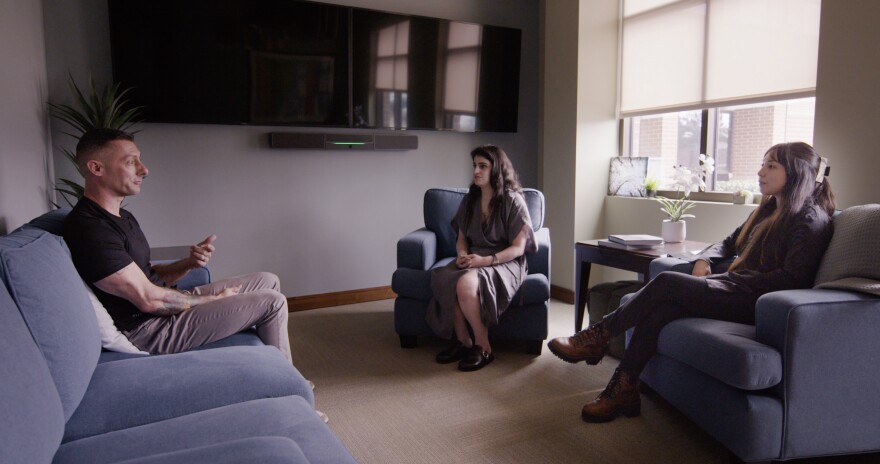
Marine Corps combat veteran Ryan Roberts participated in a mock therapy session in 2025 for Texas Public Radio’s Petrie Dish podcast series, Psychedelics and the Texas Trip. Roberts is in a psilocybin dosing room with assistant professor Amanda Tamman (center) and research coordinator Mia Del Motte (at right) who supported Baylor College of Medicine’s psilocybin study for veterans with PTSD at the Menninger Clinic in Houston
“We arrived on a Tuesday, and the first thing we did was go to downtown Tijuana to get an EKG and a sonogram to check our hearts,” recalls Coppedge. “After extensive testing, they cleared us to go.”
Later that day, Coppedge’s cohort participated in group ceremonies, writing down their intentions and sharing what they hoped to take from the experience. “I felt an immediate camaraderie — we were all down there to get better,” says Coppedge.
Around 8 p.m. on that first evening, the cohort entered a room where each was hooked up to an EKG machine and an IV in preparation for the hours-long, all-night experience.
Coppedge lay down in a bed. After taking the ibogaine medicine, he recalls feeling terrified, because, he says, “there was no turning back.”
Often, people who experienced ibogaine described watching scenes, not from Hollywood movies, but from pivotal moments — such as childhood traumas and violent war battles — in their own lives. They described reliving these moments as spectators, an objective perspective that may help them process their traumas.
That type of visual experience didn’t happen for Coppedge. He recalled seeing an old family photo that disappeared quickly. Instead, his prolonged visions were more abstract, bright colors traveling around him, which felt like electricity and energy flowing through his body.
At points, he thought he might die. He felt nauseated and vomited, which provided relief. “About that time, the visions stopped and the medicine took it a little easier on me,” says Coppedge.
His biggest takeaway was to trust that the medicine would give him what he needed. “The point is to let go,” says Coppedge. “Reliving stuff from my past wasn’t what I needed. I needed to come to the present moment.”
Before he took ibogaine, Coppedge explained to a nurse how he experiences depression. When stress escalates, Coppedge feels panic attacks and loses control of his breathing.
“She was there during the most difficult part of the ibogaine experience, coaching me to find my breath. And once I started to do that, to find my breath, that’s when I finally felt okay.”
Coppedge says the day after an intense ibogaine experience is called “gray day” because many participants feel tired and nauseated. On Wednesday, gray day, they rested and wrote in journals.
On Thursday, the cohort prepared for their final psychedelic experience. They smoked 5-MeO-DMT, a powerful, fast-acting medicine naturally derived from the venom of the Sonoran Desert toad, which can also be chemically synthesized. 5-MeO-DMT is often called the “God Molecule,” because, for many, it induces mystical experiences and feelings of oneness.
“That’s not what it felt like for me,” recalls Coppedge. After smoking 5-MeO-DMT, he felt intense anxiety, as if his body and the universe were dissolving. He described it as “an off-gassing of trauma,” and he cried and screamed.
“In the meeting before, they told us, if you hear people screaming, don’t be alarmed, it’s just the sounds of getting better,” says Coppedge. “I loved that phrase, because that’s what it was. It wasn’t blissful, but it was deeply cathartic.”
It’s been two months since Coppedge’s trip to Mexico. He says his anxiety hasn’t vanished but it’s more manageable. At home, he is focusing on healing through talk therapy, meditation, journaling, exercise, and reconnecting with his community.
He has also found a renewed love for his legal career.
“I learned that I am the medicine — everything I need is within me,” says Coppedge.
Courtesy photo / Garrett Coppedge
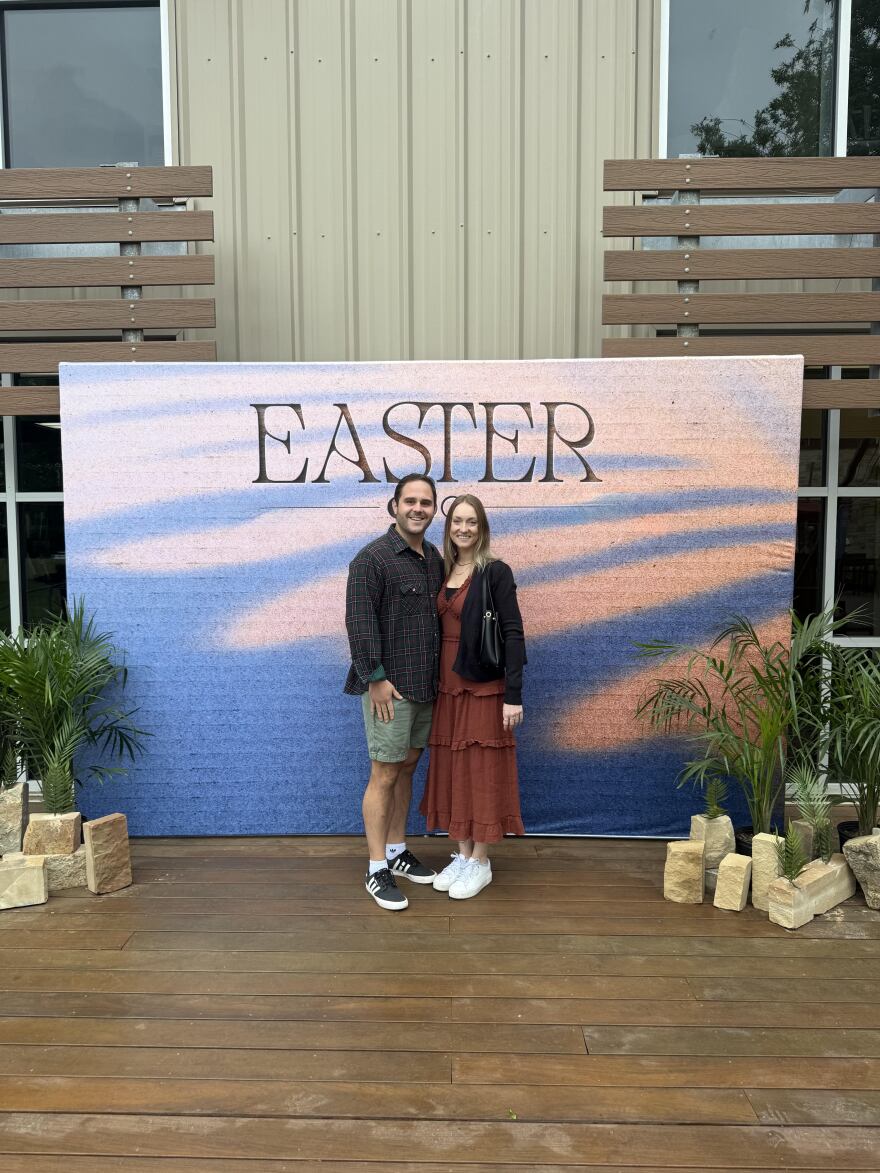
Garrett Coppedge and his partner Amanda one month after his treatment
Texas’ outsized role in supporting psychedelic research
Since 2021, Texas and about 30 states have passed or proposed bipartisan legislation to fund psychedelic research, propose regulatory reform, create regulated access programs, and establish task forces to plan how these treatments will be implemented in the U.S. healthcare system.
“Nothing we’re seeing play out on the national stage would have happened without Texas,” says Logan Davidson, who has developed psychedelic legislation and serves as legislative director of Veterans Exploring Treatment Solutions and senior advisor of Texans for Greater Mental Health.
Davidson points to Texas’ landmark laws, backed by veterans, for sparking a psychedelic policy revolution. In 2021, Texas became the first state in the U.S. to pass legislation (HB 1802) that funded psychedelic research, a psilocybin clinical trial for veterans with PTSD. Then, in 2025, Texas made the largest public investment in psychedelic research in American history at that time. SB 2308 allocated $50 million in state funding for ibogaine clinical trials.
Courtesy photo / Rachel Barno
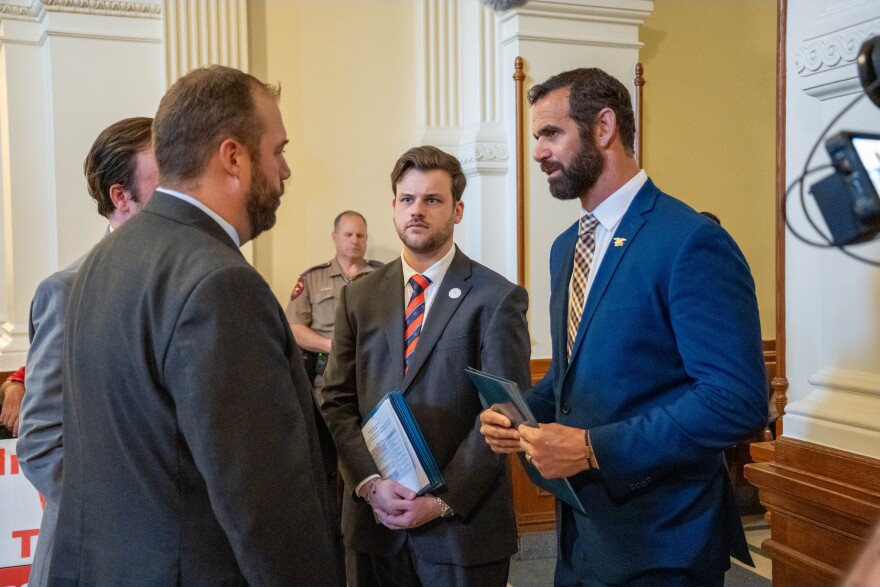
At the Texas State Capitol in 2025, Logan Davidson (center), Marcus Capone of Veterans Exploring Treatment Solutions (at right), and Texas state Rep. John Bucy discuss SB 2308, a law that will fund ibogaine clinical trials.
Meanwhile in Congress, U.S. Rep. Dan Crenshaw, who serves Texas’ 2nd district, led the bipartisan Douglas Mike Day Psychedelic Therapy to Save Lives Act, named after a former Navy SEAL and Silver Star recipient who died by suicide. The legislation, included in the 2023 defense budget, provided $10 million in grants to study psychedelic treatments.
Key advocates for psychedelic research include former Texas Governor Rick Perry and Bryan Hubbard, CEO of the non-profit advocacy organization Americans for Ibogaine. The pair succeeded in getting the Texas Legislature to pass SB 2308. Now, they’re working with lawmakers throughout the U.S. to create similar state-funded ibogaine clinical trials. Several states have passed or proposed legislation and may get a boost from President Trump’s executive order which allocates at least $50 million to match state-funded psychedelic research programs.
How Texans can legally access psychedelic-assisted therapies
Currently, there are two legal ways to access psychedelic-assisted therapy in Texas: ketamine clinics and clinical trials.
“Ketamine-assisted therapy is available at clinics throughout Texas. There’s even some telehealth options,” says Davidson. “Ketamine gets grouped in with psychedelics, but it does not have the same limitations as being a Schedule I compound awaiting FDA approval.”
Most psychedelics were classified as Schedule I compounds after the 1970 Controlled Substances Act was enacted. Schedule I drugs, including psilocybin, MDMA, LSD, 5-MeO-DMT, and ibogaine, are illegal to use and possess, and are defined as having no currently accepted medical use.
The legal way to access Schedule I psychedelics in Texas is through clinical trials, which researchers are leading at institutions across the state, including at Baylor College of Medicine and The University of Texas at Austin. A full list of U.S. clinical trials is available on ClinicalTrials.gov.
Adults who travel to Oregon and Colorado can access psilocybin with trained facilitators. Voters in those states passed ballot initiatives to create regulated access programs.
New Mexico’s medical psilocybin program is anticipated to launch by the end of 2026. The program will treat conditions such as depression, PTSD, substance use disorders, and end-of-life care.
How President Trump’s executive order could help make psychedelics available in every state
One part of the executive order directs the FDA Commissioner to provide National Priority Vouchers to companies whose psychedelic compounds have received Breakthrough Therapy designations, which include formulations of psilocybin, LSD, MDMA, and 5-MeO-DMT.
“Think about the FDA drug development process as a highway. Getting Breakthrough Therapy designation is like driving in an express lane. A National Priority Voucher is like having a police escort,” says Davidson. “Those drug applications will be reviewed on the most accelerated timeline possible. If the data supports approval, then the FDA will approve them.”
While the timeline is uncertain, FDA Commissioner Martin Makary told NBC News that the first psychedelic drug might be approved this year.
The executive order also establishes a way for patients with life-threatening and terminal conditions to access Schedule I drugs under the Right to Try Act. Under this law, these patients can access experimental drugs that have passed Phase I testing but are not FDA approved. To access psychedelics in this way, qualified patients would need a willing prescriber and a government-approved manufacturer.
For years, the U.S. Drug Enforcement Administration has denied patients with life-threatening conditions access to Schedule I psychedelic drugs that have cleared Phase I testing through the Right to Try Act, because the Controlled Substances Act classifies Schedule I drugs as illegal. It’s a catch-22.
“The Right to Try pathway is reconciling a conflict in existing law,” says Davidson. “There’s a bill in Congress right now, the Freedom to Heal Act, that specifically seeks to address this, but it’s tricky to assign a timeline.”
If the FDA approves psychedelics, health insurance coverage and a trained psychedelic facilitator workforce throughout the country would need to be in place to ensure that all Americans gain access.
Today, people who travel abroad for psychedelic-assisted therapy pay out of pocket, unless they receive support from charitable organizations. They also endure risks involved in accessing medical care outside the United States.
Coppedge estimates he spent around $10,000 for his treatment and trip to Mexico, one that coincided with cartel violence. “I was terrified, says Coppedge, “but I felt that I had no other option.”