

Restoration teams are on site at the Multnomah Athletic Club in Portland, Ore., May 4, 2026. The facility was damaged after a man drove an explosives-laden vehicle into the entrance of the building in the early hours of Saturday morning.
Frankie Benitez / OPB
Despite the damage, fear and loss of life, the explosive devices driven into the Multnomah Athletic Club and detonated by a former employee could’ve been far more devastating, Portland police said during a news conference Monday afternoon.
“It is simply luck that we didn’t have a much larger blast,” Portland Police Bureau Sgt. Jim DeFrain, who works on the Metropolitan Explosive Disposal Unit, told reporters.
Just before 3 a.m. Saturday, Bruce Valentine Whitman, 49, crashed a rental vehicle through the glass windows of the MAC building. Whitman drove around inside the club’s ground floor before several pipe bombs inside the vehicle detonated. He died in the car after it went up in flames.
Whitman had a long history of mental illness and anger directed at the MAC and its members, according to court records and family accounts.
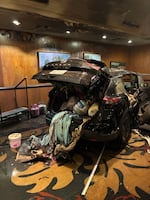
A vehicle, loaded with propane tanks, sits inside the Multnomah Athletic Club. Police officials say the car held 20 propane tanks and approximately 10 improvised explosive devices.
Courtesy of the Portland Police Bureau
Portland Police Commander James Crooker said Whitman was a lone actor. During a search of his home, officers didn’t find any manifesto or note. Crooker said so far there is no intent of domestic terrorism.
“We are pretty far along in the investigation,” Crooker said. “He was fixated on his former employer and in an act of suicide, he intended to destroy that building. There doesn’t appear to be any intent to have done anything further.”
The vehicle contained 20 intact propane tanks and approximately 10 improvised explosive devices, some of which had exploded. As a result, investigators said they don’t know exactly how many bombs were inside the vehicle, Crooker said.

Propane tanks recovered from the vehicle that drove into the Multnomah Athletic Club on May 2, 2026.
Courtesy of the Portland Police Bureau
“We recovered two or three live devices from the scene that were in different stages of detonating,” DeFrain said. “And these things, bombs want to explode, and so it’s incumbent on us to be wildly careful.”
DeFrain said the first responders who arrived on scene early Saturday morning did not initially know about the explosive devices inside the vehicle.
“The firefighters began to pull the propane tanks out, and one of the firefighters opened up a door and a partially detonated pipe bomb fell at his feet,” he said. “It’s important to recognize how close this was to a real tragedy, and how lucky we are that it wasn’t.”
DeFrain described Whitman as “sophisticated” and “intelligent.”
The FBI tracked down video footage from retail stores that shows Whitman making purchases for the explosive devices.
“He went to great pains to make sure that he purchased the components for the devices at multiple different locations to prevent any of the individual locations from realizing what was about to occur,” Crooker said.

An undated image provided by family, of 48-year-old Bruce Valentine Whitman, who drove an explosives-laden vehicle through the front of the Multnomah Athletic Club early May 2, 2026. According to Whitman’s mother Rita Lenzer, he had struggled with mental illness for several years and was diagnosed with bipolar disorder and schizophrenia.
Courtesy of Rita Lenzer
Court records reveal turbulent behavior, threats
As far back as 2022, Whitman threatened to destroy the MAC and showed up at the homes of six different club members, according to Multnomah County Circuit Court records.
“Whitman threatened to kill one member’s neighbor, threatened to kill a different member and told them he was going to burn down the MAC, and told another member he was there to murder the member,” Portland Police Officer Michael Hansen wrote in a June 15, 2022, petition ordering Whitman to surrender deadly weapons.
Oregon’s red flag law went into effect in 2018. It enables family members, roommates and law enforcement to petition the court to “remove a weapon, or a concealed handgun license, from an individual who is at risk for suicide or is a danger to others.”
Whitman’s history was previously reported by The Oregonian.
According to court records, Whitman looked for MAC stickers on vehicles around Portland and would confront members in their cars. During an incident May 24, 2022, Whitman drove alongside another car driven by a woman who was a MAC member and flagged her down.
“After she stopped to see what he wanted Whitman yelled insults at the member and told her ‘I am going to kill you,’” Hansen wrote in the petition. He also noted in the same document that Whitman believed people at the MAC were “involved in a campaign of harassment and wanting to cause him physical harm.”
Police did not find Whitman’s concerns valid.
“Whitman has accused police officers and crisis responders of being sent by the MAC to harass him when they have had contact with him,” Hansen wrote.
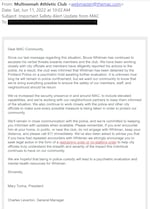
In June of 2022, the Multnomah Athletic Club sent an email to inform members of Whitman’s escalated threats.
Obtained by OPB
Whitman worked as a bartender at the MAC before he was fired. In June of 2022, club security informed members in an email that Whitman’s verbal threats had “escalated” and that he had been “detained by the Portland Police on a psychiatric hold awaiting further evaluation.”
Sgt. Josh Silverman, who oversees the Portland police’s Behavioral Health Unit, said that in June 2022, Whitman’s behavior “met the threshold for a peace officer hold.” He explained during Monday’s news conference how the team moved to involuntarily commit Whitman, temporarily holding him so he could be evaluated for mental health treatment.
Whitman was released two weeks later, Silverman said, because state law requires a high threshold to civilly commit someone.
“It’s tricky because you are taking people who frequently haven’t committed any crimes and you’re depriving them of civil liberty, you’re in many cases locking them up. And so that bar should be really high,” Silverman said. “On the other hand, a feature of a lot of these mental illnesses is that you don’t think you have a mental illness,” and that can lead to “unintended consequences.”

A bomb squad officer works outside the Multnomah Athletic Club as Portland Police Bureau, Federal Bureau of Investigations and Bureau of Alcohol, Tobacco, Firearms and Explosives crews work at the scene where a car with an explosive device inside crashed into the MAC, leaving one person dead and several blocks around the area closed, in Portland, Ore., on May 2, 2026.
Eli Imadali / OPB

An unidentified object that could be an explosive device carried in a bucket is lowered into a larger bucket outside the Multnomah Athletic Club as Portland Police Bureau, Federal Bureau of Investigations and Bureau of Alcohol, Tobacco, Firearms and Explosives crews work at the scene where a car with an explosive device inside crashed into the MAC, leaving one person dead and several blocks around the area closed, in Portland, Ore., on May 2, 2026.
Eli Imadali / OPB
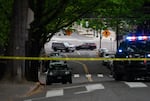
Law enforcement cars sit parked outside the Multnomah Athletic Club as Portland Police Bureau, Federal Bureau of Investigations and Bureau of Alcohol, Tobacco, Firearms and Explosives crews work at the scene where a car with an explosive device inside crashed into the MAC, leaving one person dead and several blocks around the area closed, in Portland, Ore., on May 2, 2026.
Eli Imadali / OPB

An Explosive Ordinance Disposal robot maneuvers outside the Multnomah Athletic Club as Portland Police Bureau, Federal Bureau of Investigations and Bureau of Alcohol, Tobacco, Firearms and Explosives crews work at the scene where a car with an explosive device inside crashed into the MAC, leaving one person dead and several blocks around the area closed, in Portland, Ore., on May 2, 2026.
Eli Imadali / OPB

A bomb squad officer works outside the Multnomah Athletic Club as Portland Police Bureau, Federal Bureau of Investigations and Bureau of Alcohol, Tobacco, Firearms and Explosives crews work at the scene where a car with an explosive device inside crashed into the MAC, leaving one person dead and several blocks around the area closed, in Portland, Ore., on May 2, 2026.
Eli Imadali / OPB

A Portland police officer walks outside the Multnomah Athletic Club as Portland Police Bureau, Federal Bureau of Investigations and Bureau of Alcohol, Tobacco, Firearms and Explosives crews work at the scene where a car with an explosive device inside crashed into the MAC, leaving one person dead and several blocks around the area closed, in Portland, Ore., on May 2, 2026.
Eli Imadali / OPB
Records show Whitman’s past threats extended beyond the athletic club.
During a separate incident Jan. 29, 2022, Whitman threatened his brother Jason Erickson at a restaurant after a family funeral in Corvallis.
Erickson told police he thought Whitman may have been under the influence of drugs or intoxicated when Whitman held a steak knife to his throat and said: “‘Don’t ever talk to me again … if I see you again I will kill you,’” according to court documents.
Whitman was arrested in 1999 for misdemeanor battery in Boise, Idaho, but the case was dismissed, court records show.
On Feb. 16, 2026, Whitman attempted to kill himself. He was subsequently admitted to Unity Center for Behavioral Health in Portland and diagnosed with schizophrenia and bipolar disorder, Lenzer told OPB Sunday. Police filed another extreme risk protection order and Whitman surrendered two firearms, a 9 mm and a .38 special revolver, records show.
Throughout these incidents, Silverman said Monday, PPB’s Behavioral Health Unit “used the tools available to them under Oregon law,” including the civil commitment process, removing firearms and coordinating with mental health resources outside of law enforcement.
“Whitman continued to struggle with significant, serious behavioral health challenges, and he did not consistently engage in ongoing treatment,” Silverman said. “This is a difficult case that underscores both the dedication of our behavioral health unit and the limitations of the current system when someone is unwilling or unable to maintain long-term engagement with services.”