

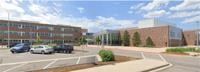
The main entrance of Westminster High School. (Image from Google Street View, edited for clarity.)
Google Earth
Westminster Public Schools board member Aaron Martin paused before addressing the audience at the April 28 school board meeting, choking up as he began to speak.
“I’m going to take a minute and tell you guys about Denae,” Martin said.
Denae, a student at Westminster High School, died this school year. He had known her since she was 8 years old, when she was one of his first softball players. He described her as the team’s emotional rock and said he’d been reviewing photos of her that week and noticed almost every one showed her consoling someone else.
“And this is just one, right?” Martin said, referring to two other Westminster High School student deaths.
He told the board that at least one teacher had taught all three students this school year.
Earlier, student ambassador and Westminster High senior Fernanda Galvin spoke on behalf of her classmates.
“It really takes a toll on you,” Galvin said. “I think we saw more than we would need to see in our first loss to know that we need to stress the importance of mental health, and it sort of feels like neglect when it keeps occurring and nothing really seems to happen.”
Heidi Weekley, executive director of integrated services for the district, said 13 mental health providers serve Westminster High School.
The total includes 10 school counselors, school psychologists and school social workers. Two more are school-based therapists working through a partnership with Adams County’s Community Reach Center. The 13th is a behavioral health technician embedded in the Kids First Healthcare medical clinic on the high school campus.
“Students are accessing these supports on a regular basis,” Weekley said, admitting she was surprised by Galvin’s statement.
Places To GoWhere students and families can get help
Westminster Public Schools lists mental health staff at each school under Student Life at wps.org. The district’s school-based therapy partner is Community Reach Center, the designated mental health provider for Medicaid-eligible Adams County residents, with a Westminster outpatient office at 1870 W. 122nd Ave. Walk-in crisis services are available at the same location.
If you or someone you know is struggling, the 988 Suicide and Crisis Lifeline is free and confidential, available by call or text at 988. Calls and texts to 988 from Colorado area codes route to Colorado Crisis Services, the state’s 24/7 behavioral health network, which offers Spanish-language support.
The Crisis Text Line is available by texting HOME to 741741. Colorado Crisis Services can also be reached directly at 1-844-493-8255 or by texting TALK to 38255.
A gap in awareness, not services
Galvin told the board that students don’t always know what’s available, citing a free local therapy resource that few classmates had accessed.
Of the 7,282 students enrolled in Westminster Public Schools, 5,729 are Hispanic or Latino, according to district data, just under four in five. Weekley said the district publishes community mental health resource lists in English and Spanish and sends them home to families before extended breaks.
Classroom lessons in social and emotional learning, which the district calls personal relational competencies, are running across the high school in the weeks before summer.
She also said families need to know how to find help outside of the school day.
The district’s online mental health page lists school counselors, school psychologists and mental health interventionists by name and email address at each of its 21 schools.
Additionally, Weekley said the district has school-based partnerships with therapists from the Community Reach Center and a behavioral health technician from Kids First Healthcare.
The district response
The district finalized a protocol this school year for responding to a student death by suicide, Weekley said, noting the district is still launching it. The structured response, known as postvention, draws three district-level mental health coordinators to the building to add capacity.
Staff identify the students closest to the deceased through class schedules, friend groups, sports teams and clubs and offer targeted check-ins. The district coordinates outreach to families and to community connections beyond the school day.
Staff affected by a loss are pre-identified through the same crisis response plan, Weekley said, rather than self-referring. A staff mental health director, who sits in the district’s human resources department, coordinates support for adults. Weekley said the position is unusual among Colorado districts.
All 10 of the school counselors, school psychologists and school social workers at Westminster High have completed Applied Suicide Intervention Skills Training, a three-day program known as ASIST.
Mental Health First Aid, a separate training in mental health literacy, is currently required for the district’s educational support professionals, the paraprofessionals and office staff who interact with students daily but aren’t trained clinicians.
The district will offer Mental Health First Aid to teachers and other licensed staff over the summer, Weekley said. Galvin had asked the board for more support for teachers grieving and supporting grieving students
And Westminster High will launch a student mental health advisory committee in the 2026-27 school year. The district already runs similar committees at some middle schools, and Weekley said she and the high school principal had been discussing extending the model.
A statewide trend, a single school’s year
Westminster’s losses come against a Colorado backdrop that has been moving in the other direction. The 2023 Healthy Kids Colorado Survey, the state’s most comprehensive survey of youth health, found 26% of Colorado high schoolers reported persistent feelings of sadness or hopelessness, down from 40% in 2021 and 35% in 2019, according to the Colorado Department of Public Health and Environment. Eleven percent had seriously considered suicide, down from 17% two years earlier.
CDPHE attributed the improvement to “state and community investments in prevention programming and protective factors paying off.”
The national picture is different. The 2023 Youth Risk Behavior Survey, released by the Centers for Disease Control and Prevention in October 2024, found 40% of U.S. high school students experienced persistent feelings of sadness or hopelessness and 20% had seriously considered suicide.
The U.S. Surgeon General’s 2023 advisory on social media and youth mental health, citing data that more than three in four high schoolers use social media frequently, stated the issue “cannot simply fall to parents and children.”
Did you find this article insightful? Subscribe to Class Notes to never miss a story and get my take on what’s behind the headlines. Free every Friday.