

5 mental health trends for 2026: Closing the gap to access and care
“You’re not alone.” It’s a comforting and common refrain in a society that has increasingly embraced the importance of mental health. Yet, for all this growing awareness, the truth is that too many Americans are lonely. According to the American Psychological Association, more than half of U.S. adults feel isolated, left out, and stressed out by societal division.
In honor of Mental Health Awareness Month, Rula conducted its annual State of Mental Health Report to dive into trends on mental health and understand why many people have trouble accessing the care they need, despite growing awareness.
Based on responses from more than 2,000 U.S. adults, the 2026 report, The Spaces Between Us: Navigating the Gaps, Traps, and Barriers of Mental Health in America, identifies:
Key trends shaping Americans’ mental healthWhy and how people seek mental healthcareBarriers that impact access to supportFinancial stress is a barrier to care, and it’s quickly getting worse.Common mental health issues like depression and anxiety have risen by around 10% since 2025.While 60% of U.S. adults report that mental health has become more important to them, access to mental health services has declined, with 52.6% never trying services like talk therapy or psychiatry.
5 major trends uncovered in Rula’s 2026 State of Mental Health Report
1. The attitude-behavior gap: Awareness isn’t enough
Despite growing awareness of its importance, access to mental healthcare isn’t keeping pace with need. While nearly 60% of respondents report that mental health has become more important to them in the last five years, reported access to mental health services has slightly declined, from 50% in 2025 to 47.4% in 2026. This means that 52.6% of U.S. adults haven’t accessed services like talk therapy or psychiatry.
 Rula
Rula
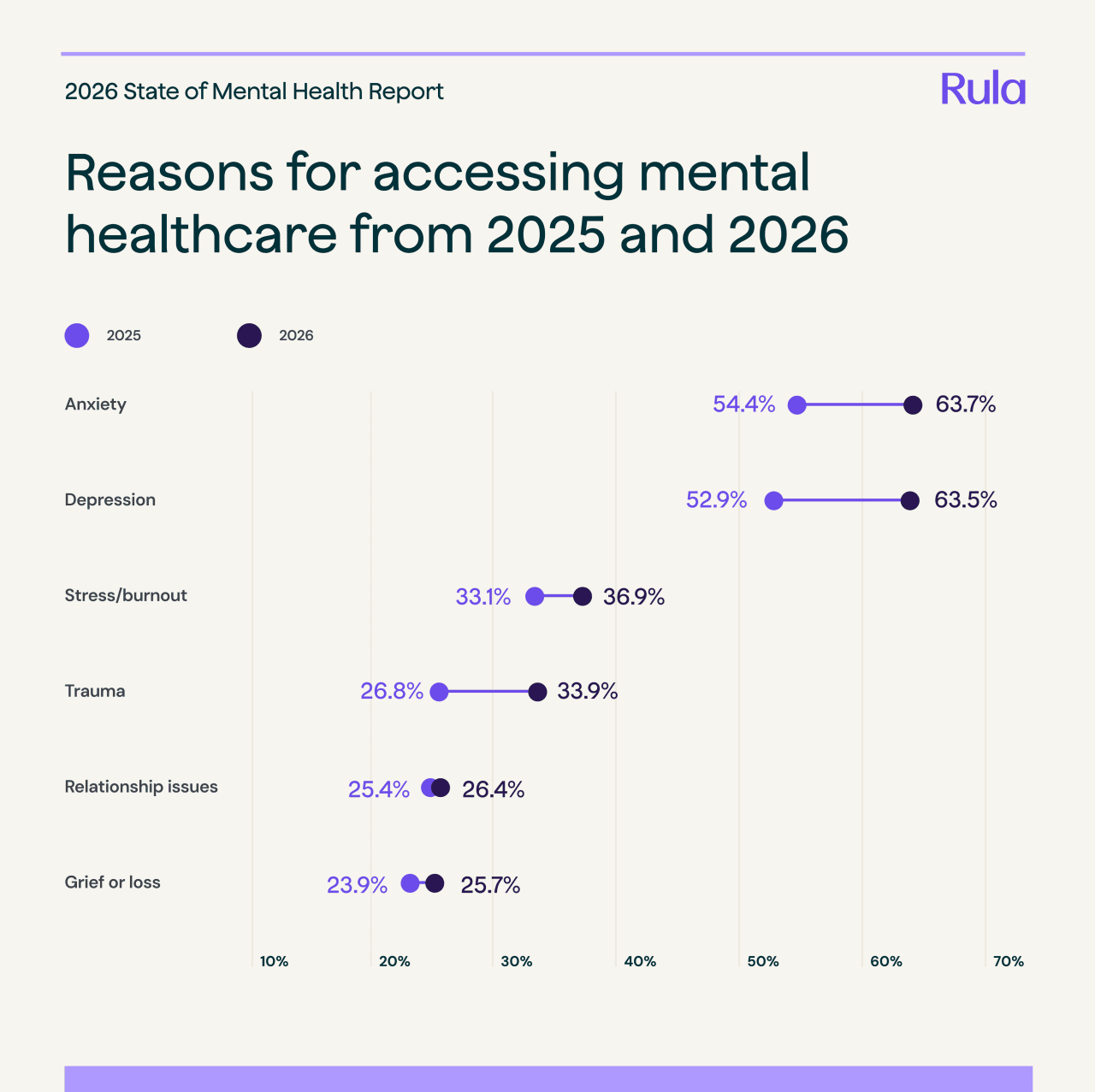
Yet there’s a growing need for mental healthcare, as shown by the rising incidence of common mental health issues. The top reasons people seek support all increased from 2025 to 2026, with some rising over 10%. These include:
Anxiety (63.7%; +9.3% increase)Depression (63.5%; +10.6% increase)Stress or burnout (33.9%; + 3.8% increase)Grief or loss (25.7%; +7.1% increase)
Anxiety and depression rose by 9.3% and 10.6%, respectively, between 2025 and 2026, and stress/burnout and trauma rose by 3.8% and 7.1%.
Although 81% of Americans now recognize the importance of mental health, awareness alone isn’t enough for everyone to get the help they might need. While many understand that therapy might help them, they often lack the confidence to take the first step.
The two most significant barriers to care are:
Cost, which was cited by more than 1 in 4 respondents.”Finding the right therapist,” which was reported as a barrier by 19% of respondents.
Education about mental health support options also presents a hurdle, as roughly 37% of respondents are unsure what kind of therapy would be most beneficial for them. In addition, many people don’t know how to track their moods and mental health symptoms, which could help them decide if therapy is right for them. When asked whether they track their mental health, the respondents’ most common response was, “I don’t keep track.”
Many Americans are looking for social permission to access care. Having people in your circle who are openly speaking about and/or seeking mental health support is the single most powerful external motivator, cited by nearly half of all respondents (47%). Encouragement from family and friends to pursue mental healthcare was a close second, at 41% (a 5.3% increase from 2025).
2. The financial multiplier: A cycle of vulnerability
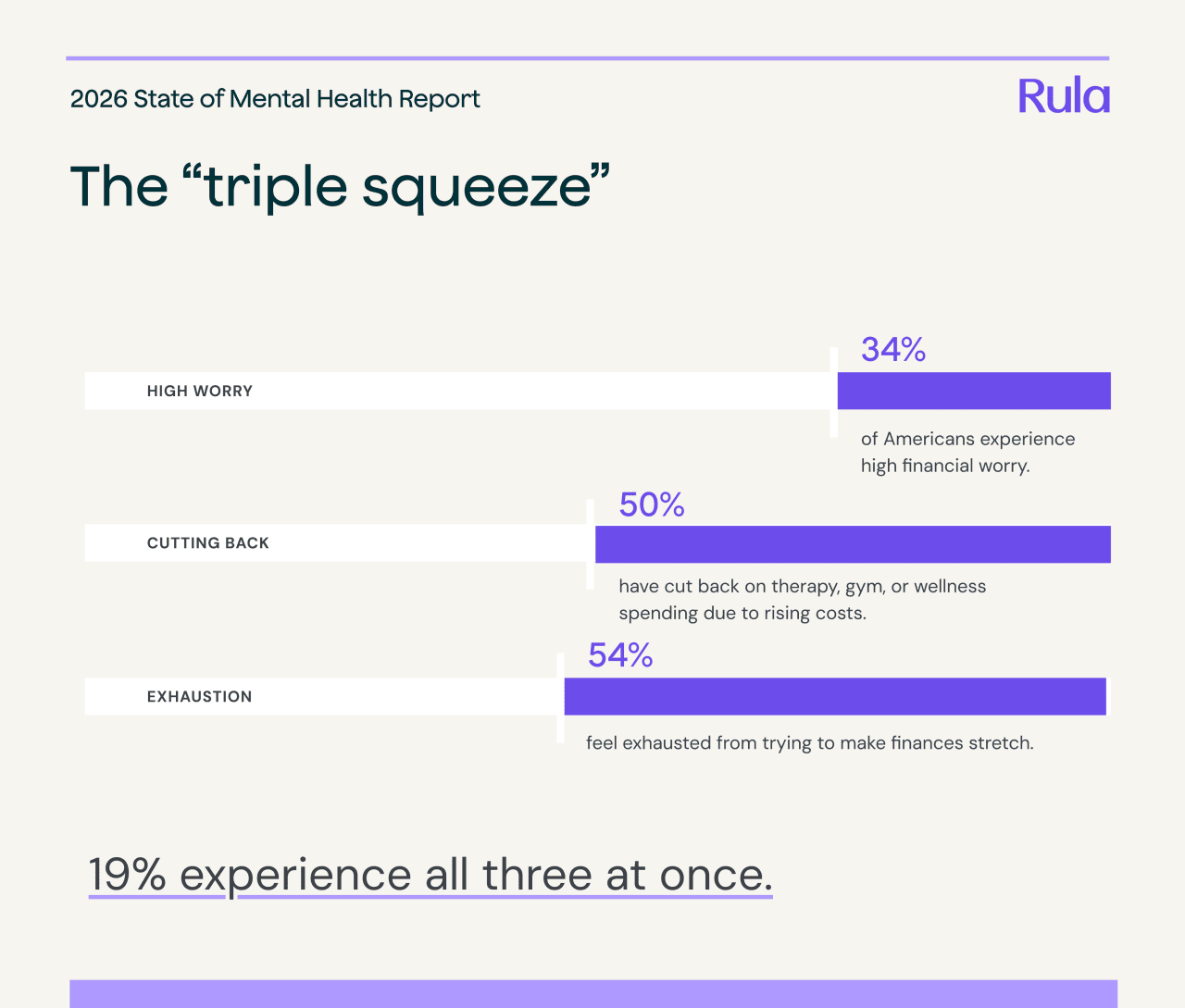
The increasing cost of living and an unstable job market are deeply affecting Americans’ ability to access mental healthcare, as many struggle to cover basic expenses. The report reveals that 34% of Americans experience high financial stress, worrying about their finances daily or weekly.
 Rula
Rula
This financial burden is directly impacting healthcare choices. For example, half of all respondents have reduced spending on therapy, gym memberships, or personal health due to rising costs. And a significant 54% feel exhausted from constantly trying to make their finances stretch.
These results show that those who need care most are often the least able to afford it. Both this year and last year, cost was the leading obstacle to seeking support. The financial barrier to mental healthcare is getting more extreme, as it was cited by 41% of respondents in 2026 — a sharp increase from just 25% in 2025.
For people earning less than $50,000 annually, the high financial stress rate jumps to 42%. Financial pressure was also a reason to seek help, with 19.8% of Americans looking for mental health support specifically to address financial difficulties.
The report identifies a concerning “triple squeeze” affecting financially stressed Americans seeking mental health support:
34% experience high financial worry.50% have cut back on health-related services due to rising costs.54% feel exhausted from stretching their finances.19% experience all three of the above factors at once.
When people struggle financially to meet their basic needs, the perceived cost of traditional therapy might be too great. But this untreated stress can compound, creating a vicious cycle of vulnerability that’s tough to escape without resources.
3. The gender gap: Matching complexity to care
The report highlights a significant gap in how men and women interact with mental healthcare.
As a group, women consistently engage more with mental health services. They are:
22% more likely than men to have ever accessed care.31% more likely than men to currently be in care.
Women also seek support for common concerns at notably higher rates. They are:
13% more likely to seek support for anxiety.10% more likely for depression.21.6% more likely for trauma-related concerns.10.6% more likely for stress or burnout.
While higher reported rates of anxiety and depression in women may partially explain this increased engagement, it may also point to a stigma that relies on masculinity norms to discourage men from seeking help. Despite this higher engagement, women report significantly lower improvement rates in therapy (71%) compared to men (81%).
This gap suggests that the current mental health system may not be designed for people with complex needs.
Women are 76% more likely than men to cite four or more reasons for seeking care, which may mean that their mental health challenges tend to be more complex. To make things even more complicated, women are 40% more likely to cite an inability to find the right therapist as a barrier. In fact, women often cycle through four or more providers before they find a suitable match.
However, the complexity of women’s mental health concerns might present an opportunity to create systems that provide better patient matching.
Improving mental health outcomes for everyone requires a system that provides better provider-patient matches, especially given the complex needs reported by women.
4. Beneath the mask: Mental health in the workplace
While organizations have made strides in diminishing mental health stigma and expanding wellness benefits, a significant gap remains between policy and a truly healthy workplace.
Our report reveals that 43% of respondents have avoided telling their manager about a mental health challenge.
When employees mask these issues, they’re often bottling up emotions and creating inner turmoil that can impact their work. This could also cause them to miss out on vital at-work support, as managers are trained to advocate for their employees by adjusting workloads, clarifying benefits, or fostering team connections. Disclosing a mental health challenge could give employees the “social permission” they need to seek care.
Our research also highlights critical cultural and structural tensions, showing notable disparities:
Women are more likely than men to leave or consider leaving their jobs due to mental health concerns, despite being more inclined to seek care.Gen Zers are six times more likely than Gen Xers to hide their mental health situations at work.
Though Gen Z is lauded for mental health awareness, this openness often doesn’t extend to the workplace. As the youngest cohort, they may fear that showing vulnerability could be seen by management as a performance risk.
 Rula
Rula
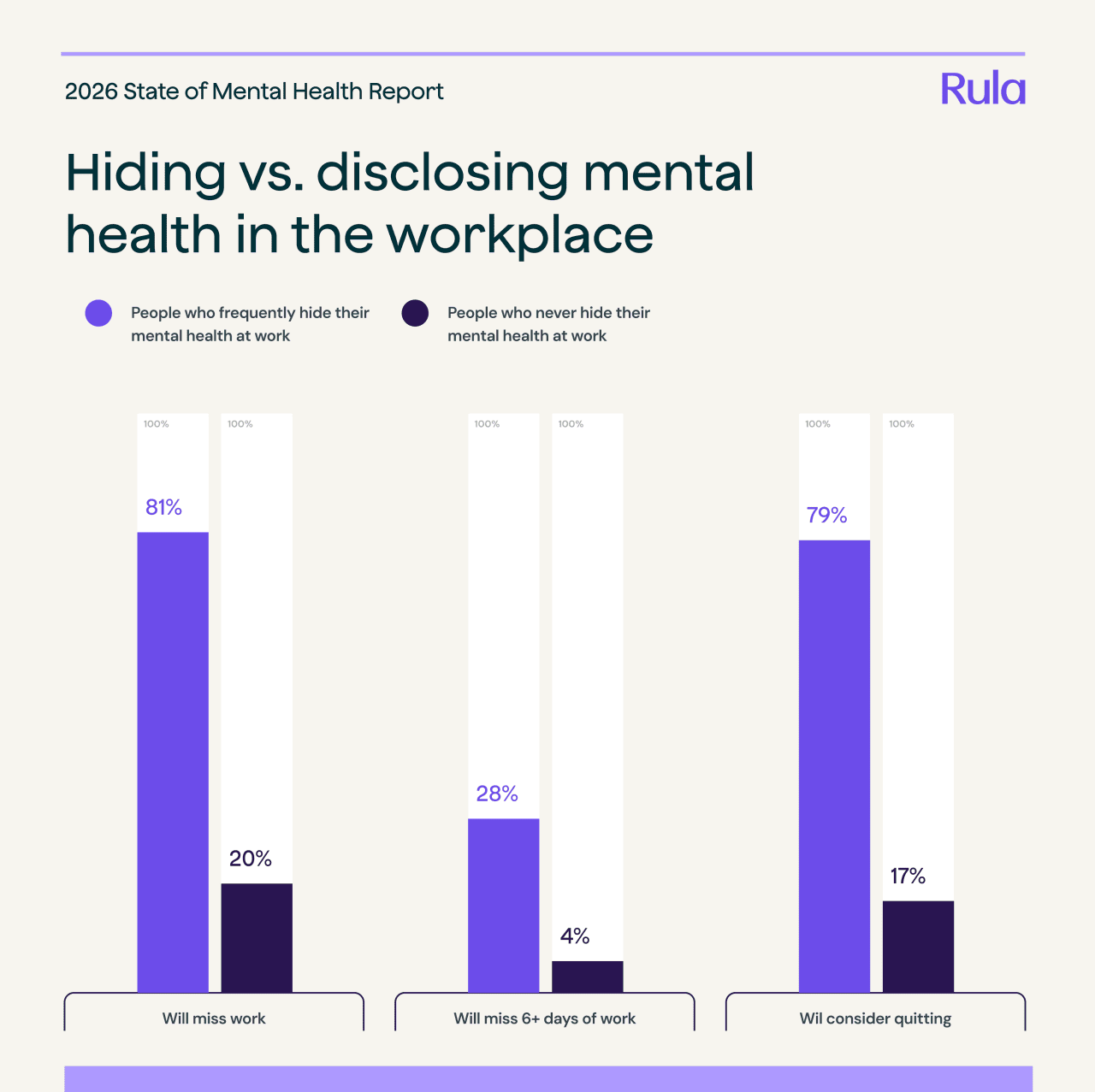
Among people who frequently hide their mental health at work:
81% miss work28% miss six or more days of work79% consider quitting
Among people who never hide their mental health at work:
20% miss work4% miss six or more days of work17% consider quitting
Workplace stigma is a clear operational risk. To bridge the gap, employers must proactively make mental health support visible, accessible, and normalized. This means actively marketing resources, reducing friction in accessing care, and ensuring support is available without mandatory disclosure.
5. The new technology frontier: AI in mental healthcare
The mental healthcare landscape is evolving, with many Americans seeking support from alternative sources. A significant finding from the survey is that more than 1 in 5 Americans have used AI chatbots for mental health support.
This trend isn’t driven by a simple preference for technology but rather by the desire for emotional safety and lower barriers to entry. The top reasons respondents gave for turning to AI were:
Feels more anonymous: 41%Is less intimidating than therapy: 39%Is more affordable: 35%I prefer digital communication: 32%I’m not comfortable face to face: 28%
Despite increasing concerns that AI might replace human clinicians, the data suggests a more complementary role. Seventy-one percent of AI therapy users have also been in traditional therapy, indicating that AI is expanding the reach of care to those already open to receiving it, rather than pulling people away from established services.
However, skepticism remains, and with good reason. Research from MIT highlights that using AI alone for mental health support may not be reliable and can potentially worsen feelings of loneliness. Americans are largely divided on AI’s overall impact: 31% are hopeful, 34% are anxious, and 34% are neutral.
Closing the gap between awareness and getting help
The story the data tells is both clear and complicated: awareness alone isn’t enough. Americans are paying more attention to their mental health than ever before, but attention without access leaves too many people navigating stress, isolation, and rising symptoms on their own. Financial strain, emotional vulnerability, and structural barriers continue to widen the gap between recognizing a need for support and actually receiving it.
Closing that gap will require more than conversation. It means making care more affordable, more approachable, and more aligned with how people actually seek help today. It means meeting people where they are — whether that’s through traditional therapy, digital tools, or new models of care that reduce friction and stigma.
Latest Headlines from CNN