
Home / News / Yerby Fellows present new research on mental health, stress, and HIV
Hide caption
Show caption
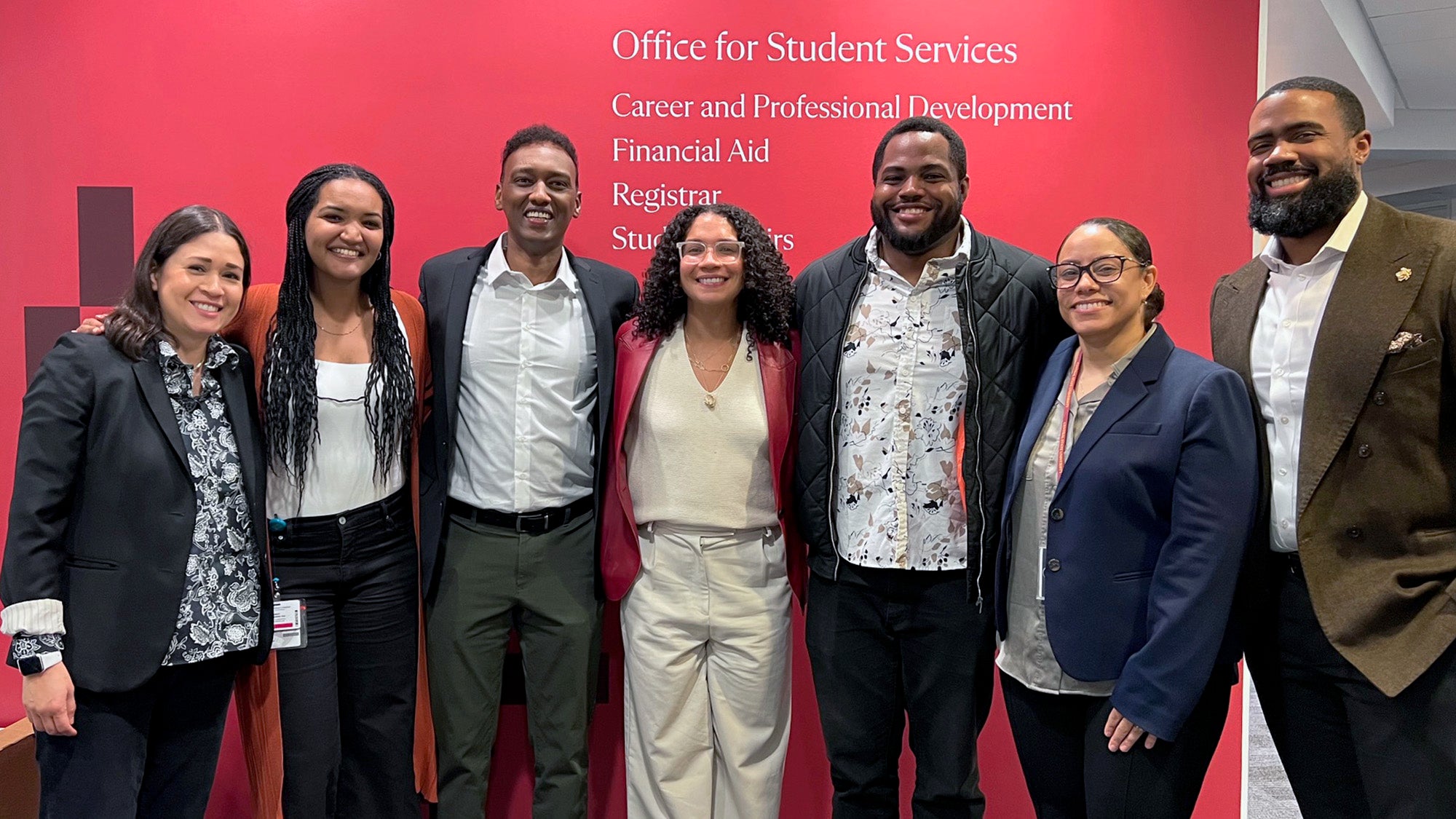
From left, Kim Salas Harris, director of pathway programs and faculty pipeline initiatives, Yerby Fellows Hiwot Zewdie, Abdinasir Ali, Domonique Reed, Cameron Wiley, and Merriah Croston, Bryan Thomas, chief community and belonging officer / Courtesy of Kim Salas Harris
Three Yerby Fellows presented their research at an April 29 symposium at Harvard T.H. Chan School of Public Health. Topics included mental health benefits from expansion of the Earned Income Tax Credit (EITC), the impact of a stress coping strategy known as “John Henryism” on Black Americans’ health, and patterns of alcohol use and HIV risk in South Africa.
The Yerby Fellowship Program provides a bridge between academic training in public health-related fields and entry-level faculty positions. Fellows develop and pursue their own research agendas, working for up to two years under the guidance of senior Harvard Chan School faculty members with compatible interests. It has trained more than 70 fellows since its inception in 2001.
The Fellowship honors the late Alonzo Smythe Yerby, MPH ’48, a public health pioneer who helped create Medicare. Yerby served as an associate dean at Harvard Chan School and was its first Black department chair (the Department of Health Services Administration, forerunner to the Department of Health Policy and Management).
At the recent Yerby Symposium, held in FXB G-12, each fellow was introduced by their faculty mentor.
The Earned Income Tax Credit and mental health
Rita Hamad, professor of social epidemiology and public policy, recalled first encountering Abdinasir Ali’s work when she was a guest editor at the journal Health Affairs. She recommended a paper for publication that he co-authored as part of his PhD dissertation at the University of Iowa, and she happily said yes when he later approached her about mentorship. Hamad said that she hopes to collaborate with him in his new role as an assistant professor at the University of Nevada, Reno.
Ali presented research showing that expansions of the EITC—which helps low- to moderate-income working individuals and families—significantly improved mental health among young adults, reducing frequent mental distress. Effects on physical health and behaviors like binge drinking were more limited, according to his research. His work has also shown mental health benefits for low-income renters, though not homeowners. Currently, he’s looking at state-level EITC expansions, with early results suggesting associations with modest improvements in physical health.
Sociocultural coping and health
Cameron Wiley earned a PhD in psychological sciences from the University of California, Irvine prior to coming to Harvard Chan School. In her introduction, Laura Kubzansky, professor of social and behavioral sciences, noted that moving from psychology to public health is not a small leap. “So, hats off to braving the disciplinary divides and taking on all the nuances and methods and puzzles of epidemiology and public health,” she said.
Wiley said that his overall research aim is to clarify the most effective psychosocial factors and biological pathways to target in order to reduce racial and ethnic health disparities. He presented research on John Henryism, a term coined to describe the continuous effort by some Black Americans to actively cope with discrimination and other stressors by working exceptionally hard—which some research has suggested can be detrimental to their health. Wiley’s study examined whether higher levels of John Henryism were associated with earlier disease onset in Black Americans over a 35-year period. He said that he was surprised that his findings suggest a non-linear relationship, with moderate levels potentially being protective.
Alcohol use and HIV
Jeff Imai-Eaton, associate professor of epidemiology, recalled being excited to work with Domonique Reed. He was new at Harvard Chan School and coming from a background in infectious disease dynamics. He saw that Reed—whose PhD research at Columbia looked at HIV risk determinants among girls and young women in Sub-Saharan Africa—had used many of the same data sets he used in his research but approached the work with a different set of methods. The seeds for their strong working relationship were sown when she showed up at their first meeting with a highly detailed plan for her Yerby research. “That was just awesome,” Imai-Eaton said
Reed presented research on how hazardous alcohol use patterns in sub-Saharan Africa influence HIV acquisition risk and treatment. She found that greater alcohol use increased HIV risk through sexual behaviors and also increased disruptions in the HIV care cascade—meaning, the stages from diagnosis to viral suppression—with the greatest burden concentrated among men and people who binge drink. Her upcoming research will focus on how to target both formal and informal venues where alcohol is consumed for HIV prevention interventions.
Last Updated
Featured in this article
Professor of Social Epidemiology and Public Policy
Get the latest public health news
Stay connected with Harvard Chan School