
LAS CRUCES — Cecilia Sharbutt’s son Samuel was diagnosed with autism just before age 3.
Sharbutt understood autism more than most, having worked for a decade as an educational assistant for special needs students at Las Cruces Public Schools. She thought she understood what would need to happen next: finding medical specialists who could help manage behaviors and give Samuel a chance at success.
But more diagnoses came: attention deficit hyperactivity disorder, sensory processing disorder, oppositional defiant disorder, and a rare chromosomal disorder. Each condition had its own spectrum of treatment, its own requirements and complications. Autism alone is one of the most complex neurodevelopmental disorders to treat. Now she was looking at a conglomeration of medical and behavioral needs that seemed impossible to address.
“Where do I go?” she recalls thinking frantically. “What do I do? How do I help my child? What does my child need? There’s all these questions, and you don’t realize until it happens to you how hard it is to find answers.”
Parents and foster parents across New Mexico have faced insurmountable barriers in their efforts to identify children’s mental and behavioral health conditions and connect with services, in large part due to severe provider shortages. The rollout of a statewide system of care has fallen years behind schedule, beset by delays and administrative problems.
Most recently, a monthslong contracting dispute between the New Mexico Children, Youth and Families Department and an organization that issues required credentials for family peer support workers and other behavioral health specialists threatened to impact parents like Sharbutt, who are struggling to find services for their children. While CYFD finally granted a credentialing contract last month for the current fiscal year, it will soon have to issue another contract for services in the new fiscal year, which starts July 1.
Sharbutt had tried searching online for autism services and specialized clinicians, providers that are in critically short supply in Las Cruces. That went nowhere. Call after call to doctors’ offices didn’t help either. Eventually, the stress of trying to find help for her son became so great that she suffered a series of strokes, she said.
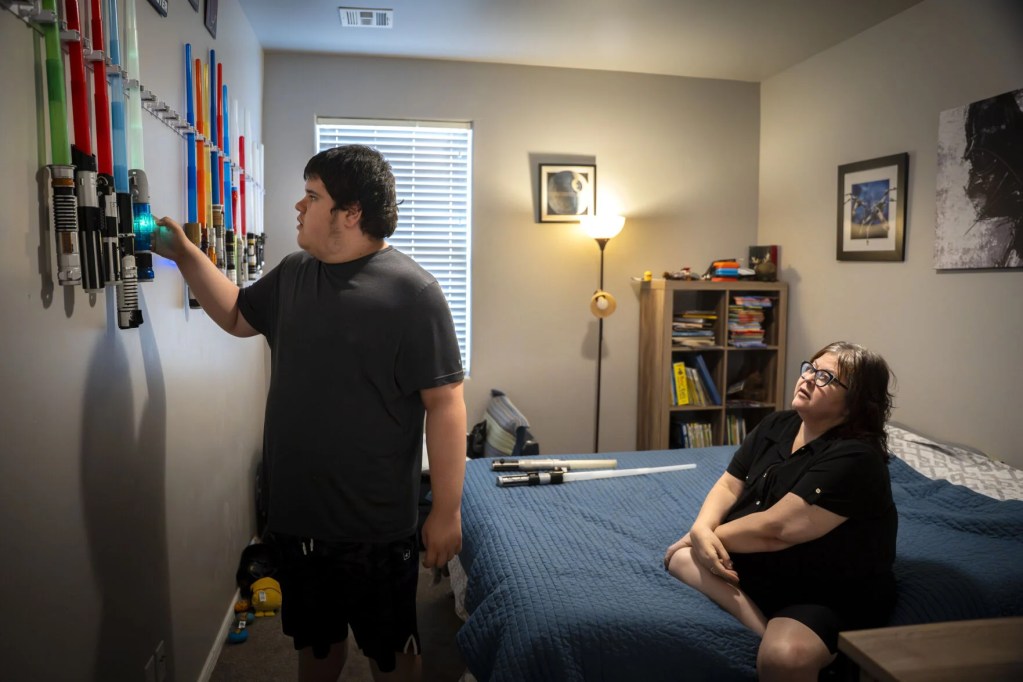 Samuel Sharbutt plays with his collection of light sabers in his bedroom last week while spending time with his mother. “If we didn’t have all the support we get from the therapies, it would be very difficult,” Cecilia Sharbutt said.
Nathan Burton/The New Mexican
“There were nights where I would be up all night just crying because I felt so alone,” Sharbutt said in an interview. “It didn’t matter who I spoke to, didn’t matter who I talked to, nobody had any answers for me. You literally feel like you’re all alone in a crowded room and you’re screaming at the top of your lungs and nobody’s hearing you.”
As Sharbutt searched for help, Samuel’s behaviors got worse. On at least one occasion he was put in a physical restraint in class, his mother said, leaving him covered in bruises and escalating his panic response even further. Even at home, Samuel struggled. On several occasions, Sharbutt said she had to call 911 to ask for an ambulance and a crisis response team to come to her house.
Years into Sharbutt’s search for services for her son, she learned the state had developed a specialized workforce for just this purpose: family peer support workers, a type of expert trained in locating treatment for kids and implementing a plan of care.
Eventually, Sharbutt met Monica Miura, family peer support worker based in Albuquerque. Miura was able to identify a complex array of services available to Samuel and help enroll him in treatment — in-home applied behavioral analysis therapy, occupational therapy, physical therapy, speech therapy and an ensemble of other specialty care, all covered by Medicaid. Miura even helped file paperwork for behavioral therapists to accompany Samuel to school.
Workers like Miura have been central to the state’s efforts to build a new system of mental and behavioral healthcare for youth.
State falls behind
In 2020, CYFD and the state Health Care Authority committed to creating “an effective system for delivery of community-based mental and behavioral health services” for all New Mexico kids. That commitment was part of the settlement in the Kevin S. lawsuit, which accused the state of “locking New Mexico’s foster children into a vicious cycle of declining physical, mental and behavioral health.”
A major part of that effort centered on high-fidelity wraparound services, which provide individualized care for kids with complex needs. Wrap facilitators, a type of specialist certified by the credentialing board, were a required component of those services.
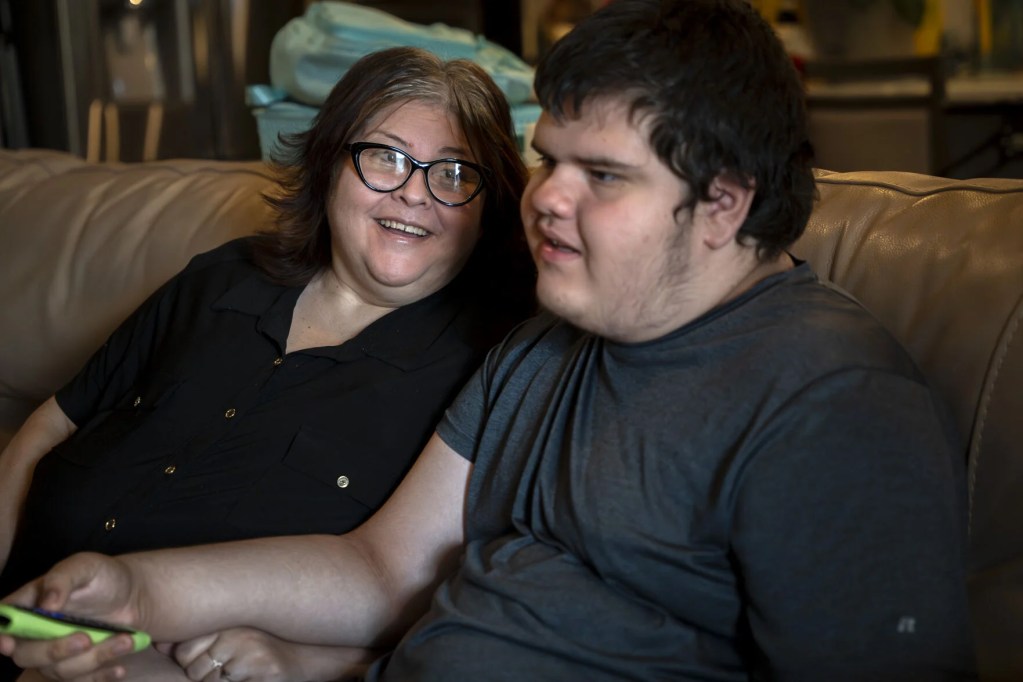 Cecilia Sharbutt and her son Samuel, 15, laugh as they watch television together and chat April 30 in their Las Cruces home.
Nathan Burton/The New Mexican
“Sometimes you can’t even get to the starting line” without the help of a specialist like a family peer support worker, said George Davis, CYFD’s former head of psychiatry. Davis is also a plaintiff in the Kevin S. lawsuit, which led to the settlement pushing for wraparound services to improve youth mental and behavioral healthcare.
Family peer support workers, while not technically part of the Kevin S. agreement, have frequently worked with foster parents to secure services for foster children. Many wraparound services require family peer support workers to be part of a child’s care plan in order to bill Medicaid.
But in the years since the Kevin S. settlement was signed, the state has struggled to meet its commitments, and the number of kids receiving these services while in foster care has decreased dramatically, according to independent monitors overseeing the Kevin S. settlement.
In 2024, the latest year for which data is available, only 53 foster children received high-fidelity wraparound services, down from 149 in 2019.
Contract dispute
The state faced yet another set of challenges in delivering these services last year.
CYFD did not issue a contract to the New Mexico Credentialing Board for Behavioral Health Professionals when the current fiscal year started on July 1. Without a contract, the credentialing board had to operate for months without funding.
On March 23, the board suspended its certifications and renewals of credentials — a move that threatened to cause widespread behavioral health disruptions statewide. Family peer support workers, wrap facilitators, and others who needed new credentials or needed their existing credentials renewed feared they would be out of a job.
The board had demanded back pay for its work, which was finally granted in a contract issued by CYFD and signed by the board April 28. But the contract lasts only through the end of July — after that, the board and CYFD will have to start the process over for a new contract for fiscal year 2027.
CYFD spokesman Jake Thompson said in a statement it took “longer than expected” to issue the board’s contract, attributing the delay to “extended negotiations, legal review” and other factors.
“They’re finally doing the right thing,” Miura, who is former member of the credentialing board, said. “But this is not a professional way to do business. They’ve done this to multiple contractors this year.”
“This only gets us a few months,” Miura said of the new contract. “It’s a stopgap. We need to watch them to make sure that CYFD is issuing contracts in a timely manner, in a way that doesn’t burn the people who do the work. Are we going to be right back in the same place when a new contract comes due July 1?”
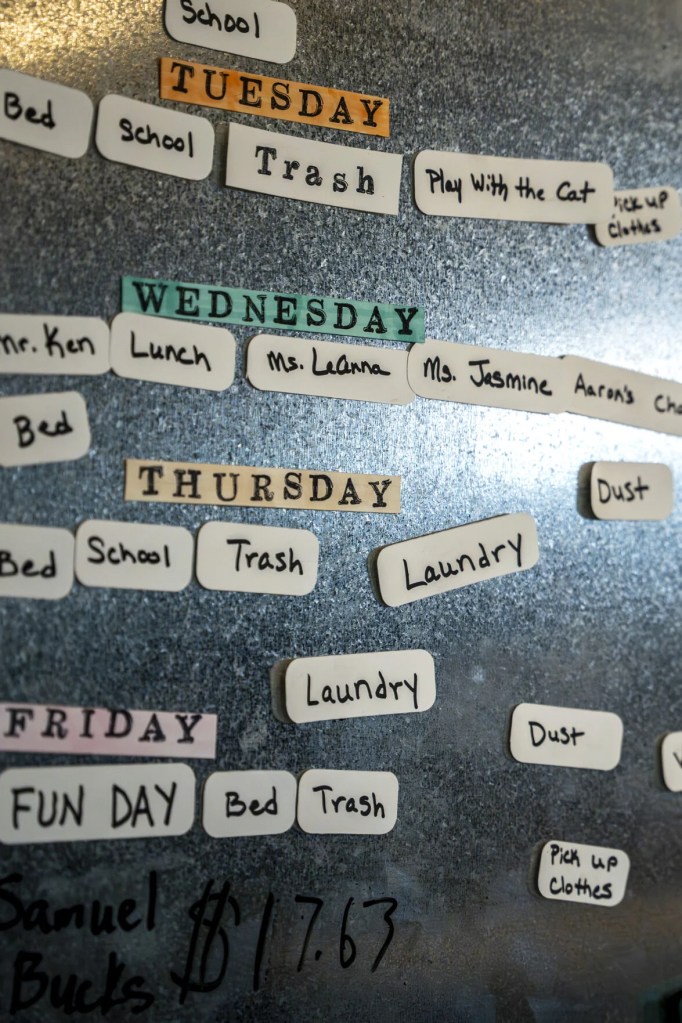 A board shows the Sharbutt’s family schedule in their Las Cruces home.
Nathan Burton/The New Mexican
Thompson said CYFD is already in negotiations for a new contract and does not expect delays.
“The department is committed to timely credentialing of children’s behavioral health workers going forward,” Thompson said.
A vital service
Counties across New Mexico are experiencing severe shortages of psychiatrists, pediatricians, counselors and other mental and behavioral health providers. Those shortages are especially severe in Las Cruces — a study by New Mexico State University found Doña Ana County had the state’s second-highest deficit of psychiatrists.
That shortage has created a crisis for parents of children with disabilities, who face long wait times and a maze of requirements for enrolling in care. Waitlists can be over a year long.
In that environment, Sharbutt said, finding help for her son would have been all but impossible without assistance from a family peer support worker.
It’s still a challenge.
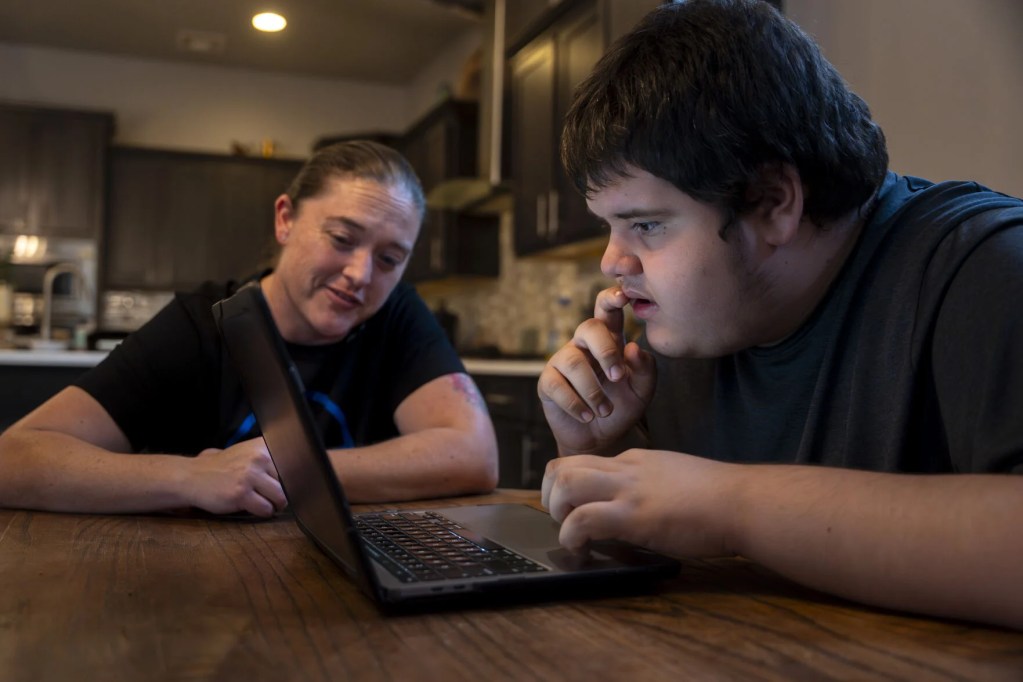 Samuel Sharbutt, 15, right, works on mathematics with teacher Krystalyn Wilkins on April 30 at their home in Las Cruces.
Nathan Burton/The New Mexican
Samuel still has not gotten some of the help he needs. He’s gone nearly two years without early and periodic screening, diagnostic and treatment, or EPSDT, a service that is supposed to provide kids with ongoing mental health, dental and medical care.
“There are a lot of families here who are in need of those kind of programs, but there’s not any agencies here who can provide them,” Sharbutt said.
Still, Samuel has come a long way since his diagnosis. Teachers who once told Sharbutt her son would need to be institutionalized now pull her aside to tell her how well he’s doing. His behavior problems have all but disappeared, and he is now performing above his grade level in science.
He’s memorized all the major constellations — Orion is his favorite — and last year he joined the school science club at the invitation of his science teacher. He has an uncanny knack for recounting detailed plot lines of films and books, and he hopes to one day be a filmmaker.
“We all have dreams and hopes for our children, and when you’re told that your child is never going to be able to do those things, it’s difficult,” Sharbutt said. “I will never put limitations on my son. I know other parents feel the same way. I hope they can find the same kind of help I did.”
This article first appeared on Searchlight New Mexico.