
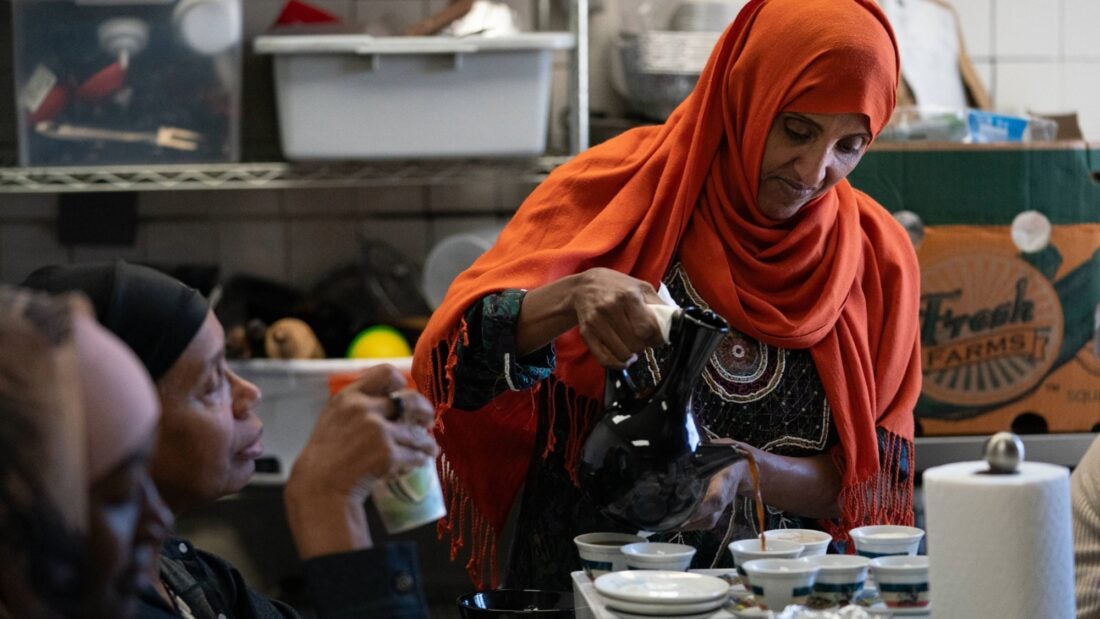
 Amina Hassan, a member of the the United Women of East Africa Support Team’s Baraka and Bilal Catering, prepares food and drinks at the center. Photo: Harrison Hill
After 3 p.m. on most days, the United Women of East Africa Support Team (UWEAST) center in San Diego is bustling with activity. You might find a Girl Scout troop meeting, the boys in basketball league games, and a bunch of teens in the hangout zone known as The Hub. Or there might be some tutoring, help with college applications, or job counseling. There are the Eid and Ramadan bazaars and maybe a yoga class. And from the commercial kitchen in the back, you can count on the savory, spicy scents of sambuusas, chicken and rice, lentil stew, and Ethiopian sourdough bread, which is known as injera.
“The mood is so light-hearted here,” said 25-year-old Noun Abdelaziz, a center regular since her days as a Girl Scout. “It’s truly a place of joy.”
While the atmosphere may be convivial and upbeat, UWEAST’s mission is serious. San Diego has the nation’s second-largest East African refugee population and is the adopted home to more than 30,000 refugees from South Sudan, Ethiopia, Kenya, Eritrea, and other parts of East Africa.
Many have settled in and around UWEAST’s City Heights neighborhood. In their home countries, most survived horrific violence and hardship. Many continue to battle poverty, crime, unemployment, and discrimination in the U.S.
Whatever the risks facing the population assisted by UWEAST, the agency aims to serve as a place of warmth and connection and to help its East African refugee community to thrive mentally, physically, and spiritually. Using culturally concordant programming and supports, UWEAST is focusing on health care, public safety, housing, and education, said Sahra Abdi, the organization’s founder and executive director. “Foremost though, we want our community to feel like they have a place they belong, a place where they can be themselves, and where people will understand them, accept them, and be there for them.”
Abdi founded UWEAST in 2008 as an organization dedicated to women and children. It quickly became clear that the entire community needed a support center. Today, UWEAST fields a small but mighty team that helps hundreds of refugees and their families each week. The center’s programming and efforts are intentional and informed by lived experience.
Abdelaziz, a refugee from Sudan at age 9, is UWEAST’s advocacy lead. When she’s not hopping a plane to Sacramento to meet with lawmakers about tenant rights or health care issues affecting refugees, she’s developing classes that weren’t offered when she was a struggling refugee teen. For example, one recent training opportunity was the “Health as Wealth” series, through which young women learned from other women about their bodies, nutrition, and stress.
The Key to Success Is Trust
“We explore everything — even many intimate topics — in order for young girls to develop an understanding of their health and wellness very early on,” said Abdelaziz, who is currently a graduate student and plans to become a physician assistant to further her health advocacy and serve the UWEAST community. She also helps programs at the center like the health care research partnership with the University of California, San Diego. Recently, UCSD researchers teamed up with UWEAST to research high blood pressure among East African refugees.
“Our community trusts us,” said Abdelaziz. “So, if the researchers didn’t have us, they probably would not agree to participate. Being able to serve as that bridge to research and health is an important aspect of our work.”
UWEAST’s women and girls are interested in current events. The center serves as a surrogate home for refugee women, a place to seek solace and support.
Abdelaziz says that because she is the eldest daughter in her immigrant family, she bears heavy responsibilities. Daughters help support the household, raise younger siblings, and serve as translators while also pursuing their own education and navigating an adopted culture that in many ways is far from the lives they previously experienced.
It’s an “othering” experience to come to the U.S. and for the first time see women dressing and acting differently, she said. “I know what it feels like to develop cultural understandings and mannerisms and be socialized a certain way but then have to leave all that and basically break that apart,” Abdelaziz said. The center can help members of the community feel less isolated.
Reconsidering Some Customs
UWEAST coordinator Jama Mohammad focuses on programming for boys and young men. He found his calling after community concern about a series of suicides by East African men.
“Many of us are products of trauma,” said Mohammad, a Somalia native who earned a master’s degree in marriage and family therapy. “In our culture as men, we are not encouraged to express emotions or ask for help.”
The suicides galvanized the community and challenged UWEAST to address old customs. “We really listened to what people told us,” he said. “Now we have a men’s circle that meets regularly as men and boys to learn about physical and mental well-being. We also learn how to express ourselves and seek support.”
Through community outreach and research, UWEAST discovered that their young men needed a place to gather and “be comfortable in their own skin,” Mohammad said. That’s when the center created The Hub, a comfortable hangout with separate hours for men and for women. The men love Friday nights and Sunday football. UWEAST also launched a men’s basketball league.
“But you can’t come to play basketball unless you participate in the men’s circles,” he said. The center launched a mentorship program so elders can develop leadership skills to support younger men, and those efforts are paying off. “We have reduced suicide,” Mohammad said. “It’s not down to zero, sadly, but we are definitely not seeing the numbers we once saw.”
Mental Health Counseling
The aroma of sambuusas wafting out of the kitchen are the work of the women of Baraka & Bilal Catering, a UWEAST program that instills cultural pride and connection to East African foods. The program offers jobs and small business education to refugee women who might have difficulty finding employment because of language or education barriers. Baraka & Bilal serves businesses and organizations all over the city, which Abdi says is an excellent way to form connections across the San Diego area and share the richness of East African culture.
UWEAST has big plans this year. It’s moving to a new location that include an expanded commercial kitchen, offices, and therapy rooms.
UWEAST has some culturally competent mental health professionals who have occasionally volunteered services. They hope to formalize a counseling program in the new facility. The center is looking for funding to hire mental health professionals who understand the challenges faced by multicultural and refugee families. UWEAST has supported several staff members preparing for training as mental health clinicians, but the dearth of appropriate supervisors for trainees remains a significant challenge to satisfying licensure requirements.
The mental health services are important because they provide a sorely needed path to healing and self-acceptance, Abdi said.
“We are teaching kindness and empathy to create a better world,” she said. “It’s so much easier to do this if first you accept yourself.”