
If you were having a mental health crisis, would you want someone with a gun and taser telling you to calm down? That’s often the reality when someone calls 911 in response to a behavioral or mental health emergency.
The standard response to an emergency call is to send the police, no matter the situation, but what if we could be sending trained experts who know exactly how to respond?
To keep our community safe, we need to be sure that we will be treated with empathy and receive the proper care we need when we are experiencing mental health and behavioral health emergencies. Alternative emergency response programs, or ARP, are a way to achieve those goals. These programs provide alternative methods for responding to non-violent, non-medical emergency calls, such as sending trained behavioral health experts to help people in crisis.
The Allegheny County Department of Human Services (ACDHS), under the direction of Interim Director Alex Jutca, needs to expand its pilot ARP into a fully-funded, county-wide program to ensure the well-being of all residents.
There’s currently an ARP operating in several areas of Allegheny County, run by ACDHS and Resources for Human Development. The A-Team sends mental and behavioral health professionals trained in de-escalation and crisis intervention to respond to relevant emergency calls.
The A-Team does not replace the police, fire department or emergency medical services. Rather, it works with those teams to ensure the best possible outcomes for people experiencing emergencies where traditional first responders are not the best equipped.
Similar programs have had major success in other cities. Denver, for example, launched a similar ARP in 2020. During its six-month trial period, reports of minor crimes dropped 34% in neighborhoods where the ARP was active, according to a Stanford University study. Additionally, the average response cost was just $151, versus $646 for a traditional response to a minor criminal offense. A study in Columbus, Ohio, indicated that there is strong community support for alternatives to policing.
Alternatives to policing often bring up concerns of safety. Are we really talking about safety, though, when police officers are not equipped to handle behavioral health crises, and as a result, end up hurting our neighbors?
Less than five years ago, 54-year old Jim Rogers, who was experiencing homelessness, died after riding a bicycle that didn’t belong to him and being tasered repeatedly by a Pittsburgh police officer. The police are clearly not equipped for every situation they respond to, and we need to be thinking about alternatives.
The A-Team is in a pilot phase, meaning the county is testing it out in limited capacity with short-term funding. The program began in late 2024 in Penn Hills and Monroeville. It expanded last year to other eastern suburbs and a handful of western municipalities near McKees Rocks.
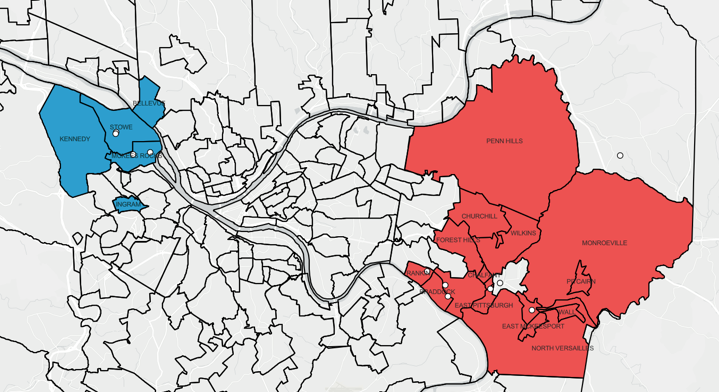 Map of early municipalities participating in Allegheny County’s alternative response program as of March 31. The county has since added around a dozen other communities in the eastern suburbs, Mon Valley and western suburbs, for a total of 33 municipalities served by the A-Team. (Courtesy of Allegheny County Department of Human Services)
While it is expanding, the program is still very limited in scope: Out of the nearly 1.4 million emergency calls Allegheny County receives every year, the A-Team has been able to respond to around 1,700. In 85% of those responses, the A-Team was able to provide support, de-escalation, or service referrals to people in need. The number of responses, though, is not nearly enough.
Editor’s note: In an email response to questions, the Allegheny County Department of Human Services said it’s important to note that the 1.4 million calls span the entire county, and while the alternative response program’s territory is expanding, it still covers only around 1 in 4 municipalities. “Since its initial launch in Penn Hills and Monroeville, the A-Team’s territory has consistently spread, now operating in 33 municipalities,” an ACDHS spokesperson wrote, with more expansion conversations ongoing. “We are proud of the progress made in the last year and a half since the launch of the A-Team and look forward to continuing to provide comprehensive support to individuals in crisis.”
Our county needs to expand the A-Team alternative emergency response pilot program into a county-wide, fully funded ACDHS program. Only then can we feel safe knowing we’ll get the proper care we need when we need it most.
Mason Joiner is a master of social work and public administration graduate student at the University of Pittsburgh and can be reached at maj390@pitt.edu.
This article first appeared on Pittsburgh’s Public Source and is republished here under a Creative Commons Attribution-NoDerivatives 4.0 International License.