
On a recent morning, two people wearing purple shirts and carrying clipboards entered the courtyard of a nondescript building in San Diego’s Midway District, speaking gently to a woman in distress.
Asking a series of standard questions, the Mobile Crisis Response Team members learned that this person was struggling to cope with several challenges: her daughter’s unmet mental health needs, the cancellation of her Medi-Cal health insurance and an inability to find a therapist willing to schedule an appointment.
After four years of such calls, these front-line mental health care workers have learned how to diffuse such situations, in this case, providing contacts for local therapists likely to be able to meet quickly and assigning a case manager to start the process of restoring Medi-Cal coverage. The team would check back in for 72 hours to make sure that progress was being made.
But this level of care is under threat due to state-level budget changes that executives warn could significantly erode mobile crisis capacity in San Diego County and statewide.
The situation that unfolded in the Midway District this week is an example of what’s at stake.
While this client was not judged to be an immediate danger to herself or others, it was not difficult to see that she was headed for some sort of psychiatric emergency if the right resources remained out of reach, said program administrator and licensed therapist Bre Lane.
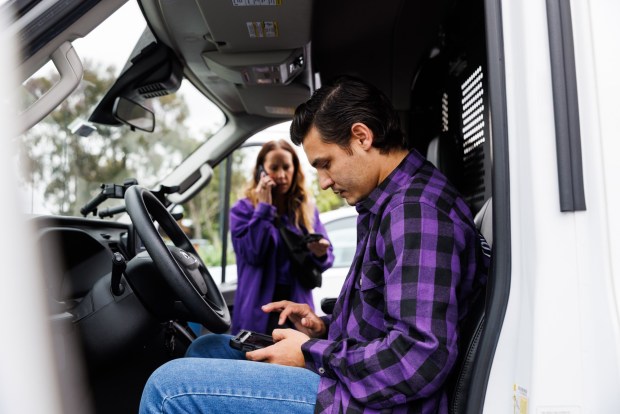 Case manager Luis Bernal and program administrator Bre Lane, a licensed clinician, prepare to head out to a call on Wednesday, May 13, 2026. (Kristian Carreon / The San Diego Union-Tribune)
Her most recent call, Lane says as she and case manager Luis Bernal drive back to MCRT headquarters in Mission Valley, illustrates the whole point of the early intervention model.
“Had we not intervened, she probably would have had to go to an emergency department,” Lane said. “Just by us going and talking to her and giving her resources, and then staying connected for 72 hours, we can prevent law enforcement from having to go out, and we can prevent unnecessary hospitalization.”
According to the program’s most recent annual report, about 60% of calls stabilize clients in the field and just 2% result in hospital treatment.
San Diego County has been among the state’s most ardent MCRT supporters. Starting the service in 2021 with just three vehicles, the operation now fields 21 vans and sport utility vehicles offering round-the-clock response throughout the region.
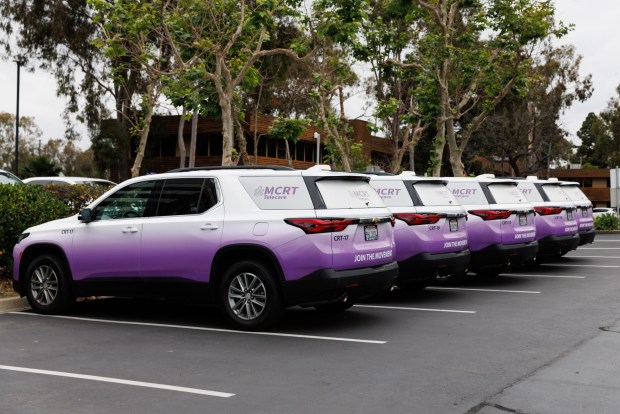 Telecare MCRT vehicles are parked in the parking lot at the Mobile Crisis Response Team headquarters on Wednesday, May 13, 2026. (Kristian Carreon / The San Diego Union-Tribune)
The service has grown rapidly, from 1,489 calls for service in the first year to 9,200 last year and a further 20% increase logged in the current year.
While countywide impact on emergency departments is not perfectly clear from publicly reported data, local ERs have shown a decrease in the number of emergency patients transferred for inpatient care.
The San Diego County Psychiatric Hospital has also seen significant changes since MCRT teams began working upstream to prevent crises. By the county’s accounting, the number of admissions to the hospital’s emergency psychiatric unit have fallen by 43% since the advent of MCRT. There were 606 monthly admissions, on average, in 2020, falling to 344 on average per month in 2025.
 Kibrom Gebregziabher, a clinician, works in the triage room where he receives crisis calls at Telecare’s Mobile Crisis Response Team headquarters on Wednesday, May 13, 2026. The center takes calls from 911 and the access and crisis line.(Kristian Carreon / The San Diego Union-Tribune)
These results, though, have not spared MCRT from potential funding cuts.
The California Department of Health Care Services indicated in January that it plans to make MCRT teams a voluntary, rather than mandatory, service statewide. That change, and the expiration of a federal program that matched state spending on crisis response teams at an 85% rate, would leave counties responsible for making up lost revenue “with local fund sources.”
Despite a strong lobbying effort against the changes, this cost-cutting solution is still in play. A spokesperson with the state finance department confirmed in an email this week that nothing has changed about the plan with the release of the state’s May budget revision on Thursday.
Nadia Privara Brahms, the county’s behavioral health director, testified on the potential effects of the change during a state Senate budget subcommittee meeting on April 30.
The director said that San Diego County’s program, which costs about $24 million per year to operate, would see a $15 million loss if the proposed changes survive the fiscal planning process.
Losing funding, she said, will “force us to significantly scale back our crisis teams, impacting our entire system.”
It was a dire assessment, especially for a county spending $1.26 billion on behavioral health services this fiscal year.
Given that a loss of $15 million would represent about 1.2% of the county’s behavioral health care budget, wouldn’t it be possible to shift other priorities to keep MCRT, a program that county officials champion as among the most effective, whole?
Privara Brahms did not respond Friday to a request for comment. But she did say during her speech in Sacramento that the proposed cuts would not be easily accommodated.
“Our county cannot absorb these costs and maintain the existing capacity … it will undo the progress we have made to improve access to care and reduce barriers,” Privara Brahms said, adding that work in local schools is also at risk.
The County Behavioral Health Directors Association of California has pushed back hard against this cost-cutting proposal, issuing a statement Thursday that called on Gov. Gavin Newsom to work with the Legislature after it became clear that the proposed MCRT funding changes were still in force after the May budget revision.
Mobile crisis response teams, said Michelle Cabrera, the association’s executive director, have shown enough positive real-world results to make them worth fighting for.
“From our perspective, of the more than 85 new initiatives that the Newsom administration has rolled out in behavioral health, the crown jewel has been mobile crisis response teams,” Cabrera said. “They have really brought a tremendous amount of value in avoided confrontations with law enforcement, avoiding unnecessarily sending people to the emergency department.”
 Case manager Luis Bernal and program administrator Bre Lane walk back to their van after speaking with an individual at another Telecare location on Wednesday. (Kristian Carreon / The San Diego Union-Tribune)
Making these programs optional, rather than mandatory, and thus shifting a greater funding burden to county behavioral health departments, is likely to fall hardest on rural counties with significantly lower population densities than are found in urban centers such as Los Angeles, San Francisco and San Diego.
“Without the state funding, without the state mandate, you absolutely will see pockets where it either doesn’t exist at all, or it’s only in the nine-to-five hours,” Cabrera said.
Bre Lane, the San Diego MCRT program administrator, was instrumental in building the local program into what it is today. It is hard, she said, to imagine shrinking a program that has grown so much in just five years.
“When we first opened, we were doing like 50 calls a month, and I remember feeling like, ‘oh my god, we’re doing something, you know,’” she said. “And now we have some times where we’re doing 50 calls a day.”