
 (Ivan Pantic/Getty Images)
Mental health is a common topic in conversations about health and wellness in the United States. In fact, Americans are nearly as likely to say they are putting a lot of effort into taking care of their mental health as they are to say the same about their physical health.
As the nation marks Mental Health Awareness Month, here’s a look at how Americans describe their mental health and who they feel comfortable talking to about it, based on Pew Research Center surveys.
About this research
For Mental Health Awareness Month, this Pew Research Center analysis looks at Americans’ experiences with and views about mental health, based on our surveys of U.S. adults, teens ages 13 to 17 and parents of teens.
Why did we do this?
Pew Research Center does research to help the public, media and decision-makers understand important topics. This analysis builds on our prior research related to Americans’ health, including their mental health.
Learn more about Pew Research Center.
How did we do this?
All findings in this analysis come from previous Center publications. Details about these publications, including survey field dates and other methodological information, can be found through the links in the text.
Most U.S. adults rate their mental health positively, but around one-in-five do not, according to a Center survey from October 2025. Overall, 48% describe their mental health as excellent or very good, 30% say it is good, and 22% say it is fair or poor.
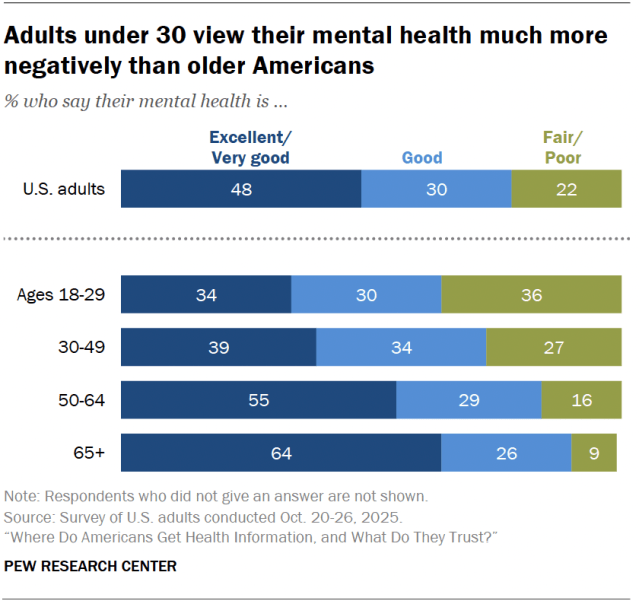
Some demographic groups are more likely than others to say their mental health is fair or poor. Younger Americans especially stand out: Adults under 30 are four times as likely as those ages 65 and older to rate their mental health as fair or poor (36% vs. 9%).
Ratings of mental health also differ by income. Around a third of adults with lower incomes (32%) rate their mental health as fair or poor, a higher share than among middle- and upper-income adults (19% and 13%, respectively).
Women are about as likely as men to say their mental health is fair or poor (23% vs. 20%).
Most adults say they are putting effort into taking care of their mental health. Overall, 36% say they are putting in a lot of effort, while 49% are putting in a little and 15% say they are putting in no effort at all, according to the October 2025 survey.
Although younger adults are more likely than older adults to rate their mental health negatively, the share of younger adults who say they are putting a lot of effort into their mental health doesn’t differ from most other age groups. And it is only slightly smaller than the share of those ages 65 and older who say the same.
Half of adults or more say they would feel extremely or very comfortable talking about their mental health with a close friend (57%), an immediate family member (52%) or a mental health therapist (50%), according to a February 2024 Center survey. Adults are less comfortable talking about these subjects with a religious or spiritual leader (31%) or with a neighbor (11%).
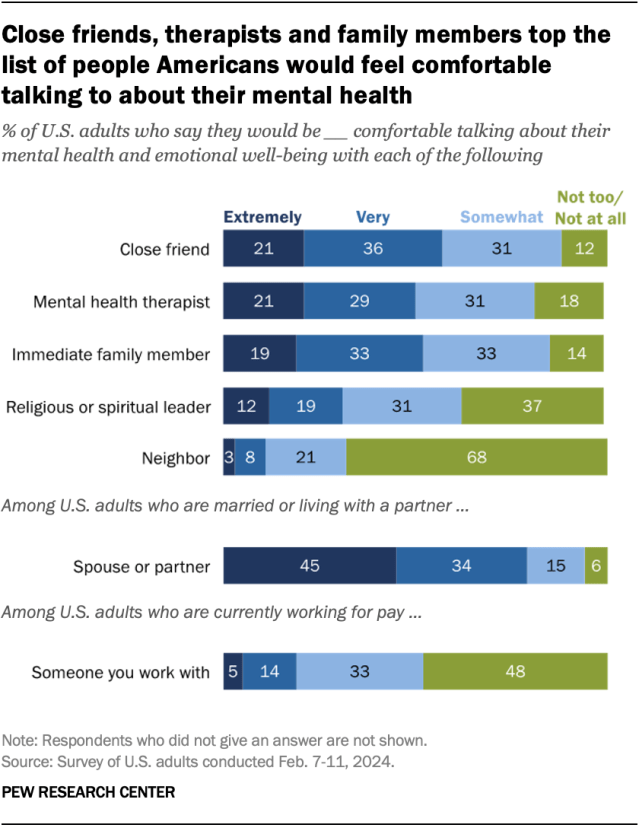
Among adults who are married or living with a partner, a large majority (79%) say they would be extremely or very comfortable talking to their significant other about their mental health and emotional well-being.
Among those who are employed, just 19% would be extremely or very comfortable talking to a co-worker about these topics.
Around a third of U.S. teens ages 13 to 17 (35%) are extremely or very concerned about the mental health of teens these days, according to a fall 2024 Center survey. A slightly larger share (42%) say they are somewhat concerned, while 23% are not too or not at all concerned.
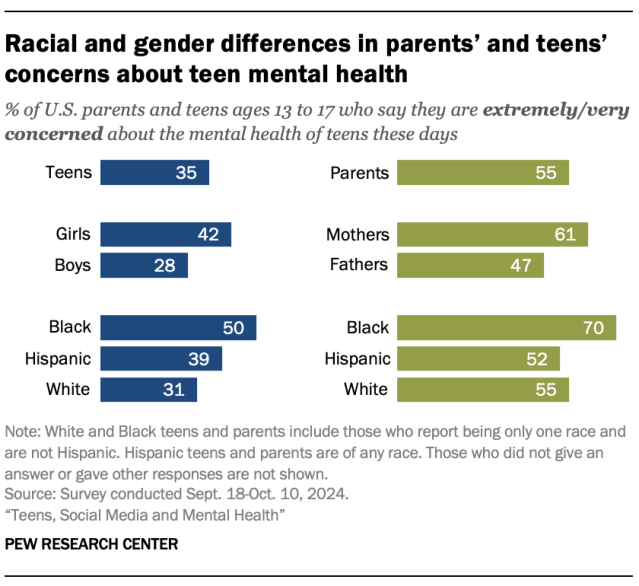
Teen girls are more likely than boys to say they are extremely or very concerned about the mental health of their peers these days (42% vs. 28%). And 50% of Black teens say this, compared with 39% of Hispanic teens and a smaller share of White teens (31%). (There were not enough Asian respondents in the sample to be broken out into a separate analysis. As always, their responses are included in the general population figures throughout.)
Parents of teens are more likely than teens themselves to be concerned about teen mental health, according to the fall 2024 survey. More than half of parents with a teen age 13 to 17 (55%) report being extremely or very concerned about this. Around a third are somewhat concerned (34%), while 11% are not too or not at all concerned.
Some of the same demographic differences that appear among teens also appear among parents of teens. For example, mothers of teens are more likely than fathers (61% vs. 47%) to say they are extremely or very concerned about the mental health of teens these days. And 70% of Black parents of teens say this, compared with smaller shares among White (55%) and Hispanic parents (52%).
Teens are more comfortable talking about their mental health with a parent or friend than with a therapist. Around half of teens ages 13 to 17 say they would be extremely or very comfortable talking about their mental health with a parent (52%) or friend (48%). Smaller shares say this about talking to a mental health therapist (31%), a family member other than their parents (26%) or a teacher (12%), according to the fall 2024 survey.