
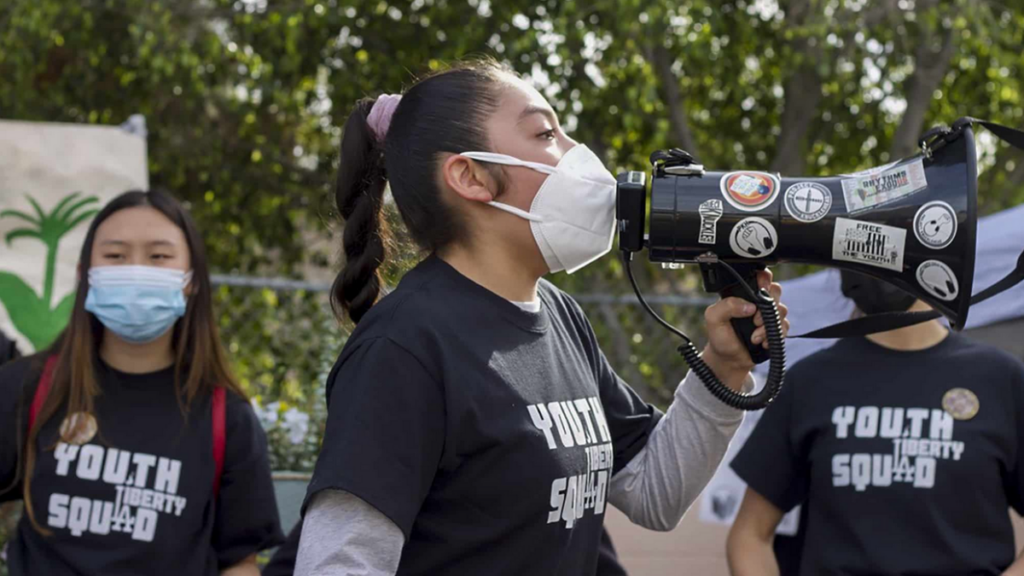
 Youth protest in 2020 in Los Angeles, where demonstrations against Trump and ICE are ongoing (Photo: Shutterstock)
As the Trump administration presses forward with its campaign of detention, family separation and deportation, the mental health of immigrant communities continues to decline.
The push has intensified the deep anguish of many who escaped unbearable trauma in their home countries only to be dogged by inescapable anxiety in the place where they sought refuge.
“What seemed to sit underneath it for many patients was this profound sense of helplessness,” said Sophia Pages, a licensed marriage and family therapist and executive director of behavioral health at Zocalo Health, a network of primary care clinics that largely serve Latino families on Medicaid.
No matter their course of action — being extra-careful, changing routines or even staying home more — nothing protects against ICE, patients said.
“And that loss of control was deeply destabilizing and can intensify depression, trauma-related distress and suicidal thinking,” Pages told NPR.
More than half of the patients Zocalo screened dealt with anxiety so great it affected their daily lives. Almost 75% had depression and nearly 1 in 8 contemplated suicide — a rate of suicidal ideation more than twice that of the general population.
Esperanza, a 29-year-old mother of two from Oaxaca, Mexico, came to the United States in 2023 after a local cartel began extorting her family — demanding fees to farm their own land and pressuring her husband into drug runs.
“When things started getting really bad, we grabbed our stuff and came to the border,” she said, asking that only her first name be used to protect her asylum case.
The journey was traumatic in itself: Cartel members followed them until they crossed into the U.S. By the time they began building a life in California, Esperanza was already struggling. “I wasn’t sleeping. I was having heart palpitations. I was just getting clammy all the time. And that was really affecting me as a woman, as a wife and as a mother.”
When ICE raids began sweeping through the Los Angeles area, her symptoms worsened. Facing immigration court, she was consumed by a single fear: “What if they send me back? What if my kids stay and they just send me? What’s going to happen to them?”
Her 11-year-old son carries the same dread. He is terrified to let her leave the house alone, afraid she’ll be taken while he’s not there. “If they get both of us, then at least we’ll be together,” he said.
Their experience is not an outlier. Children in immigrant communities were already carrying a heavier mental health burden before enforcement expanded — navigating new cultures, languages and environments while managing past trauma and discrimination.
“All those things existed already, putting these communities at risk,” said Ariana Hoet, a pediatric psychologist at Nationwide Children’s Hospital. “Now we add a chronic stressor — this is what’s happening with immigration.”
In mixed-status families, most children are acutely aware of their parents’ vulnerability and live in fear of separation.
A recent study published in the New England Journal of Medicine found that those who experience a parent’s deportation face more than double the odds of developing PTSD.
The effects ripple outward, with children in surrounding communities reporting higher levels of depression, anxiety and trauma. It even shows up in their bodies and behavior.
“You see kids become more clingy, very anxious and worried,” Hoet said. “They can become quieter, withdrawn socially. They don’t want to do things that they typically do.”
For Esperanza, therapy has helped a little. She has learned breathing exercises, found community through her local church, and is sharing the coping skills she’s learned with her husband and son. It is the best she can do, faced with the specter of an ICE regime that does not care about her or her family’s wellbeing.