
When Julian Sanchez returned to the Sebastopol Police Department Wednesday morning, May 20, someone was waiting for him in the lobby. Sanchez, an outreach worker for Sonoma County’s behavioral health division, had just returned from doing a few rounds in Sebastopol’s downtown area.
In a public parking lot, he brought food to someone living in a van who had trouble walking. At the Sebastopol town plaza, he encountered a man he hadn’t seen before and asked how he could help.
Back at the police station, Jennifer Apodaca, 52, was waiting for him to return, eager for an update on his efforts to get her into temporary housing. With Sanchez’s help, Apodaca will likely soon land a bed at Sonoma County’s Eliza’s Village, a 90-bed shelter near Santa Rosa’s Oakmont community.
During a brief check-in in the police department lobby, the two also discussed her health coverage and the steps she needed to replace her lost cellphone.
“He’s a miracle worker,” Apodaca said. “He’s making a change…he’s a one stop shop.”
Sanchez’s outreach work is part of a pilot program that has embedded him at the Sebastopol Police Department, an initiative aimed at more effectively addressing the needs of homeless people who come into contact with law enforcement. That includes linking people to shelter and housing; healthcare; mental health and substance use screening; and social services and public benefits.
The pilot is funded by Measure O, a countywide, 10-year, quarter-cent sales tax supporters say has become an integral part of the local safety net for those facing behavioral health and homelessness issues. As the voter-approved tax is slated to sunset in 2030, supporters are increasingly concerned about how the loss of funds will impact local services.
On Monday, May 18, Nolan Sullivan, the county’s director of health services, participated in a public forum hosted by the Sonoma County League of Women Voters to discuss Measure O and the services it funds. The forum was the first of what the county is calling the “Measure O Roadshow,” a campaign aimed at generating support from voters for extending the sales tax.
Health officials said they plan to put the tax extension on the November 2028 ballot.
During the online forum, Nolan explained that Measure O was the county’s response to perennial budget deficits back around the time of the 2017 North Bay wildfires. Those shortfalls led to layoffs of about 100 health services workers and the elimination of a dozen contracts with service providers, he said.
The annual revenue generated by the tax comprises about 10% of the county Behavioral Health Division’s $300 million budget.
“In 2017, the train really went off the track in terms of behavioral health funding,” Sullivan said. “Measure O really helped stabilize some semblance of cushion for our behavioral health system.”
Sullivan pointed out that Measure O specifically lays out how funds are to be used, with 22% going toward behavioral health facilities; 44% for emergency psychiatric services; 18% for outpatient services; 14% for homeless and behavioral health care coordination; and 2% for transitional and permanent supportive housing.
A little more than 5 years into Measure O’s tenure, nearly $165 million has been spent on local programs and services as of the 2024-25 fiscal year. In that time, the tax has served 3,309 individuals at the county’s psychiatric emergency department known as the Crisis Stabilization Unit and 704 others at the county’s inpatient psychiatric health facility, where people can receive up to 14 days of intensive 24-hour care.
Sullivan said Measure O-funded mobile crisis services have reached 2,572 people, housed another 1,281 in residential care facilities for transition to a more independent level of care; and 949 others housed in “home-like housing,” referred to as residential crisis services.
Sullivan, who previously worked 18 years in Yolo County, said Sonoma County’s Crisis Stabilization Unit alone sets the county apart from other places where he’s worked.
“One of the reasons I accepted the job here in Sonoma was the fact that we had a CSU, that we had a psychiatric health facility, that we had mobile crisis response rolled out with three separate teams county wide,” he said.
“This is one of the most robust behavioral health safety nets that I have ever witnessed or experienced,” he added. “Coming from a place that had none of these systems, I’ve got to tell you, we’re saving hundreds of lives with some of the things that we have in place.”
Sanchez, the county outreach worker, is part of one of the county’s newest Measure O-funded programs.
New program
The pilot that placed Sanchez at the Sebastopol Police Department was launched at the start of the year. The program gets about $200,000 in Measure O funds, which covers Sanchez’s paycheck, as well as supplies and equipment.
A similar program is in the works for Sonoma Valley, where another outreach worker will be embedded with Sonoma Police Department.

Julian Sanchez, a senior client support specialist with Sonoma County, talks with a homeless woman about getting her services in Sebastopol Wednesday, May 20, 2026. (Beth Schlanker / The Press Democrat)
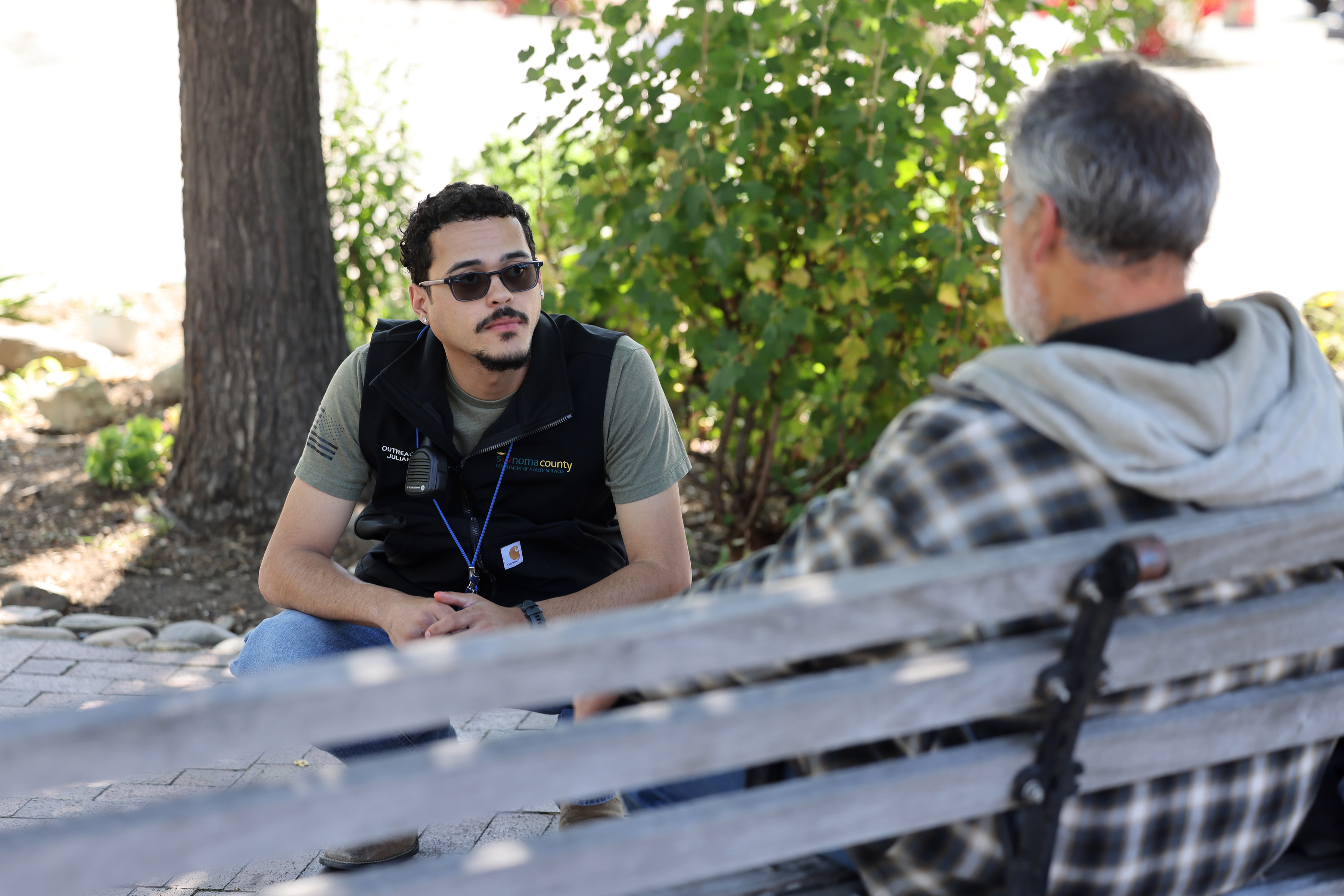
Julian Sanchez, a senior client support specialist with Sonoma County, talks with a homeless man about support services available to him at the town square in Sebastopol Wednesday, May 20, 2026. (Beth Schlanker / The Press Democrat)
Show Caption
1 of 2
Julian Sanchez, a senior client support specialist with Sonoma County, talks with a homeless woman about getting her services in Sebastopol Wednesday, May 20, 2026. (Beth Schlanker / The Press Democrat)
Between Jan. 20 and May 1 of this year, Sanchez has directly supported 50 clients, participated in 73 calls that triggered encounters between clients and police and initiated 61 outreach engagements. Of the 50 clients, 5 have been placed into shelters, 11 have signed up for services while another 17 agreed to accept future services.
Only 4 of the 50 have refused services. More than half of these clients are between the ages of 40 and 59; one is between 20 and 29 and four are between 70 and 79. The vast majority, 37, are white.
The pilot was a response to nuisance issues tied to Elderberry Commons, a permanent supportive housing site near Gravenstein Station on Sebastopol Avenue. During the first few months after Elderberry Commons was opened last spring, neighbors frequently complained about illicit drug use, trespassing and alleged prostitution.
On May 18, Sullivan and Sebastopol Police Chief Sean McDonagh hosted a “meet-and-greet” at a cafe in The Barlow to showcase the pilot program. Members of the Sebastopol City Council attended the event, as did Sanchez.
Sebastopol Police Chief Sean McDonagh said Sanchez is dispatched with police any time they receive a call that involves a homeless resident.
“There will be calls where we feel like Julian’s already got a connection with this person. They may not like police so we’ll just monitor for general protection but not get in the way of progress,” McDonagh said. “There’s other calls where we’ll go out together or Julian will just jump in for a ride-along.”
During the Zoom forum hosted by the League of Women Voters, Sullivan spent more than 45 minutes discussing all the other programs funded by Measure O. Of the nearly $165 million, $91 million has gone to support the work of community service providers; $6 million in direct payments have gone to cities, funding things like safe parking for those living in their vehicles; and nearly $68 million has gone to county-run programs, such as mobile crisis services and psychiatric beds.
In the 2024-25 fiscal year, the county spent $54.7 million of Measure O funds, with the largest expenditure, $30 million, going to psychiatric emergency and crisis services. Sullivan pointed out that during that period it was able to use Measure O funds to “leverage” millions of dollars in federal reimbursements.
“Of that $54 million, $22.1 million of that would not have been possible if we didn’t have the Measure O dollar to put up in the first place,” he said.
Leona Judson, a member of the local League of Women Voters in charge of the group’s program planning, said Sullivan’s presentation was “heavy on data” and that she was impressed with the number of services funded by the tax.
Mary-Frances Walsh, executive director National Alliance on Mental Health Sonoma County, said the county has become increasingly reliant on Measure O to fund essential services. Walsh, who is also a member of the league, said her organization helped build support for the tax.
“The county is so reliant on that funding for some very core services,” she said. “Without that funding we would see a dramatic decrease or lapse or some failures.”
You can reach Staff Writer Martin Espinoza at 707-521-5213 or martin.espinoza@pressdemocrat.com.