
Protecting the Nation’s Mental Health | Mental Health | CDC

Official websites use .gov
A .gov website belongs to an official government organization in the United States.

Secure .gov websites use HTTPS
A lock ( ) or https:// means you’ve safely connected to the .gov website. Share sensitive information only on official, secure websites.
For Everyone
Get help now
If you or someone you know is struggling or in crisis, confidential, free, 24/7/365 help is available. Call or text 988 or chat 988lifeline.org. See Resources for help.
Data show that the United States—especially its youth—is in mental health crisis.
A public health approach that helps to improve environments where we live, work, learn, and play can positively impact mental health.
Focusing on health equity can help ensure all groups of people have fair access to health and can live to their fullest potential.

Recent data shows that the United States is in mental health crisis, experienced by people of all ages—but especially among young people. This trend was observed prior to the COVID-19 pandemic, but has been worsened by pandemic-related factors. In addition, drug overdose and suicide remain leading causes of deaths in the U.S. These deaths, often associated with mental distress, continue to impact families and communities socially, emotionally, and economically long after they occur.
Explore mental health data
Access the latest mental health and well-being data among U.S. youth and adults on CDC’s Mental Health Data Channel.
Improving mental health through public health
No one approach can solve the mental health crisis alone. CDC uses its expertise in public health data, science, and systems to improve mental health outcomes in the U.S.
Public health uses a primary prevention approach to promote positive mental health by focusing on the drivers of well-being and mental distress. This approach aims to prevent mental health conditions before they develop or worsen.
We identify, understand, and intervene on upstream protective factors, i.e., environmental and societal factors, to prevent mental distress and promote well-being for individuals and communities.
We work with partners at the federal, state, and community level to improve mental health. These partners can include health care providers, public health workers, community organizations, faith-based communities, employers, local government leaders, and others.
Public Health’s role in mental health promotion and suicide prevention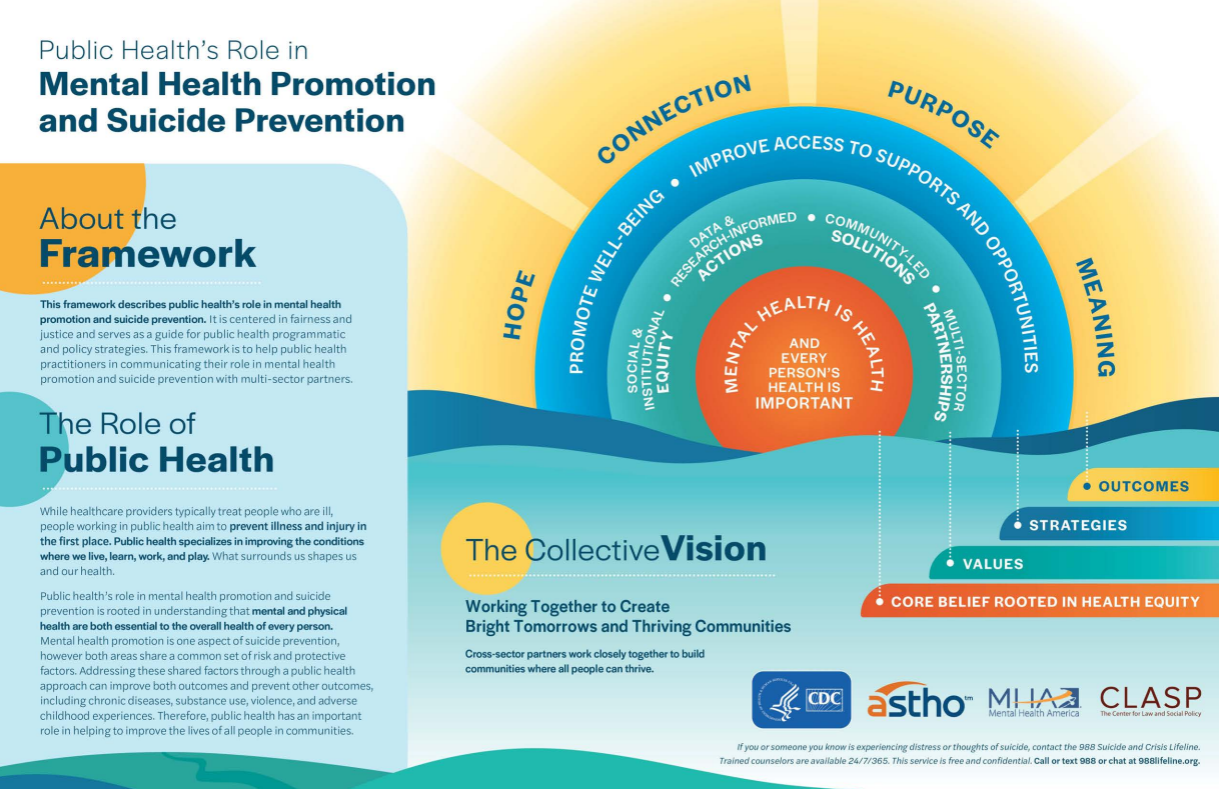
CDC and several partners released a Mental Health Framework to help public health practitioners communicate with multisector partners about their role in mental health promotion.
CDC’s Mental Health Strategy
CDC’s Mental Health Strategy for Individual, Family, Community, Society builds on the Mental Health Framework created in partnership between CDC, the Association of State and Territorial Health Officials (ASTHO), Mental Health America (MHA), and the Center for Law and Social Policy (CLASP) in October 2023.
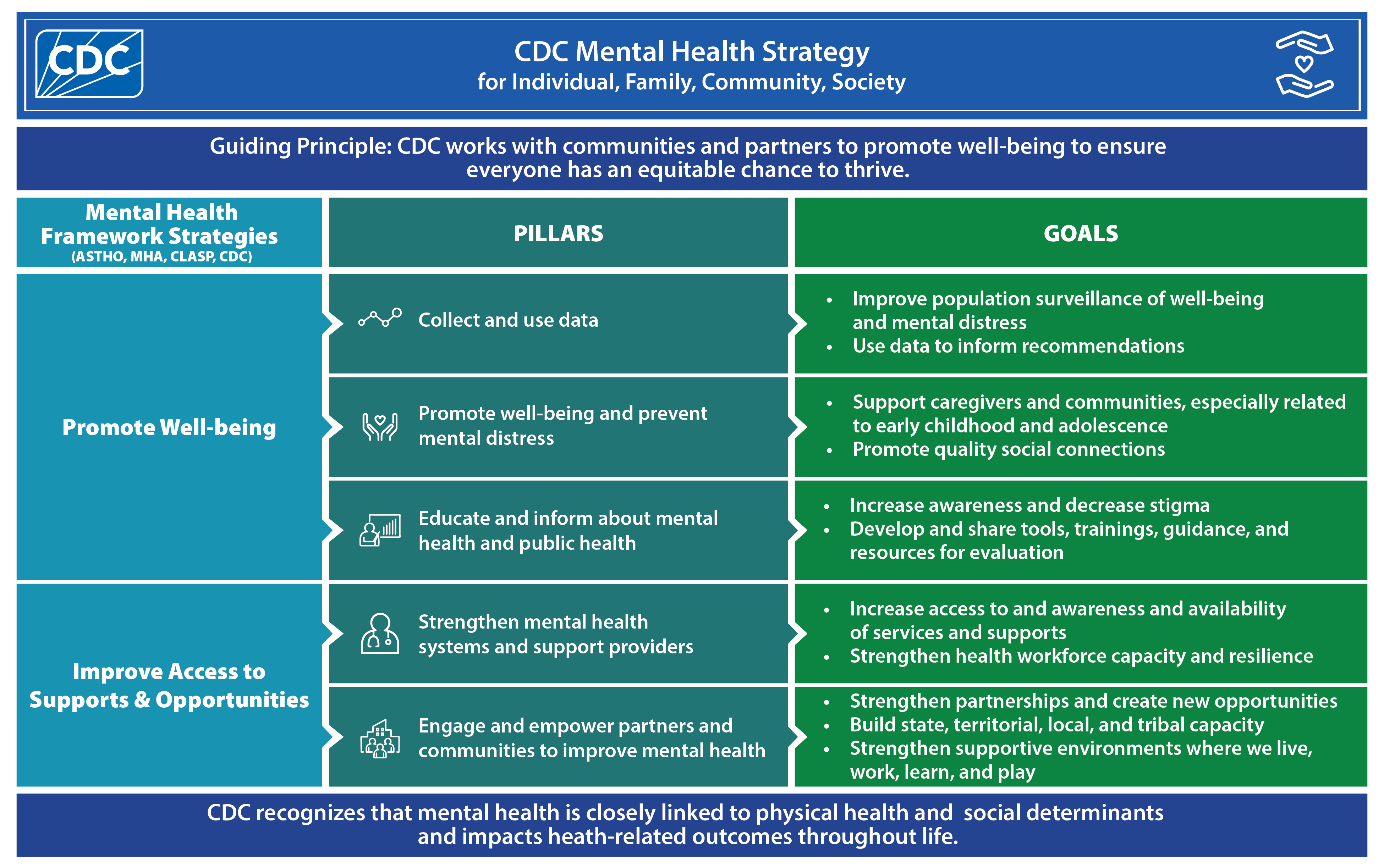
The CDC Mental Health Strategy takes a public health approach. It includes a framework to promote well-being and improve access to supports and opportunities.
CDC Mental Health Strategy for Individual, Family, Community, Society
Guiding Principle: CDC works with communities and partners to promote mental well-being to ensure everyone has an equitable chance to thrive.
Mental Health Framework Strategies (ASTHO, MHA, CLASP, CDC)
Promote Well-being
Improve Access to Supports and Opportunities
Pillars
Collect and use data
Promote mental well-being and prevent mental distress
Educate and inform about mental health and public health
Strengthen mental health systems and support providers
Engage and empower partners and communities to improve mental health
Goals
Improve population surveillance of mental well-being and mental distress
Use data to inform recommendations
Support caregivers and communities, especially related to early childhood and adolescence
Promote quality social connections
Increase awareness and decrease stigma
Develop and share tools, trainings, guidance, and resources for evaluation
Increase access to and awareness and availability of services and supports
Strengthen health workforce capacity and resilience
Strengthen partnerships and create new opportunities
Build state, territorial, local, and tribal capacity
Strengthen supportive environments where we live, work, learn, and play
CDC recognizes that mental health is closely linked to physical health and social determinants and impacts health-related outcomes throughout life.
Show Text Description
CDC’s public health strategy to improve mental health is guided by principles of health equity. Health equity is the state in which everyone has a fair and just opportunity to attain their highest level of health.1 When people have limited access to resources they need to be healthy, such as access to health care, they are more likely to struggle with health issues. CDC works with partners to promote policies and focus resources on improving the lives of populations disproportionately impacted by the mental health crisis. This includes a focus on addressing differences in social determinants of health to accelerate progress towards achieving health equity.
Disproportionately affected populations include:2
Racial and ethnic minority groups, e.g., Black, Hispanic and Latino, American Indian/Alaska Native (AI/AN), Asian American, Native Hawaiian, and Pacific Islander (AA and NHPI)
Sexual minorities
People experiencing homelessness
People who are justice-involved
People who live in rural areas
May 19, 2026
Content Source:
National Center for Injury Prevention and Control
ReferencesCDC. (2024). What is Health Equity? Retrieved August 1, 2024 from https://www.cdc.gov/health-equity/what-is/?CDC_AAref_Val=https://www.cdc.gov/healthequity/whatis/index.html
Mongelli, F., Georgakopoulos, P., & Pato, M. T. (2020). Challenges and Opportunities to Meet the Mental Health Needs of Underserved and Disenfranchised Populations in the United States. Focus, 18(1), 16–24. https://doi.org/10.1176/appi.focus.20190028