
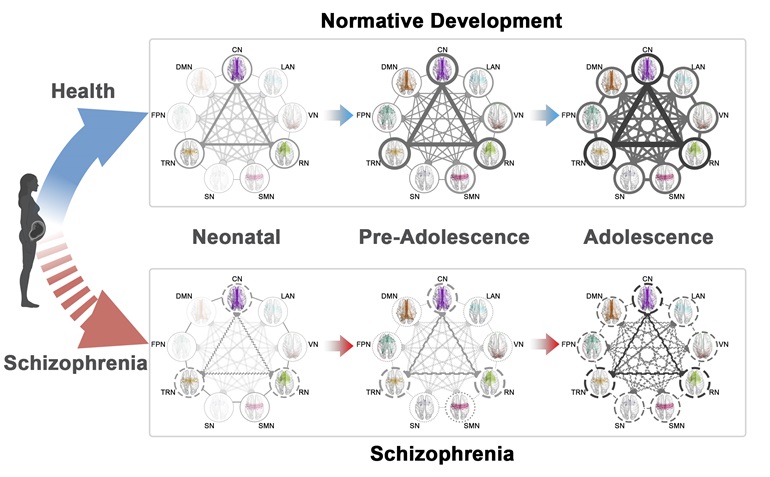
A schematic of how the pathway of normal development goes awry in schizophrenia.
A team of multi-university researchers led by Wayne State University School of Medicine Professor of Psychiatry and Behavioral Neurosciences Vaibhav Diwadkar, Ph.D., has produced a compelling overview of how humans come to feel a sense of ownership, or “me-ness,” in themselves, an issue that has vexed philosophers for centuries and which scientists have only recently begun to grapple with.
The information could provide insights into the understanding of mental health disorders such as schizophrenia.
“Fundamentally speaking, why do we have a unity of experience even though our incoming sensations like smell, touch and proprioception are fragmented across many channels? And how does this unity give rise to the sense of ‘me’?” Dr. Diwadkar asked. “We argue that the fundamental human trait of experiencing a sense of ‘me’ emerges from neurodevelopmental processes most saliently related to interoception.”
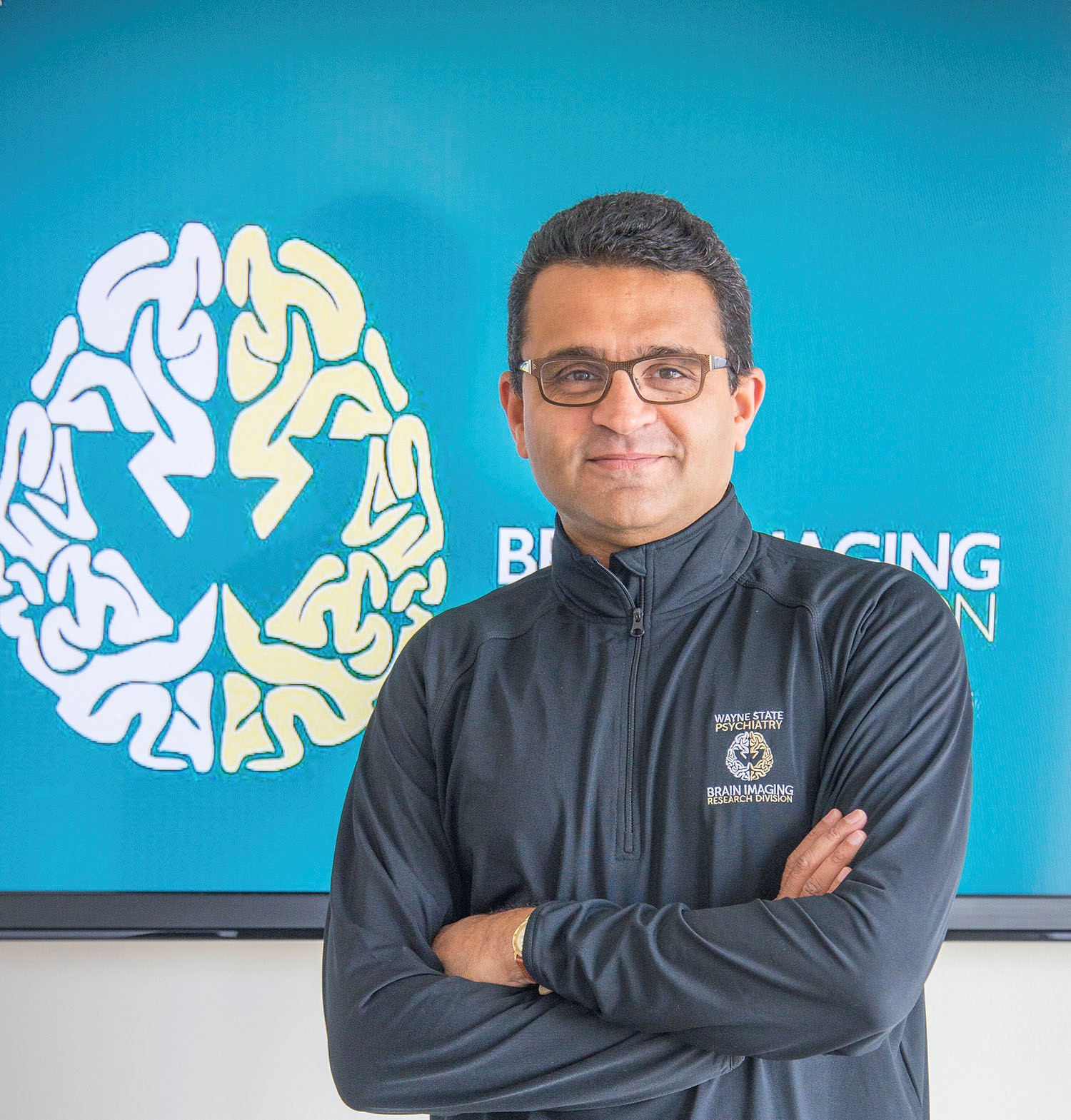
Vaibhav Diwadkar, Ph.D.
Interoception is the brain’s ability to sense and integrate internal physiological states – the thought “How cold am I feeling?” for example. Proprioception is perception or awareness of the body’s position and movement.
“Interoception, Neurodevelopment, and the Emergence of Agency: Implications for Schizophrenia,” the result of a rigorous 18-month review process, is published in the journal Neuroscience and Biobehavioral Reviews, which specializes in publishing high-significance review articles that integrate brain function with behavior.
The Visceral Afferent Training hypothesis outlined in the paper proposes that rhythmic internal signals, particularly cardiac rhythms, begin training the brain even before birth to distinguish internal sensations from external sensations. This early interoceptive development becomes the scaffold for brain networks that eventually support agency – the sense of causing one’s own actions.
“As stated in the Visceral Afferent Training hypothesis which we agree with, neurodevelopmental processes for interoception begin in utero. Here, rhythmic visceral signals (primarily cardiac in origin) begin to train the developing brain to model internally-generated sensations, and leads to the formation of rudimentary brain networks for interoception,” Dr. Diwadkar said. “Then, development in the world takes over. As the infant interacts in its world, these interoceptive signals are eventually integrated with exteroceptive — or external — inputs that drive development of brain networks for memory, attention and learning.”
The study team included scientists in Wayne State’s Department of Pediatrics and Department of Psychiatry and Behavioral Neurosciences; Harvard University’s Department of Psychiatry; Michigan State University’s departments of Psychology, Psychiatry and Human Medicine; and the University of Michigan departments of Anesthesiology, Biomedical Engineering and the Center for Consciousness Science, which drew their conclusions by reviewing notable literature in multiple disciplines, including philosophy, physiology, neuroscience, psychology and psychiatry.
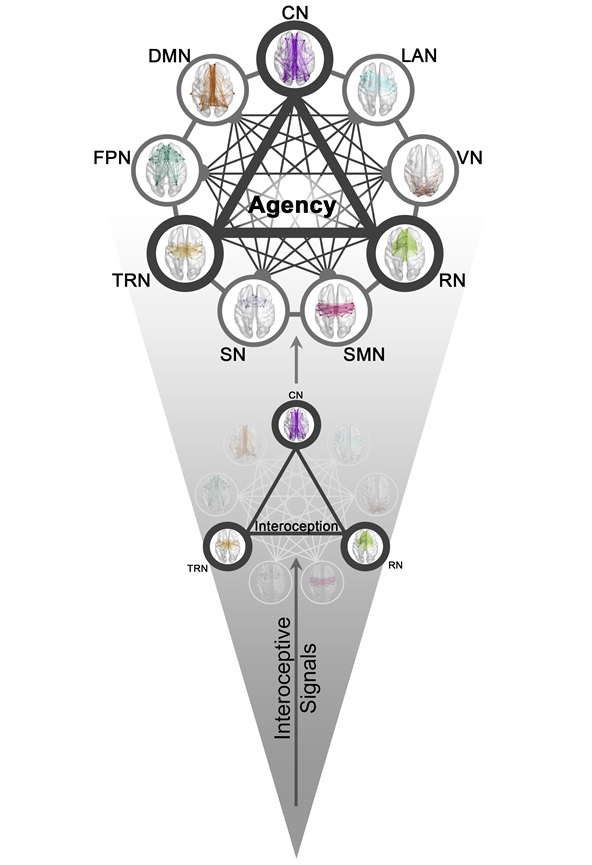
A figure shows how basic brain networks for interoception (CN: Cardiac, RN: Respiratory, TRN: Thermoregulatory), are formed early in life before then becoming integrated with networks for exteroception.
“There is currently a groundswell of interest concerning the role of the body — and in particular, the ability to monitor and regulate internal bodily states — in mental health and disease,” said Andrew Corcoran, Ph.D., a postdoctoral fellow studying brain-gut connectivity and conscious perception at the University of Copenhagen.
Dr. Corcoran, who is not part of Dr. Diwadkar’s scientific team, has written seminal papers on Visceral Afferent Training that helped shape the paper. He is a member of the INTREPID Consortium, an international adversarial collaboration commissioned as part of the Accelerating Research on Consciousness initiative.
“The more work we have mapping the cross-cutting relations between clinical phenomenology, cognitive function and development on the one hand, and the connection between psychological states and physiological dynamics on the other, the more opportunities we will have for understanding and combating mental illness. I hope that the theoretical approach adopted by Dr. Diwadkar and colleagues can be applied to other developmental disorders in which the potential contribution of the body’s internal dynamics has barely been explored,” he said.
The ideas are relevant to a mental health disorder like schizophrenia, which is characterized by deficits in ownership, agency, interoception and exteroception, but their bases have not been conceptually linked. The paper pulls together concepts that link schizophrenia to aberrant neurodevelopment, brain network dysconnection, impaired interoception and disturbed agency.
“Schizophrenia is one of the most intensively studied forms of psychopathology, making it very challenging to come up with truly novel perspectives on its origins, perpetuating factors, and potential targets for intervention,” Dr. Corcoran said. “This review is notable not only for its impressive synthesis of a very broad evidence base ranging from neural dynamics to selfhood and agency, but also for organizing these disparate findings into a sophisticated neuro-developmental framework that places bodily states at the forefront of its research agenda. I’m excited to see how this framework can be further elaborated and tested, with the hope that it stimulates novel breakthroughs that eventually lead to tangible benefits for people affected by schizophrenia and other disorders.”
Additional studies could help neuroscientists interpret the clinical and cognitive deficits that define the disorder’s core and expand interest in the study of interoception in schizophrenia.