
What GAO Found
Stakeholders and available literature identified occupation, culture, and personal life stressors that may negatively affect the mental health of law enforcement officers in the Department of Homeland Security (DHS).
Stressors that Department of Homeland Security Law Enforcement Officers May Face
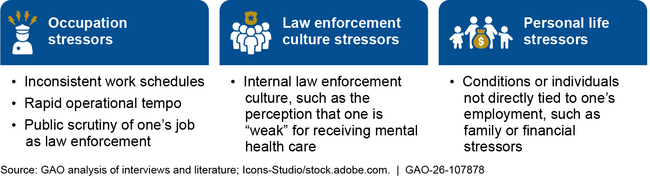
Selected law enforcement agencies—U.S. Customs and Border Protection (CBP), U.S. Immigration and Customs Enforcement (ICE), and the Transportation Security Administration (TSA)—reported that at least 99 suicide-related deaths occurred in fiscal years 2016 through 2025. During this period, CBP reported 81 of these deaths and had an average suicide rate of 17.6, which varied annually compared to nationwide trends. ICE and TSA reported a total of 18 deaths. GAO found that the agencies face challenges collecting all data specified in DHS’s suicide prevention directive, in part due to privacy concerns and their need to rely on external sources for death information. DHS’s Office of Health Security (OHS) has taken steps to centralize data collection on deaths through a new system but still relies on agencies’ data. Assessing and updating the directive and ensuring the new system reflects any changes would allow for more consistent data collection and assist in prevention efforts.
OHS and DHS law enforcement agencies have policies and programs related to mental health and suicide prevention that apply to law enforcement officers. CBP and ICE have also developed initiatives that provide additional support for officers’ mental health. For example, CBP’s Safe Harbor initiative, which is unique within DHS, offers a path for officers to seek help for mental health concerns without risking job loss or removal from duty.
OHS, CBP, ICE, and TSA have taken some steps to assess mental health and suicide prevention programs and initiatives. However, they did not consistently collect and report sufficient data to OHS to support an overall program assessment. By developing a process to consistently collect and assess relevant information, such as annual reports on program implementation, OHS could improve analysis of comparable information across agencies and strengthen oversight of mental health and suicide prevention programs.
Also, while CBP has taken steps to assess the implementation of Safe Harbor, it lacks key information, such as the extent of employee awareness, to understand whether the initiative is working as intended. Developing a plan to assess the initiative’s effectiveness would better position CBP to determine which efforts best support law enforcement officers who need mental health services.
Why GAO Did This Study
DHS is the largest federal law enforcement agency, with more than 77,000 officers across nine agencies and offices. DHS officers perform critical work to protect national security, but this work may expose them to stress that could adversely affect their mental health.
GAO was asked to review DHS’s mental health and suicide prevention efforts related to its law enforcement officers. This report examines (1) stakeholder perspectives and available literature on mental health and suicide among these officers, (2) data on law enforcement officers’ deaths by suicide, (3) mental health and suicide prevention policies and programs, and (4) efforts to assess related programs.
GAO analyzed policies and documents and reviewed literature on mental health and suicide among DHS law enforcement officers. GAO selected three agencies—CBP, ICE, and TSA—for closer review based on total officers and magnitude of mental health resources provided. GAO analyzed agency data on officers’ suicide-related deaths. GAO interviewed DHS officials, a total of ten randomly selected officers from CBP, ICE, and TSA, and stakeholders from relevant employee organizations.