
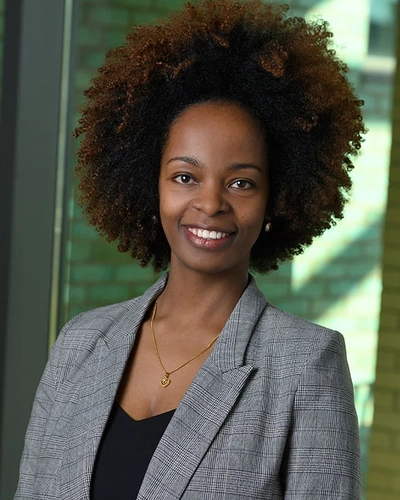
 Maji Hailemariam Debena. Photo credit Charles Stewart Mott Department of Public Health.
Maji Hailemariam Debena is a mental health epidemiologist and implementation scientist in Michigan State University’s Charles Stewart Mott Department of Public Health. Her research advances access to mental health care through peer-delivered, community-rooted interventions spanning justice-involved individuals and perinatal women affected by intimate partner violence.
I came to Flint almost a decade ago as a postdoctoral researcher. What I didn’t anticipate was that the community would claim me just as much as I hoped to serve it. Jennifer Johnson invited me into the Flint Women’s Study. At first, it felt like a wonderful adventure, sitting down with women from all walks of life, listening to their stories and learning the texture of this city through their voices.
I didn’t fully appreciate then what it would become. Over time, the work stopped feeling like a project and started feeling like a calling. It became deeply personal and entirely immersive. This work shaped my career in Flint in ways that I am still accounting for. It is the reason I stayed, the reason I kept building and the reason the research that followed has meant as much as it has.
The relationships built through that research, the trust extended by women who had every reason to withhold it and the knowledge we built together have grounded my subsequent decade in this community in ways I could not have planned. That experience is also what makes this particular paper feel significant to me beyond its findings. Belongingness, including belonging to oneself, to others and to something greater than oneself, is not just a theoretical framework we applied to a dataset. It is something I have lived in Flint. And it is what I saw women in this community practicing every day, even under conditions that systematically worked against it.
Belonging to oneself means having personal agency, self-worth and control over one’s own life. When a community faces persistent instability, underinvestment, environmental neglect and poverty, it doesn’t just erode physical health. It erodes social health, fractures this fundamental human need and, more importantly, harms women.
Using a community-based participatory research approach, our community-academic team met with 100 women and community representatives in Flint to understand how they navigate these challenges. What we found serves as a powerful mirror for the struggles and resilient strengths of women everywhere.
We found that a woman’s ability to belong to herself depends on four interconnected pillars: basic needs, services, safety and autonomy. When these are compromised by structural disinvestment, claiming self-worth becomes an act of daily resistance.
We also found major gaps in access to food, clean water and stable housing that fall hardest on pregnant women, domestic violence survivors and those managing mental health or substance use challenges. We found that gaps in transportation, maternal care, health care and education trap women in bureaucratic processes, with barriers worsened by a justified distrust of institutions. Physical and emotional insecurity limits women’s choices and shrinks their worlds, forcing them to survive rather than grow. Economic insecurity constrains personal agency in ways that compound across every other dimension of life.
Despite these heavy barriers, the interviews also revealed a strong spirit of survival. One participant told us, “I’ve yet to meet a woman in Flint who wasn’t incredibly sharp and incredibly dangerous if you tried to talk her into a corner, because she’s had to be.” Another captured what belonging to self looks like from the inside: “When you know your self-worth, you quit givin’ people discounts. They don’t give themselves credit for how far they’ve come, the things that they’ve gone through and overcame.”
I want to name what I see underneath these findings: systemic gaslighting. When society fails to provide safe neighborhoods, affordable child care or basic resources, it sends women the message that their time, safety and health do not matter. We learned that this directly undermines their autonomy and erodes their dignity.
True public health requires us to move beyond treating diseases or distributing generic resources, approaches that often carry an implicit message that women are the problem to be fixed. The real work of public health starts with building the conditions in which women have the stability and safety to claim their self-worth and feel empowered.
And Flint women already know how to do that. Despite limited opportunity, participants named concrete, community-rooted, trauma-informed solutions:
24-hour child care for nontraditional work shiftsPeer mentorshipCommunity gardensLocal skill-building workshops
These are the blueprints that women have been sketching out of necessity. The strength behind them is collective action. Even amid chronic instability, women in Flint innovate, care for one another and build mutual support every single day.
Although this research is rooted in Flint, its lessons reach far beyond it. Women facing concentrated poverty, whether in rural America, struggling cities or underresourced communities around the world, bear the compounding burdens of economic collapse and environmental neglect. This is especially true for mothers and caregivers who serve as the backbone of families and local communities.
At Michigan State University, we believe research must spur equity beyond statistics. Flint’s women offer a clear roadmap: Invest in basic needs, make public services trustworthy, ensure safety and honor autonomy so that every woman can reclaim her sense of identity, agency and self-worth.