
Plenty of us reach for cold when something hurts. A bag of frozen peas on a twisted ankle, an ice pack against a pounding headache.
Now researchers are asking a stranger question. Could cooling the head also lift a person’s mood?

A new study from Penn State suggests it might. Wearing a cooling cap for half an hour appeared to calm the brain and ease low mood in healthy young adults.
How head cooling affects the brain
The technique is called selective head cooling. It means placing a cold compress on the head for a set time, which lowers brain temperature.
The Penn State team had seen this work before. Their earlier research found that athletes recovering from concussions healed faster and reported fewer symptoms when their heads were cooled.
Injured athletes are one thing, though. The researchers wanted to know whether cooling could help people with no brain injury at all.
Measuring mood and brain activity
The team recruited 24 college students between the ages of 18 and 26. Half wore a cooling cap, while the other half wore nothing on their heads.
Each session ran for 30 minutes in a dimly lit room with ocean sounds playing softly. The cap circulated liquid coolant to maintain a temperature of 0.6°C (33°F).
Before and after the first session, everyone filled out mental health questionnaires and completed a set of cognitive tests. They also wore an EEG cap that records the brain’s electrical activity.
Then the routine was repeated for a week. Participants came in for cooling or rest every day, with one final round of testing the day after the last session.
This design allowed the team to observe two kinds of change. They could track what happened immediately after a single session and what persisted across the entire week.
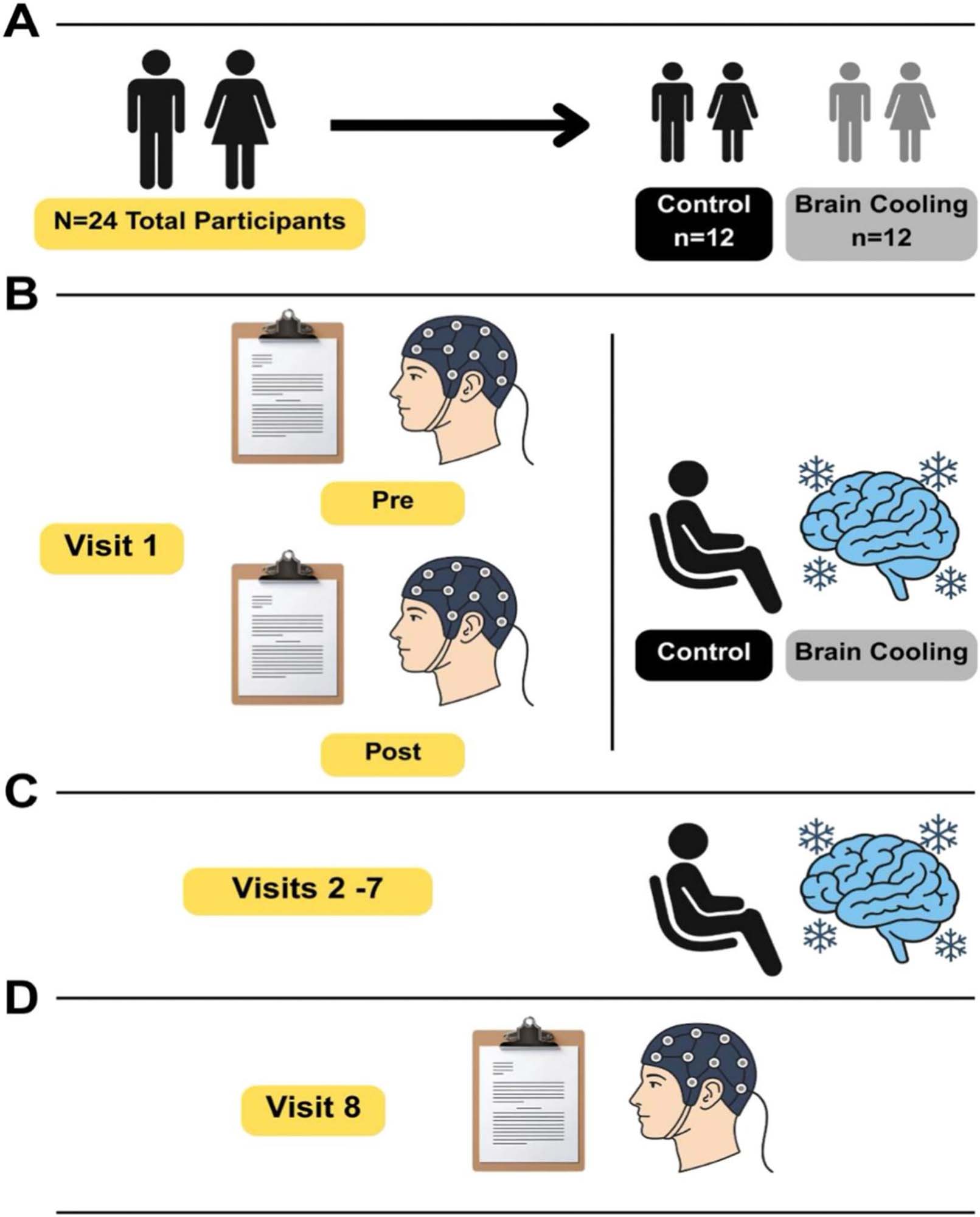 This head cooling study was a longitudinal randomized controlled trial. Study participants were divided randomly into two sex-matched groups: Head Cooling (HC) and controls. The trial consisted of a one-week intervention period and three major measurement time points. Credit: Penn State. Click image to enlarge.Brain waves calmed quickly
“The brain produces different types of waves that are associated with different levels of excitement or brain activation,” said Laura Cooney, a co-author whose undergraduate thesis at Penn State formed the basis of this work.
“Alpha waves are associated with calmness,” she said. “More specifically, they are indicative of lower overall brain activity, so this finding suggests that head cooling had an immediate calming effect.”
The data matched her description. People in the cooling group showed a clear rise in alpha waves immediately after the first session, while the control group dipped slightly.
The effect did not last, though. By the day after the final session, both groups looked the same, suggesting the calm was a short-term response rather than a lasting change in the brain.
Depression symptoms went down
Both groups reported feeling less depressed by the end of the week. The real difference showed up in how much.
People who wore the cooling cap reported a much larger drop in depression symptoms than those who simply sat. On a standard screening score, the cooling group fell by roughly five points, while the control group barely moved.
“The reduction of depression symptoms among healthy people suggests that this might be a promising treatment,” said study co-author Owen Griffith, an assistant professor of kinesiology at Penn State.
The benefit may be psychological
The researchers had expected cooling to work by directly changing the brain’s electrical activity. The EEG readings did not support that idea.
So they considered a different explanation. The benefits may be psychosomatic, meaning that mental and emotional factors, rather than physical changes in the brain, are driving the improvement.
“A person’s mood is tied to their cognition and general brain function,” said Griffith.
“In this study, the results suggested that people enjoy the sensation of head cooling. This, in turn, improved their mood, which altered their brain activity.”
“Anecdotally, most people who come into the lab agree that head cooling is relaxing and enjoyable. This may not be surprising. A cold compress or a bag of ice has been a home treatment for migraines for many years.”
Anxiety changed the results
The team also looked at participants who had an anxiety diagnosis. Eight of the 24 students fell into this group, so these findings should be viewed as early trends rather than firm conclusions.
Among them, cooling appeared to reduce the fast beta brain waves associated with stress and a wired, overactive mind. The control group with anxiety drifted in the opposite direction across the week.
This finding is worth following up on. Elevated beta activity is a common marker of anxiety, and cooling may help nudge that system back toward balance.
 Co-authors Owen Griffith, standing, and Maddie McLaughlin demonstrate the head cooling cap used in the study. Credit: Jaydyn Isiminger / Penn State. Click image to enlarge.A promising but early finding
The authors are upfront about what this study cannot yet show. The sample was small and consisted of healthy college students, which limits how broadly the findings can be applied.
The control group also sat without a sham cap, making it difficult to separate expectation effects from placebo effects.
The team says future trials should include a room-temperature cap and measure how a near-freezing cap actually feels to wear.
Cooling as a calming therapy
Researchers noted head cooling could serve as another tool for acute calming therapy alongside existing treatments.
“Our previous research demonstrated that head cooling is useful for athletes recovering from concussions,” said the study’s senior author, Semyon Slobounov, a professor of kinesiology at Penn State.
“This research suggests it may be useful for a wider group of people. It is low risk, does not involve any drugs or chemicals, and people enjoy it.”
The appeal is easy to see: a cap, half an hour, some ocean sounds, and no medication involved.
The study is published in the journal Acta Psychologica.
—–
Like what you read? Subscribe to our newsletter for engaging articles, exclusive content, and the latest updates.
Check us out on EarthSnap, a free app brought to you by Eric Ralls and Earth.com.
—–