
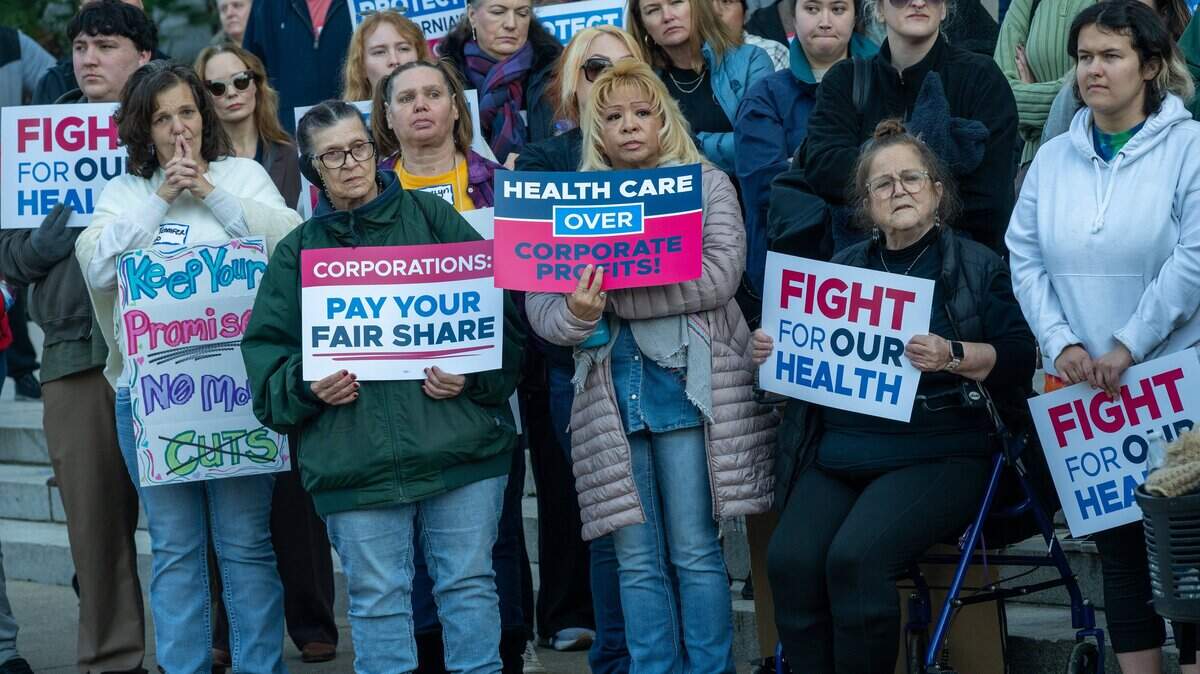
Healthcare workers hold signs at a “Fight for Our Health” rally at the Capitol on Wednesday, Jan. 14, 2026, in Sacramento. They were listening to Assemblymember Mia Bonta, chair of the Assembly Health Committee.
RENÉE C. BYER
rbyer@sacbee.com
Healthcare advocates on Friday celebrated the budget compromise between the California Assembly and Senate, after seeing many cuts they’d worked against for much of the year delayed — at least until a new governor is sworn in next year.
Though the state still has immense holes in its social safety net — rent by Republicans in Washington, D.C.’s One Big Beautiful Bill Act last year, which cut deeply into Medicaid and food aid funding — advocates said Friday at least they now have a Legislature united in challenging further cuts made by Gov. Gavin Newsom’s budget.
The governor’s proposal had gone beyond federal cuts, health access advocates had contended since its release in January, by imposing rollbacks on Medi-Cal coverage for undocumented immigrants as well as to dental care and behavioral health programs.
Most of those cuts could now be delayed or undone if Newsom accepts the Legislature’s agreement, announced Thursday night. Lawmakers delayed an imposition of asset limits on Medi-Cal that Newsom had proposed setting at $2,000, which would have affected elderly low-income Californians, and they raised it to $21,000. Cuts Newsom proposed to dental care would also be delayed under the Legislature’s plan, as would his proposal to increase a monthly premium paid by undocumented immigrants who use Medi-Cal.
Any delay to cuts that restrict people’s ability to access needed healthcare is a good one in the immediate term, executive director of the California Pan-Ethnic Health Network, Kiran Savage-Sangwan, told The Sacramento Bee on Friday.
“That offers some relief to people who would have been impacted,” she said. “We will certainly be looking forward to working with (lawmakers next year) on ensuring that these are not just temporary delays, but it’s really a permanent reinstatement of healthcare access for all Californians.”
Assembly, Senate likely to vote budget Monday
Newsom will negotiate with legislative leaders over the coming week, assuming a likely vote from lawmakers on Monday in favor of the plan leaders hashed out.
A spokesperson for Newsom told The Bee on Friday the governor appreciated the Legislature’s submitting a budget that is balanced through the next two years. Lawmakers included no significant new spending programs in their proposal.
Health advocacy groups’ concern grew after Assembly leaders initially put forward a budget position that appeared to back Newsom’s. Advocacy groups bought ads, held rallies and sent letters and news releases decrying Assembly leaders for backing the governors’ cuts. On Friday they changed their tune, expressing appreciation to both chambers for what they cast as a favorable compromise.
“California is showing the way forward in a Trump era that wants to take us backwards,” Rachel Linn Gish, spokesperson for Health Access, said in a statement Friday. “We thank our legislators for their hard work.”
Permanent solutions lacking
Given that this is the second budget cycle in which lawmakers and Newsom have sparred over coverage for undocumented immigrants, advocates say they want elected officials to find permanent solutions.
“A delay is one more day that someone can see a dentist, one more day that someone can get cancer treatment, one more day they can access lifesaving medication,” Linn Gish wrote. “But we can’t keep living in a boom and bust cycle where immigrant Californians don’t know if they will have healthcare this year or next. “
And there’s no doubt that sharp pain is ahead for the state’s healthcare system. Hospitals, already struggling in many rural areas, still face a steep drop in revenue as new federal work requirements and cuts knock people off Medi-Cal rolls.
“The federal cuts due to (Republican’s federal budget bill) are massive,” Senate Budget Committee Chair John Laird, D-Santa Cruz, told The Bee on Friday, noting the state was unable to account for the billions in lost revenue.
“Given that the federal cuts really shred the social safety net, we can triage,” Laird said. “Our strategy was to do as much as we could with less money to try to protect the social safety net.”
The California Association of Public Hospitals, which had sought a $500 million appropriation to shore the state’s government-funded hospitals against federal cuts, would see half that amount under the Legislature’s agreement. It was a major step but might not be enough to avoid scaling back the services the hospitals can provide, the group’s CEO Katie Rodriguez said in a statement.
“Without ongoing state support, public hospital systems will be forced to confront a future of multi-billion funding losses,” Rodriguez said. “If we cut services, they disappear. No one is waiting in the wings to establish a burn unit or to train the state’s doctors. This means facility closures, longer patient wait times and commutes for care, more preventable illness and death, and higher costs we all pay.”
In social services, the Legislature is rejecting a cut by the governor to popular in-home supportive service care funding for Californians with disabilities — including older adults and children. Lawmakers also propose a substantive, $80 million investment in legal aid for immigrants swept up in the Trump administration’s deportation crackdown.
Mental health crisis teams spared
Lawmakers also pushed back on a deeply unpopular move Newsom made to roll back state funding for mental health crisis response teams counties have built up in recent years. The teams, which seek to stabilize people experiencing a psychiatric crisis without taking them to crowded jails and hospitals, have drawn support from first responders and county public health directors statewide.
In the Legislature’s compromise, lawmakers reject the cost shift from the state to counties, which advocates for the program said would likely kill it off in most counties, particularly cash-strapped rural ones. The County Behavioral Health Directors Association celebrated the move.
“We encourage the Governor and Legislature to continue the work to preserve these programs that meet the urgent needs of individuals and families in crisis,” Executive Director Michelle Doty Cabrera said in a statement, “relieve pressure on law enforcement and emergency rooms, and are a critical tool for counties in outreach to unhoused individuals experiencing mental and substance use-related health crises.”
The Sacramento Bee
Andrew Graham reports for The Sacramento Bee’s Capitol Bureau, where he covers the Legislature and state politics. He previously reported in Wyoming, for the nonprofit WyoFile, and in Santa Rosa at The Press Democrat. He studied journalism at the University of Montana.