
The following story was reported by The Utah Investigative Journalism Project in partnership with KUER.
Michael Christian had struggled with addiction for the better part of a decade when he learned about The Other Side Academy on TikTok. The handful of treatment programs he attended during that time hadn’t stuck.
“I just didn’t know what to do or how to get, you know, over this addiction part, you know, and so that’s why I took the leap of faith, hoping that this would be the program to help me,” Christian said of the academy. “They advertise all these good things about it.”
The Salt Lake-based rehabilitation program was a long way from Christian’s home in Iowa, but after interviewing with staff over the phone, he said the program paid for his flight to the Beehive State.
The academy is a 2.5-year residential and transitional program that offers an opportunity to learn the skills and habits to reenter society. Many of its students have chronic issues with substance abuse, homelessness and incarceration.
Christian spent about three months there before his hope that the program would change his life soured. His time, he said, ended with a mad dash toward the nearest hospital and a subsequent stay in a mental health treatment center.
“Some people will say that this program works, right? And some people there enjoy it,” Christian said. “But I would wish that people would do their research and actually see it for what it is and listen to people’s experiences.”
“I wouldn’t wish this on my worst enemy,” he added.
The Other Side Academy has been touted as a gold standard solution for Utah’s homeless and addicted populations, with state leaders embracing the academy executives’ vision for a scaled-up 1,300-bed homeless campus. But two former clients and half a dozen service providers voiced concerns that the program is doing more harm than good for some people who pass through the academy’s front doors.
Academy leadership, meanwhile, points to its success stories. Like that of Pedro Escobar, who entered after his third parole violation and, as an ex-gang member, has a rap sheet that he described as “so full of violence that it would make you sick.”
“There is light here, right? There is hope. There’s a huge amount of us who choose to stay and who get what we came for, right? Which is change,” said Escobar, a current student who has committed to a fourth year at the academy. “I used to lead people into prison cells, and now I lead people away from prison, right, and into a better life.”
The Utah Investigative Journalism Project attempted to interview employees at one of the academy’s thrift stores and The Other Side Donuts, which is run by the academy’s sister organization, The Other Side Village.
CEO David Durocher was alerted and reached out to the project, questioning its ethics and criticizing the attempt to seek interviews without permission from the academy. He said asking the employees questions could have led to them using drugs again, and if that happened, “you’ve got blood on your hands.” The Other Side Academy then agreed to an interview with project reporters and allowed them to speak with a hand-selected group of advanced students.
Eric S. Peterson
/
The Utah Investigative Journalism Project
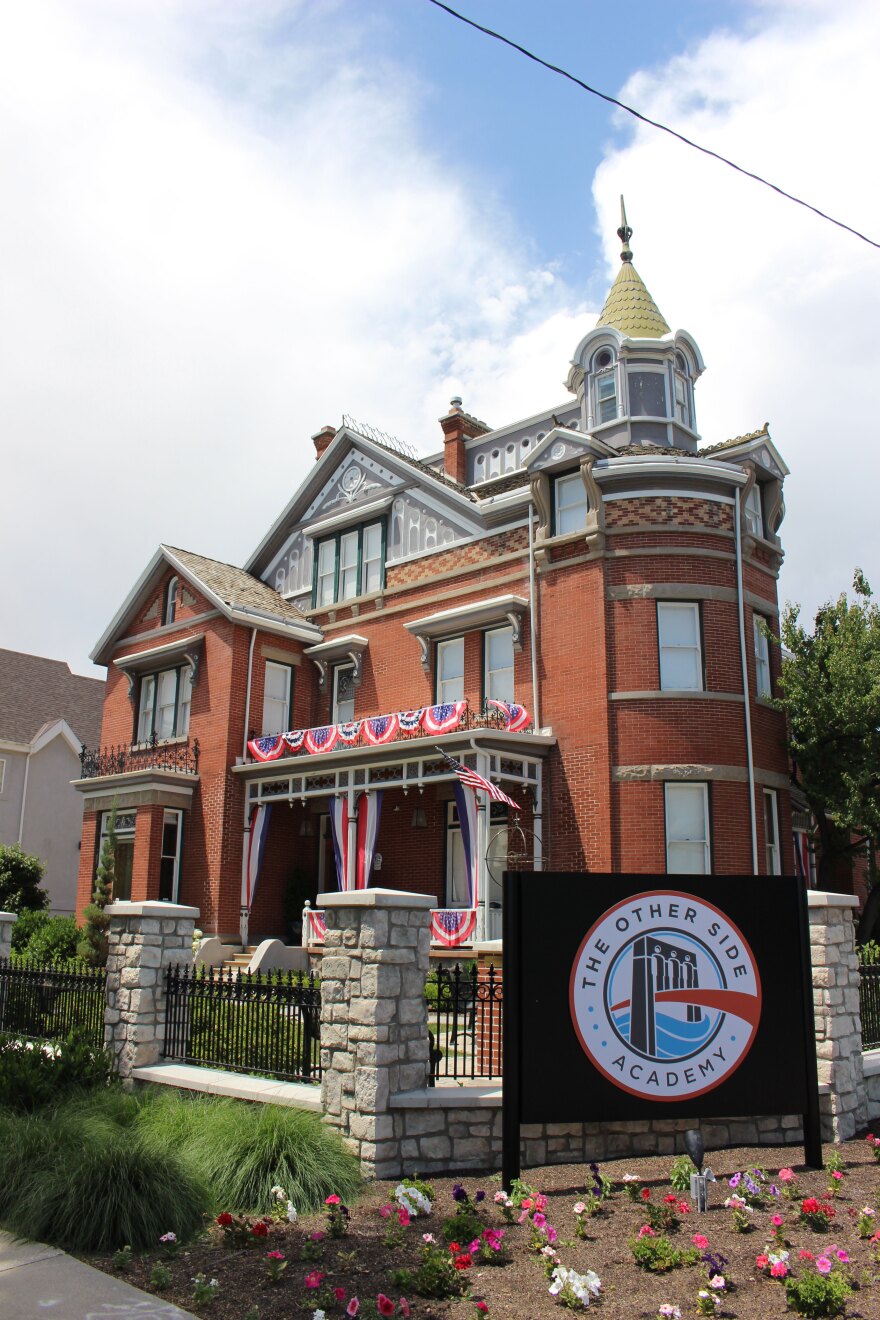
The Other Side Academy office at 667 E. 100 South, Salt Lake City, taken June 7, 2026.
An ‘outdated’ model?
The Other Side Academy is clear that it is not a medical facility. Instead, the free program uses a classic therapeutic community model in which peers in recovery run operations with a focus on overall lifestyle changes and personal accountability.
The academy promises to transform those individuals into sober and productive citizens as they learn accountability from peers. They also build life skills working within various internal departments, like legal, or public-facing businesses, specifically two thrift stores, a moving company and a landscaping business. And that work pays for their time in the program.
It’s a program that prizes honesty, accountability, hard work and self-reliance — oftentimes, to an intense level. Leadership acknowledges that the program isn’t for everyone. In fact, about half of students drop out within the first month or so, said Joseph Grenny, board chair and cofounder of the academy.
But for those who have gone through the program, it’s personal.
“I’m really defensive about the model, and I’m really willing to stand up for the model because it works,” Kevin Jepson, a third-year student, said. “I have 100, 150 people around me that are willing to hold me accountable at any time, all the time. So that’s what our movement is about. It’s about accountability, and we have the cure for addiction.”
Therapeutic communities gained popularity as a form of addiction treatment in the ‘60s and ‘70s with groups like Synanon and Delancey Street in California. But The Other Side Academy differs from many other modern therapeutic communities, which have now incorporated clinical staff ranging from mental health counselors and psychiatrist consultants to nurses and methadone specialists, according to the National Institute on Drug Abuse.
Synanon started as a rehab community but devolved into a dangerous cult movement infamous for its intensely confrontational group therapy sessions dubbed “the Game.” Delancey Street, a residential rehabilitation program started by a former Synanon member in California, is specifically cited by the academy as a source of inspiration. Academy CEO Dave Durocher himself is a graduate of Delancey.
The academy uses a group session reminiscent of the Synanon Game; in fact, the academy uses the term “game” to describe students’ biweekly group process sessions. In those sessions, students are encouraged to call each other out and be brutally honest, often with tensions and voices rising.
Christian characterized the group sessions as “where you sit around, and you scream at each other.”
Anna Hare-Diggs, who was in the academy for about a month, meanwhile, said “emotions get really high” in the sessions. She recalled a session where one woman was counterintuitively yelled at by dozens of people for having low self-esteem. Another woman was screamed at for an hour for having a bad attitude.
“It just gets like so intense,” said Hare-Diggs. “She’s just like red-faced in the corner, having a room full of 50 people scream at her.”
Grenny acknowledged that sessions can sometimes be “intense” and unpolished but held that they are effective. He said that while the model is great for some and not others, students do not have the option to opt out of the group sessions.
“People have a vested interest in each other’s improvement and their well-being, and so they’re much more direct, much more honest,” Grenny said.
He said there are peer moderators in the room to “make sure it stays productive,” and that “people are given a lot of emotional support.”
“There is light here, right? There is hope. There’s a huge amount of us who choose to stay and who get what we came for, right? Which is change.”
Pedro Escobar, a current Other Side Academy student
Dr. Elizabeth F. Howell, a University of Utah clinical professor of psychiatry, has over 30 years of experience working in the addiction field. She said while therapeutic communities can be very successful, they must be paired with safeguards, including mental and physical healthcare, therapy, healthy food, support and pay for any work rendered.
“The old kind of Synanon therapeutic community strategy, it was almost like addiction is our enemy, and we’re going to beat it out of you,” Howell said, adding, “I don’t think that that worked at all. And it’s also a kind of a setting that’s ripe for abuse and more trauma for patients.”
Evan Done is the advocacy and public policy director for Utah Support Advocates for Recovery Awareness, as well as a person in long-term recovery. He voiced concern that the academy’s peer mentors are not credentialed by the state.
“They don’t get a certification or licensure, and so my fear is always that they could be actually doing some harm to people without realizing it,” he said.
He juxtaposed that with his organization’s peer support specialists, who are state-certified after 40 hours of training and receive about six months of on-the-job training from USARA before they’re allowed to provide one-on-one peer support. That training, he said, covers topics like boundaries, ethics and the role of clinical staff vs. peer support staff.
“While we’re there to help and share our lived experience, we’re not there to be therapists, we’re not there to be clinicians, nor are we replacements for those kinds of things,” Done said.
Courtesy The Other Side Academy
Joseph Grenny, board chair and cofounder of The Other Side Academy
But Grenny called their peer group leaders “experts by experience.“ He said they “are typically veterans of 100+ group feedback sessions and have received ‘in-vivo’ training through deliberate practice. Students likewise received general mentorship status no sooner than one-year into the program and in no case are allowed to mentor others until senior staff (those with 5+ years of leadership experience) judge them prepared.”
Another important piece is a trauma-informed approach, said Howell and other experts.
“If we’re not trauma-informed, we can re-traumatize people and make it even worse,” Howell said. “There’s ways to re-traumatize people by, you know, asking them questions in a way that’s shaming and blaming and guilt-inducing.”
Escobar said it has been a good setting for him as a former foster child who was sexually and physically abused. Talking about those experiences with other students, he said, changed his life.
He said he once blamed his past behavior on his trauma but as an adult can take control.
“I can choose to hold on to that baggage and carry it with me in all my endeavors moving forward, or I could say, you know what, it’s time to heal.”
Differing views on mental health
Almost immediately, the program wasn’t what Christian expected. He said the staff told him he couldn’t take his bipolar medication during his first in-person interview.
“They were telling me that they don’t believe in mental health, that mental health isn’t real,” Christian said. “At this point, I’m already in Salt Lake, Utah. I have to do whatever I have to do to not end up on the streets.”
So Christian said he took a second “leap of faith,” stopped taking his medication and joined the program. His experience echoes accounts from both former and current students regarding mental health medications.
Anna Hare-Diggs, who was in the academy for about a month, said she was told during a screening interview that she couldn’t take antidepressants and attend the program.
“I was desperate, I just really needed to get out of the situation I was in,” she said. “I went to my doctor and was like ‘I just need you to say that like I’m off all these meds.’”
Grenny stressed that the academy is not against mental health treatment and that those who are medication dependent are instead referred to the academy’s sister program, The Other Side Village, or other equipped treatment programs.
Medication dependency and mental health diagnoses are self-reported during an initial screening interview, he confirmed.
“We encourage people to follow doctors’ orders and to get the benefit of anything that they’re recommended to have,” he said. “They’ve got other options where they can, if they’re dual-diagnosis, manage their meds there. So when they choose to come here, they’re choosing to come here.”
But even the current students that the academy leadership asked to speak to reporters agreed that it is common for residents to go off medication to join the program and even discuss it with staff.
“There’s so many people who have been on those medications but feel they can actually do the academy without them, so why not try that, too?” fourth-year-student Trisha Garner said in the interview, as some of the other five students chimed in to agree.
“I wouldn’t wish this on my worst enemy.”
Michael Christian, a former Other Side Academy student
Escobar, who has been in the program for 27 months, said he had been on anxiety medication.
“I was honest with them in my interview process, and they asked me if I was willing to not take them anymore,” he said. “I told them, ‘Hey, I haven’t been taking it for a while, I’m willing to give it a shot if you guys will take me.’ And so, it’s not like if you take any medications, they’re not going to accept you. It’s just, are you willing to try something different?”
But for Hare-Diggs, the negative impacts of quitting her meds cold turkey have been long-lasting.
“There was a lot of days where I was just like ‘this is awful.’ Like, I was pretty suicidal while I was there,” she said. “I think that experience kind of just messed me up in the head for like a year after, and I’ve gone to therapy twice a week pretty much since then.”
Strict rules
No talking to the opposite sex. Don’t speak about your past or your family. Wake up on time. Shave your face. Make your bed. No access to a phone.
The academy runs on strict rules, which its leadership says “keeps the house safe” and helps students learn how to become self-sufficient. As students advance through the program, they earn more freedoms.
“It’s similar to what you might do with a teenager. You’re not going to give the keys to a 12-year-old, you know, to the car. They’re going to have to earn it. You’ll have to know: Are they trustworthy? And little by little, they get more and more,” said Tim Stay, CEO of The Other Side Foundation. “We’re going to have stricter rules at the beginning and more autonomy near the end.”
For Christian and Hare-Diggs, however, those rules often felt punitive and difficult to follow.
“I really didn’t talk a lot at all cause I didn’t know what I was going to say that was going to get me in trouble,” said Hare-Diggs. “I can’t talk about, like, whether I dislike something. I can’t talk about if something hurts on my body. I can’t talk about if I’m not loving the program.”
Jepson, one of the current students, said that intensity and strict rules are necessary.
“I love how intense this is,” Jepson said. “I know manipulators like myself, and we’re all so similar, that this is the answer. This is what we need, accountability.”
Current students in the program described themselves as “master manipulators” and “selfish” — terms that were echoed by Durocher, who described himself as a former “hardcore drug addict” for 27 years.
“I had become a liar and a cheater and a thief and a manipulator. That’s who I became as an adult,” said Durocher. “When I got to Delancey Street, finally, some people looked at me and loved me enough to tell me the truth. They looked me in the eye and told me who I had become and also said, ‘Now we’re going to show you how to become somebody different.’”
“Before a splittee goes and tells you something about the academy, you gotta understand, they aren’t here. They didn’t choose to do something different. They didn’t choose to do the hard things.”
Jesse Demayo, a current Other Side Academy student
Students are encouraged to correct each other when they break the rules, and too many corrections lead to discipline. That is often a loss of free time or doing extra hours of work. Christian said staff instructed him not to discuss that he is gay, and he was eventually corrected for talking about his family. He said his punishment was scrubbing a bathroom wall for six hours.
“You can’t talk to no one, you can’t look at anyone, you just have to clean,” he said. “And I remember sitting there, and I’m just crying, like I just want to call my mom, you know. I feel like it’s not adult-like, but it was very traumatizing for me.”
Stay stressed that the academy has absolutely zero bias towards sexual orientation. But limitations on what students can talk about, he said, help them succeed.
“We found that it’s been important to say ‘this is a new chance for you.’ So we ask them not to talk about their past, because often, addicts will build up their reputation, their persona, by saying, ‘Look at all the terrible things I did, and that’s who I am,’” Stay said. “It’s more of saying ‘This is your chance to be a new person.’”
For Hare-Diggs, however, it felt like “they took away like all the things that I knew were me,” she said. “It took me a long time to like re-recognize like the things that I really valued and the things that were important.”
It’s that reimagining of the students that worries Josh Kreeck, who previously ran The Road Home’s Men’s Resource Center. When students enter the academy, they sit on a wooden bench, sometimes for hours — a test of their readiness and willingness to commit to the program.
Kreeck, however, worries the bench is also a tool to break students down and that the program does not always build students back up to be self-sufficient.
”They’re not rebuilding somebody’s personality afterwards or helping them self-actualize, that’s what therapy really would do, right? What they’re really doing is they’re helping them conform to their programming.”
That becomes especially hazardous when a person’s job, housing and community are intertwined and leaving is difficult, Kreeck added.
Courtesy The Other Side Academy
Dave Durocher, CEO of The Other Side Academy
A spokesperson for the academy said 45% of students ask to stay a third year or longer after graduating from the 30-month program.
“What does that tell you?” CEO Dave Durocher said. “Why are they asking to stay longer? Because they now know, ‘Man, I need more time,’ and there’s no dollar amount that says you have to leave. They get to stay until they’re ready. Isn’t that what’s important? That when they graduate, they’re ready to reintegrate back into the community as productive members in our community.”
Strong loyalty to the academy becomes evident when folks leave, criticize or question it.
Current students referred to those who have left the program as “splittees” in the interview and were adamant that those who speak negatively about the program were simply not ready to accept it.
“It comes down to — they’re not ready to change,” third-year student Jesse Demayo said. “Before a splittee goes and tells you something about the academy, you gotta understand, they aren’t here. They didn’t choose to do something different. They didn’t choose to do the hard things.”
Christian, however, said he is doing much better since leaving the program.
“I’m eight months sober,” he said. “I work a program. I just bought a car. I’m moving into my own place this week — like all the things that they said that I could not do, I’m doing.”
“It took me a long time to like re-recognize like the things that I really valued and the things that were important.”
Anna Hare-Diggs, a former Other Side Academy student
A question of choice
During The Utah Investigative Journalism Project’s interview with current students, one turned to the man next to him and offered up a question: “I’ve got some heroin right here. Would you like some?”
When the man refused, he turned to reporters to finish his point: “Does he have a disease or does he have a choice?”
It mirrored, almost word for word, a separate interaction between Durocher and the project.
“Whether it is or whether it isn’t, it is ultimately your responsibility,” Durocher said after making a faux offer of heroin to a reporter in response to a question about whether he viewed addiction as a choice. “There’s contributing factors to why people decide to use and what causes them to go there. There’s contributing factors, but still, ultimately, as an adult, right? Sooner or later, we have to decide.”
Howell disagrees with the characterization of addiction as a choice. She said that while there is usually a choice involved with someone’s first interaction with drugs or alcohol, that eventually changes.
“There’s a point when people develop addiction where they don’t really have that choice anymore because their brain has been changed enough that it’s not the way it was when they started,” she said. “It’s not as simple as they just need to decide that they’re going to do something, pull themselves up by their bootstraps and then it will be done.”
The matter of choice and personal accountability is baked into everything the academy does, for better or worse. That conflation with morality worries some.
Done believes there is a place for programs like the academy, but he wishes all individuals were clinically assessed before entering a specific treatment program. He said seeing addiction as a moral failing makes it easier to blame the individual when they don’t succeed in a treatment program.
“It’s a lot easier to like shift the responsibility that way and say like, ‘Well, they just weren’t ready, or they didn’t really want it,’ when maybe we just didn’t have the right kind of support system available for them,” Done said. “I truly don’t believe that there are people that are like treatment resistant. I think that there are programs that are people-resistant.”