
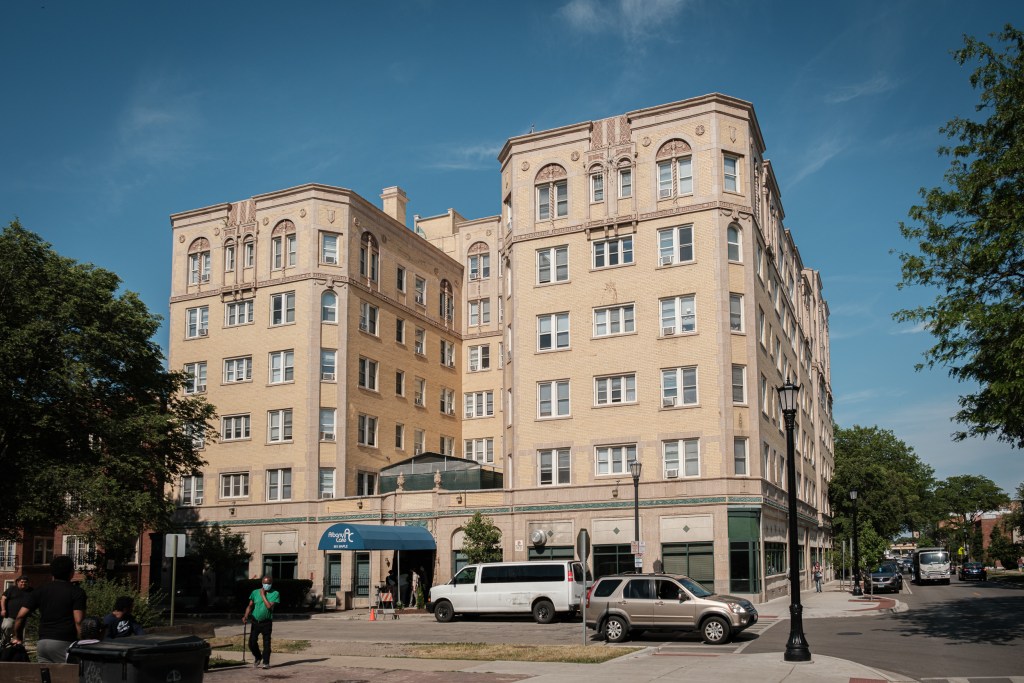
 Albany Care, 901 Maple St., as seen in June 2026. Credit: Joerg Metzner
State officials cited numerous past violations and allegations documented at Albany Care, the psychiatric rehabilitation center at 901 Maple Ave., in the recent push to shut the facility down, bolstering their case’s main focus on a resident’s January death with reports of medical neglect, deficient treatment, failing to investigate sexual misconduct and more dating as far back as March 2025.
On April 28, the Illinois Department of Public Health issued Albany Care a Level 6 sanction, the most severe violation possible for specialized mental health rehabilitation facilities (SMHRFs), and a Notice of Revocation. This began the process of potentially shutting the facility down, which is expected to take several months to resolve through administrative appeals and a potential future lawsuit.
The state’s report primarily focused on the Jan. 13 death of facility resident Sonia Moreno, 60, after staff allegedly failed to treat her worsening respiratory health over months of repeated hospitalizations, but also cites six other investigations covering incidents before Moreno’s death. These effectively form a case record to support the argument Albany Care violated state law and regulations and “consistently and repeatedly failed to take necessary corrective action,” as alleged in the sanction notice.
Albany Care did not respond to a request for comment on state surveyors’ findings and allegations in the cited investigations. Shayne Schumacher, the facility’s executive director and former clinical director, previously described the state’s actions the result of “a small number of NIMBYs in Evanston … weaponizing the oversight of our facility,” and told the RoundTable Albany Care will “vigorously defend ourselves.”
Albany Care is barred from admitting new patients during the sanction proceedings, and state officials informed existing patients of their ability to seek relocation “outside of Albany Care into other community-based settings,” such as another SMHRF or other facilities and group homes. The facility houses 171 residents as of June 4, according to a previous statement from Schumacher, down significantly from its original capacity of 417 people and its restricted capacity in July 2025 of 245 people.
‘Could have led to death’: Neglect alleged in March 2025
The six earlier investigations include two Level 5 sanctions for conditions creating a high risk of a facility resident’s death or serious injury, and four Level 4 sanctions for conditions that are likely to cause “more than minimal” harm to a resident. The earliest case cited mainly concerns another resident’s March 2025 death, which resulted in a Level 5 sanction issued in July.
This resident was Steven Murphy, 72, who had lived at Albany Care since 1998 and was diagnosed with paranoid schizophrenia, hemochromatosis and hypertension, among other chronic conditions. State surveyors report Murphy took blood pressure medications every morning and was known for being very independent and rarely needing assistance from facility staff.
But when Murphy came to the nurses’ station at 6 a.m. March 25 for his morning medications, at least two staffers and one other patient said he appeared unwell, with the patient telling state surveyors he seemed “very weak and had difficulty walking, which was unusual for him.” The nurses helped him to the station and took his vital signs, recording at 6:42 a.m. that he had an elevated heart rate of 127 beats per minute and elevated blood pressure of 149/95.
“Upon reviewing [Murphy’s] vital signs for February and March 2025, there were no significant findings of consistently elevated pulse rates,” state surveyors wrote. “The pulse rate of 127 bpm recorded on March 25, 2025, was notably higher than [Murphy’s] usual baseline.”
Both staffers told the surveyors they realized they should call 911 for Murphy, but they failed to do so. One of them, a licensed practical nurse, said she told the other staffer to stay with Murphy while she left to make the call, but she “urgently needed to use the bathroom” and did not call 911. Murphy had left by the time she returned, and no one called 911 until 7:04 a.m. when he collapsed in front of the facility’s front entrance.
Murphy was initially alert but unresponsive to staff and emergency responders after his collapse, and his condition soon deteriorated into cardiac arrest. He was taken to St. Francis Hospital, and after continued resuscitation efforts failed he was declared dead at 8:09 a.m., according to the state report. The Cook County Medical Examiner’s Office determined his cause of death to be hypertensive and atherosclerotic cardiovascular disease.
Through interviews and review of facility documents, state surveyors found that the staffers who took Murphy’s vitals did not alert a physician or the director of nursing as required and did not find records of anyone retaking his vitals later or observing him closely before his fall. Albany Care’s incident report to IDPH did not mention his elevated heart rate or any change in condition before his fall.
The surveyors ultimately found that the facility failed to adequately treat Murphy that morning, which “could have led to [his] death,” and allege this constitutes an act of neglect which Albany Care failed to report to the state. The same survey also cites a separate situation where nurses recorded a patient’s elevated blood pressure two days in a row but failed to notify a physician or any other medical official until several days later.
The other Level 5 sanction was the last case cited before Moreno’s death and covers two incidents of residents starting fires after not being reevaluated as “safe smokers.” This status allows residents to freely carry their own tobacco and lighters, and reevaluations are required every three months or after any incident or change in a resident’s condition that could impact safety or well-being.
In October, staff found an empty alcohol bottle and cigarette butts while searching a resident’s room and reported them to a mental health worker, but did not initiate a reassessment or confiscate her smoking materials as required. She later intentionally lit her bedsheet and hospital gown on fire, triggering the fire alarm and leading to her immediate discharge.
A few weeks later in November, a resident with schizophrenia caught her hair on fire while smoking outside and later claimed “demons” had done it to her. Surveyors found she had not been reassessed for smoking since she was first admitted 10 months earlier.
Violations in care, investigations, discharges
The four Level 4 sanctions cover cases between Murphy’s death and the fire incidents, including allegations of failure to provide care, improper investigation of sexual misconduct and improper discharges of facility residents. Several cases specifically cite Schumacher, who served as the clinical director before taking over as executive director in March.
In one case, a mental health professional hired in February 2025 engaged in an “inappropriate sexual relationship” with a facility resident, and state surveyors allege Albany Care failed to remove the staffer from the facility during its investigation or report the situation to IDPH. Schumacher told surveyors she learned in August the staffer was messaging the resident and sending him money, and initiated an investigation on Aug. 30.
“A lot had been mentioned to me as far as [the staffer’s] ethical behaviors being sub-par to expectations and her clinical work was not up to par despite multiple education attempts with training,” Schumacher told surveyors. “[She] was sexually inappropriate and said explicit things to staff on multiple occasions.”
Despite this, Schumacher did not place the staffer on leave, only transferring her to a different floor and ordering her to cease contact with the resident. The staffer was ultimately fired Sept. 30 and Albany Care reported the incident to the state Oct. 2. Schumacher told surveyors the report was not filed earlier because the staffer “was not licensed, she was still in school to obtain her license.”
In another case, a resident with bipolar disorder told a nurse he was having suicidal thoughts and believed they were a side effect of his medication. The nurse notified a doctor, who directed the nurse to call an ambulance to transfer the resident to the hospital for a psychiatric evaluation.
But Schumacher soon “turned the ambulance around,” keeping the resident at Albany Care against the doctor’s directions. “I was not given any explanation,” the nurse told surveyors. “I tried to send him out but [Schumacher] stopped it.”
The next day, the resident came to the nurses’ station with two “large gashes” he had cut into his left arm, telling staff he “was depressed and cut himself.” Staff treated his injuries and sent him to the hospital for a two-week psychiatric stay.
Multiple cases also cite Albany Care for improperly discharging residents without following state requirements. This includes two instances where staff failed to notify the residents’ legal guardians of their departure, one where they failed to notify the state government, and one where a resident was immediately discharged for nonpayment despite the facility not actually billing him for his stay yet.
Other cited violations include failing to prevent residents from attacking each other after observing aggressive behavior and numerous instances of staff failing to follow prescription orders or document medication distribution. When surveyors asked the director of nursing last July about errors in medication records, the director responded, “I guess we are going to have to [start] auditing again.”
A prehearing for Albany Care’s appeal of the license revocation is scheduled for June 18. The City of Evanston, which does not have regulatory power over Albany Care, is suing the facility in an effort to compel changes, and the next status hearing is set for Aug. 6.
Related Stories