
View(s):
Dr. Dasanthi Akmeemana shows achievable pathway through cost-effective interventions
By Kumudini Hettiarachchi
Wide and varied have been and will be the interventions for the benefit of the mental health of Sri Lankans by the College of Psychiatrists.
It was at the inauguration of the 23rd Annual Academic Sessions of the Sri Lanka College of Psychiatrists on June 5 in Colombo that current President Dr. Dasanthi Akmeemana placed before the eminent audience the work that has been going on. It was also the occasion on which Dr. Akmeemana was ceremonially inducted as President by the Immediate Past President Dr. Sajeewana Amarasinghe.
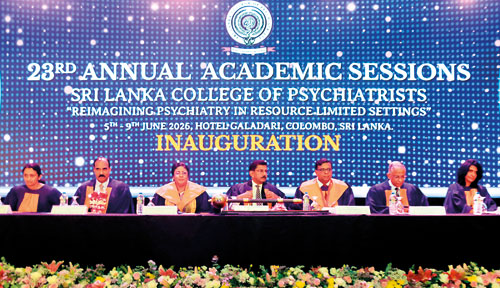
The head-table: (from the left) Dr. Malsha Gunathilake, Prof. T.S. Sathyanarayana Rao, Dr. Dasanthi Akmeemana, Dr. Anil Jasinghe, Dr. Sajeewana Amarasinghe, Dr. Asela Gunawardena and Prof. Dewasmika Ariyasinghe
Emphasising that mental health is the vital foundation for personal fulfilment, meaningful relationships and social well-being, Dr. Akmeemana pointed out the World Health Organization (WHO) affirmation of the enjoyment of the highest attainable standard of mental health being neither a luxury nor a privilege, but a fundamental right.
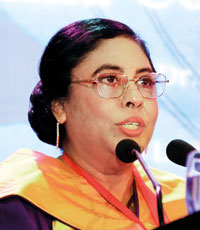
Dr. Dasanthi Akmeemana
Having embraced as her theme ‘Re-imagining Psychiatry in a Resource-Limited Setting’, she said that the WHO principle calls “upon us to act not only as clinicians and policymakers, but also as stewards of justice, dignity and inclusion for all those affected by mental illness”.
The disturbing global statistics came next:
n More than 1 billion people – nearly 1 in every 7 people – were living with a mental health disorder in 2021, as highlighted in the ‘2025 World Health Statistics’. These figures reflect the immense and growing burden of mental health conditions worldwide. Among these conditions, anxiety and depressive disorders together, accounted for more than two-thirds of all mental health disorders.
n In 2021, depressive disorders alone became the second leading cause of Years Lived with Disability (YLDs), surpassed only by back and neck pain worldwide and iron-deficiency anaemia in the Southeast Asia region. However, only 9% of individuals receive adequate treatment.
Then the Sri Lankan situation:
n The prevalence of mental illness in Sri Lanka has been estimated at a ‘significant’ 11.9% in 2019, according to the ‘2023 WHO publication of Mental Health Conditions in the South-East Asia Region’.
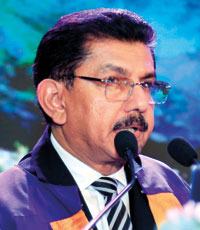
Dr. Anil Jasinghe
n A 2024 report by the National Institute for Health and Care Research Organization has recorded a doubling of Depression Anxiety Stress Scales from 2.9% in 2018–2019 to 6.1% in 2021–2022. This highlights a growing public health challenge.
n This is while the prevalence of mental, neurological and substance use disorders had risen from 30.1% in 2000, to 31.1% in 2019.
n Around 4.1% of the total population was estimated to be living with depressive disorders in 2015, according to epidemiological statistics published by the Health Ministry. Prevalence rates varied across age groups, with the highest rates observed among older adults.
n With a rapidly-ageing population, data show a corresponding rise in the prevalence of dementia.
n Per-capita alcohol consumption among individuals aged 15 years and above, measured in litres of pure alcohol, has increased over the years, reflecting a trend similar to that observed across the South-East Asian region.
According to Dr. Akmeemana, mental health conditions remain widespread, often misunderstood and significantly under-treated worldwide, while services to address them continue to be under-resourced. Alongside these shared global challenges, Sri Lanka faces its “own unique realities” within the mental healthcare system.
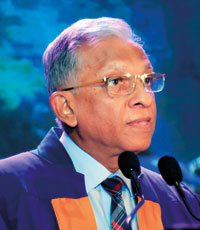
Dr. Asela Gunawardena
She lamented that despite ongoing shared efforts to strengthen mental health services and expand access to care, Sri Lanka’s system continues to experience significant resource limitations amidst a steadily increasing demand for services across all age groups. These challenges can hinder timely intervention, equitable access to care and ultimately patient outcomes.
The mental healthcare system also faces shortages of trained professionals, including Consultant Psychiatrists, Medical Officers of Mental Health, psychologists, mental health nurses and other multidisciplinary team members, she said.
With regard to another “significant” challenge, this Psychiatrist said it is the steadily increasing demand for care. An upward trend in the utilization of inpatient mental health services, alongside a reduction in outpatient service usage, continues to place additional strain on the already burdened healthcare sector. This pattern may also suggest that many patients present at a later stage of illness, possibly due to gaps in early identification and limited access to timely intervention.
“Thus re-imagining and optimising the use of our existing resources is not merely a strategic consideration, but one of the most practical and achievable pathways toward strengthening mental healthcare delivery in Sri Lanka,” she said, with the way forward being to maximise health outcomes within existing resource constraints by enhancing service accessibility, strengthening the quality and continuity of care and promoting cost-effective interventions.
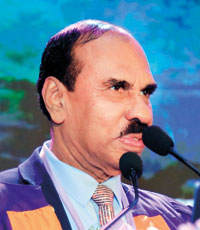
Prof. T.S. Sathyanarayana Rao
Next she brought under the spotlight several initiatives that have been undertaken to translate these principles into practice. They include raising public awareness about mental health with a ‘key milestone’ being the launch of the Nirogi app, the first Sri Lankan mobile application dedicated to mental health. It represents a locally developed solution to existing service gaps.
There is also the newly-developed maternal mental health screening programme, designed by the college in collaboration with the Family Health Bureau, with structured assessments during all 3 trimesters of pregnancy and the 1st & 2nd week and 1st & 6th month post-partum period. A pilot study is underway in the Gampaha district.
Another is expanding the use of telemedicine with District Psychiatrists conducting clinics remotely with patients attending peripheral Medical Officer of Health (MOH) centres. Meanwhile, the college has signed a Memorandum of Understanding with the Mobitel e-channeling platform, to enable remote consultations for patients attending MOH centres in areas affected by the Ditwah cyclone.
A pilot study is also being planned to identify the role that 1990 ‘Suwa Seriya’ ambulance service could play in enabling early access to psychiatric care, while the college together with the Health Ministry is training primary care doctors on the identification and management of substance use disorders.
“Re-imagining psychiatry through resource optimisation is not merely about improving efficiency, but about improving patient outcomes through evidence-based practice, technology, multidisciplinary collaboration and equitable access to care,” added Dr. Akmeemana.
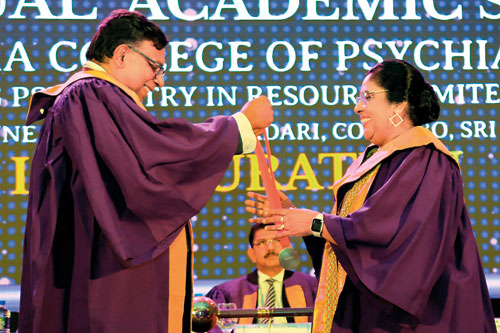
Dr. Sajeewana Amarasinghe inducting Dr. Dasanthi Akmeemana as President. Pix by M.A. Pushpa Kumara
The packed agenda at the grand ceremony included speeches by Guest of Honour & Director General of Health Services, Dr. Asela Gunawardena; Special Guest & President of the Indian Psychiatric Society and South Asian Society for Sexual Medicine, Prof. T. S. Sathyanarayana Rao; and Chief Guest & Health Secretary, Dr. Anil Jasinghe. The Vote of Thanks was by college Secretary Dr. Malsha Gunathilake.
The Oration on ‘The alcohol we don’t talk about: From households to hospital wards to policy’ was delivered by Prof. Dewasmika Ariyasinghe of the Faculty of Medicine, University of Peradeniya.
Appreciating the fact that Sri Lanka has achieved a “substantial reduction” in suicide rates since the mid-1990s, Dr. Dasanthi Akmeemana, however, called for urgent action to address self-harm increases in different age groups; maternal suicides and geographical disparities.
Looking at data, she said that the national suicide rate declined from 47.0 per 100,000 population in 1995 to an overall rate of 15 per 100,000 population in 2022, with rates of 27 per 100,000 among males and 5 per 100,000 among females.
“However, the rate of suicide increases by age, with the highest rate among older males, while among females, it is highest in young women. Females show a dual peak, one in the 17-25 year age-group and the other in the over-55 year age-group,” she said.
She explained that in females, the overall rates of suicide plateaued around 2015, but in males, there has been an upward trend in overall suicides that started in 2016.
In 2023 alone, 3,440 individuals had lost their lives to suicide, with the highest rates among both males and females reported from certain districts, Dr. Akmeemana said, stressing the dire need for culturally and regionally-tailored prevention strategies.
“Maternal suicides have also shown an increase over recent years, underscoring the importance of strengthening early identification, psychosocial support and accessible mental health interventions for vulnerable populations,” she added.
The best way to say that you found the home of your dreams is by finding it on Hitad.lk. We have listings for apartments for sale or rent in Sri Lanka, no matter what locale you’re looking for! Whether you live in Colombo, Galle, Kandy, Matara, Jaffna and more – we’ve got them all!